Introduction: A Roar That Shook an Empire
Every freedom struggle has its heroes—some remembered in every textbook, and some whose names echo more quietly, yet powerfully, through history. Lala Lajpat Rai, known as Punjab Kesari (The Lion of Punjab), was one such giant. He wasn’t just a freedom fighter; he was a reformer, thinker, and a man who dared to stand tall against the might of the British Raj. His story is not just about battles against foreign rulers but also about the battle to awaken India’s soul.
Early Life: Roots of a Revolutionary
Lala Lajpat Rai was born on 28th January 1865 in Dhudike village, Punjab. His father, Munshi Radha Krishan, was a teacher of Persian and Urdu, while his mother, Gulab Devi, was deeply religious. From her, young Lajpat imbibed a sense of dharmic duty and spiritual courage.
As a boy, he was extraordinary—sharp in intellect, fiery in temperament, and deeply inspired by the Vedic wisdom and Arya Samaj movement of Swami Dayananda Saraswati. This early exposure planted the seeds of national pride and reformist zeal in his heart.
He studied law in Lahore, where his mind was shaped by debates on nationalism and justice. But Rai’s ambitions stretched beyond personal success—he wanted to dedicate his life to the upliftment of India.
Ideology: Pride in Vedic Roots, Vision for Swaraj
Rai firmly believed that India’s ancient culture and knowledge systems were her greatest strength. While many educated Indians of that era were swayed by Western ways, Rai stood tall in asserting that Swaraj (self-rule) was the natural right of Indians.
- He promoted Vedic education, seeing it as a means to awaken confidence in Indian identity.
- He championed self-reliance—economic, cultural, and political.
- He rejected blind imitation of the West, urging Indians to blend modern progress with cultural pride.
This unique vision earned him love and respect far beyond Punjab.
Lal-Bal-Pal: The Trio of Fire
By the early 1900s, India’s freedom movement was split between moderates (who sought slow reforms) and extremists (who demanded immediate self-rule). Rai, along with Bal Gangadhar Tilak and Bipin Chandra Pal, led the extremist camp. The trio came to be known as Lal-Bal-Pal.
Together, they infused the freedom struggle with passion, action, and fearlessness. Their voices thundered in meetings, their writings stirred the educated youth, and their vision inspired the masses. This was a turning point—the idea of Swaraj was no longer distant; it became a demand that the British could no longer ignore.
Beyond Politics: Social Reformer and Nation Builder
Unlike many leaders who confined themselves to politics, Rai worked tirelessly at the grassroots level:
- Education: He believed education was the true weapon of freedom. He established the Dayanand Anglo-Vedic (DAV) College in Lahore and later supported the creation of National College, Lahore, where Bhagat Singh was among the students.
- Healthcare: In memory of his mother, he established the Gulab Devi Chest Hospital in Lahore (which still exists in Pakistan).
- Economy: He co-founded the Punjab National Bank in 1894—a bank run by Indians, for Indians, when British banks dominated India’s economy.
- Social Reform: He actively opposed caste discrimination, child marriage, and supported women’s education.
For Rai, true freedom was not just political independence but social and cultural rejuvenation.
Voice Beyond Borders: Lajpat Rai in the World
Rai was among the first Indian leaders to take the freedom struggle to the global stage.
- In 1914, he went to the United States and spent almost 5 years there.
- He founded the Indian Home Rule League of America in New York.
- His writings like Young India and Unhappy India exposed the realities of colonial exploitation to the world.
- He built strong relationships with American intellectuals and leaders, who started seeing India’s freedom as a moral cause.
In a time when India’s struggle was seen as a local rebellion, Rai turned it into an international issue.
The Final Sacrifice: “Simon Go Back!”
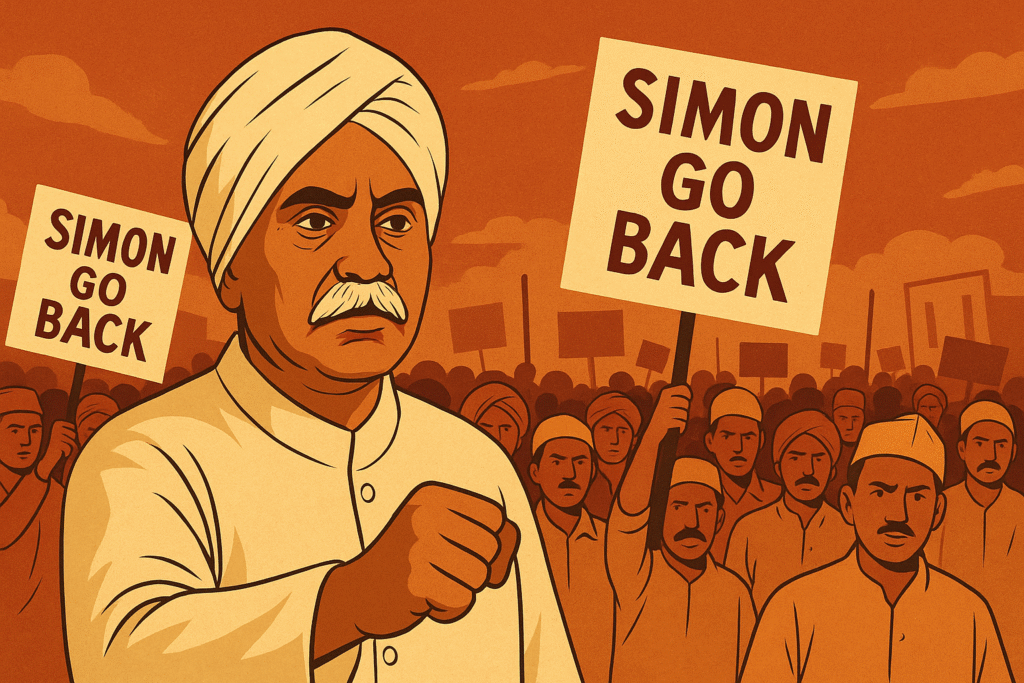
In 1928, the British government sent the Simon Commission to India to discuss constitutional reforms. Shockingly, not a single Indian was included in the commission. This insult angered the entire nation.
On 30th October 1928, in Lahore, Lala Lajpat Rai led a peaceful protest march against the Commission. The air was filled with chants of:
“Simon Go Back! Simon Go Back!”
But the protest was brutally attacked by the British police under Superintendent James A. Scott. Rai was beaten mercilessly with lathis. Bloodied but unbroken, Rai declared:
“I declare that the blows struck at me today will be the last nails in the coffin of British imperialism.”
Within weeks, his injuries led to his death on 17th November 1928. His martyrdom enraged the youth—Bhagat Singh, Rajguru, and others carried forward his fire, striking directly at the British officer responsible.
Legacy: The Lion Still Roars
Even today, nearly a century later, Lala Lajpat Rai’s life is a lesson in courage, conviction, and sacrifice.
- He taught us that freedom must be complete—political, economic, social, and cultural.
- He built institutions that still serve India—schools, colleges, hospitals, and banks.
- He inspired generations, from moderates to revolutionaries, to dream of an independent Bharat.
His roar still echoes whenever India faces a challenge: stand tall, fight with courage, and never surrender your values.
Conclusion: Remembering Punjab Kesari
Lala Lajpat Rai’s story is not just history—it is a call to action. His life reminds us that freedom is not handed down; it is fought for, built upon, and preserved with sweat and sacrifice.
As we remember him, let us not only bow to his memory but also carry forward his vision of a strong, self-reliant, and culturally proud India.