
Introduction: A Journey of Inspiration
Dr. A. P. J. Abdul Kalam, fondly known as the “Missile Man of India,” was not just a scientist but a visionary who embodied the essence of both science and spirituality. Born on October 15, 1931, in Rameswaram, Tamil Nadu, he rose from humble beginnings to become one of the most revered figures in contemporary India. His story is a testament to how science and spirituality can coexist harmoniously in the quest for knowledge, innovation, and a deeper understanding of life.
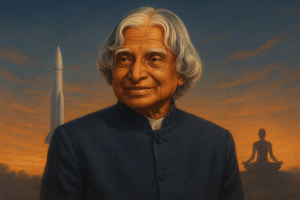
But what made Kalam’s journey particularly unique? Was it merely his scientific achievements, or was there something deeper that drove his relentless pursuit of excellence? In this comprehensive exploration, we will delve into the life of A. P. J. Abdul Kalam, uncovering how he seamlessly integrated scientific inquiry with spiritual wisdom, and how his vision continues to inspire millions around the globe.
Early Life: Roots of Curiosity and Faith
Kalam’s early life was marked by a profound sense of curiosity and a strong moral compass instilled in him by his parents. His father, Jainulabdeen, was a devout Muslim who emphasized the importance of education, while his mother, Ashiamma, nurtured his spiritual side, encouraging him to cultivate values such as honesty, faith, and perseverance. This dual influence of science and spirituality would later shape Kalam’s worldview.
The Spark of Curiosity
As a child, Kalam was captivated by the world around him. His insatiable curiosity led him to explore the skies, marveling at the birds and dreaming of flying. His fascination with science was not born in a classroom but rather from the living tapestry of his environment. He often recounted the tale of encountering a group of birds lifting off and the sense of wonder it sparked within him, leading him to pursue a career in aerospace engineering.
Education: Bridging Knowledge with Wisdom
Kalam’s academic journey was characterized by hard work and determination. After completing his schooling in Rameswaram, he moved to Chennai to study at the Madras Institute of Technology. Here, he encountered the rigors of scientific education, yet he never lost sight of the spiritual lessons imparted by his upbringing. His education was not merely about acquiring knowledge but about understanding the interconnectedness of all things.
Science as a Pathway to Understanding
For Kalam, science was a pathway to uncovering the mysteries of the universe. He embraced the rationale behind scientific principles while recognizing that these principles could coexist with spiritual beliefs. He believed that true scientific inquiry should seek not only to understand how things work but also to ponder why they exist. In his words, “Science is a beautiful gift to humanity; we should not distort it.” This belief laid the groundwork for his future endeavors in space and defense technology, where he contributed significantly to India’s missile development programs.
Scientific Achievements: A Legacy of Innovation
Dr. Kalam’s contributions to science are monumental. He played a pivotal role in India’s space and missile programs, including the successful launch of the Agni and Prithvi missiles. His work was characterized by an unwavering commitment to innovation, yet he often emphasized the importance of ethical considerations in scientific advancements.
The Fusion of Spirit and Science
Kalam’s approach to science was deeply influenced by his spiritual beliefs. He often recounted his experiences in the laboratory, where he would meditate before experiments, seeking guidance from a higher power. This practice exemplified his belief that science and spirituality could inform and enhance one another. It was not merely about data and equations; it was about a deeper connection to purpose and meaning.
Key Contributions
- Integrated Guided Missile Development Program (IGMDP): Under Kalam’s leadership, India developed a series of missiles that established the country as a global player in defense technology.
- India’s Space Program: Kalam was instrumental in the development of satellite launch vehicles, contributing to India’s capabilities in space exploration.
- Vision 2020: In his book, “India 2020: A Vision for the New Millennium,” he outlined a roadmap for transforming India into a developed nation, emphasizing the need for technological advancements aligned with ethical standards.
Philosophy of Life: The Spiritual Soul of a Scientist

Beyond his remarkable achievements in science, Kalam was a man deeply rooted in his spiritual beliefs. He often spoke about the importance of values such as honesty, integrity, and compassion. For him, these values were not just moral guidelines but essential elements of scientific inquiry.
Lessons from Spirituality
Kalam’s spirituality was not confined to rituals or dogma; it was a living practice that guided his actions and decisions. He believed in the power of prayer and meditation, often crediting these practices for his clarity of thought and resolve. He famously stated, “If you want to shine like a sun, first burn like a sun,” emphasizing the importance of hard work and dedication grounded in a spiritual context.
Connecting with the Youth
As a former President of India, Kalam’s ability to connect with young minds was unparalleled. He traveled extensively across the country, sharing his vision and inspiring the youth to dream big. He often encouraged them to follow their passions, reminding them that both science and spirituality could coexist in their journeys. His legacy is a testament to the idea that innovation should be paired with ethical considerations and spiritual grounding.
Practical Tips: Integrating Science and Spirituality in Daily Life
Inspired by Dr. Kalam’s life, how can we integrate the dual aspects of science and spirituality into our daily lives? Here are some actionable steps:
1. Cultivate a Spirit of Inquiry
- Engage in lifelong learning: Read books, attend workshops, and explore various fields.
- Ask questions: Don’t hesitate to seek answers about the world around you.
2. Practice Mindfulness
- Incorporate meditation into your daily routine. Even a few minutes can enhance focus and clarity.
- Reflect on your experiences: Journaling can help clarify your thoughts and spiritual insights.
3. Embrace Ethical Living
- Align your actions with your values: Strive to make choices that reflect your beliefs.
- Engage in community service: Use your skills to uplift others while reinforcing your sense of purpose.
4. Foster Creative Expression
- Explore artistic outlets: Whether through writing, painting, or music, creativity can be a spiritual practice.
- Share your knowledge: Teach others what you have learned, bridging the gap between science and spirituality.
Why It Matters: The Legacy of A. P. J. Abdul Kalam
The legacy of A. P. J. Abdul Kalam is not just in his scientific achievements but in the way he embodied the synthesis of science and spirituality. His life serves as a reminder that the pursuit of knowledge should be accompanied by a commitment to ethical responsibility and spiritual growth. In a world increasingly divided by materialism and skepticism, Kalam’s vision offers a path forward—a call to embrace both the scientific and the spiritual facets of existence.
Key Takeaways
- Dr. Kalam’s life illustrates the harmonious coexistence of science and spirituality.
- His teachings encourage us to pursue knowledge while upholding ethical values.
- The integration of curiosity, mindfulness, and creativity can enrich our lives.
- Kalam’s legacy inspires future generations to dream big and act with purpose.
Conclusion: A Vision for the Future
A. P. J. Abdul Kalam’s story is one of resilience, vision, and profound wisdom. He invites us to see beyond the dichotomy of science and spirituality, encouraging us to weave them into the fabric of our lives. As we navigate the complexities of the modern world, let us carry forward his teachings—embracing curiosity, fostering ethics in our pursuits, and nurturing the spiritual soul within each of us.
In the spirit of Kalam, let us strive not only to be successful in our individual paths but to uplift humanity as a whole, creating a future that reflects the best of both science and spirituality.