
An Unforgettable Legacy: The Story of Aryabhata
In the heart of ancient India, during the 5th century CE, a young mathematician and astronomer emerged, whose work would resonate through the ages, inspiring generations of scholars and enthusiasts alike. Aryabhata, a name synonymous with brilliance, is not just a figure in the annals of history but a beacon of knowledge that illuminated the fields of mathematics and astronomy long before the Western world acknowledged the vastness of the universe.
Imagine a world where the very foundations of mathematics and astronomy were still being laid, where the concept of zero was revolutionary, and where celestial bodies moved according to complex rules that few could comprehend. In such a milieu, Aryabhata’s ideas flourished, challenging the status quo and pushing the boundaries of human understanding.
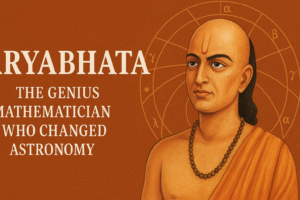
But who was Aryabhata? What ignited his passion for numbers and stars? And why does his work still matter today? Join us on a journey through his life, ideas, and the profound impact he left on both India and the world.
The Life and Times of Aryabhata
Aryabhata was born in 476 CE in Kusumapura, which many believe to be present-day Patna, Bihar. From an early age, he exhibited an extraordinary affinity for mathematics and astronomy, drawing the attention of scholars and rulers alike. But his life was not just about academic pursuits; it was also about understanding the cosmos and our place within it.
In a time when India was a melting pot of cultures and ideas, Aryabhata was deeply influenced by the Vedic texts. The Vedas, coupled with his inquisitive nature, led him to explore profound questions about the universe, time, and space.
Early Education and Influences
Little is known about Aryabhata’s formal education, but it is widely believed he studied at the famed Nalanda University, a hub for scholars from various disciplines. His thirst for knowledge and the environment of rigorous intellectual discourse played a significant role in shaping his pursuits.
During this period, the work of earlier scholars such as Panini, Brahmagupta, and others provided a foundation on which Aryabhata could build his theories. He took the essence of their findings and added his unique insights, paving the way for a new understanding of mathematics and astronomy.
Aryabhata’s Major Works
Aryabhata’s seminal work, the Aryabhatiya, written in Sanskrit, serves as a cornerstone of ancient Indian mathematics and astronomy. It consists of 118 verses and covers a range of topics, including arithmetic, algebra, and planetary calculations. Here are some of the key components of his work:
1. The Concept of Zero and Place Value
- The Birth of Zero: Aryabhata is credited with the introduction of the concept of zero as a numeral, which revolutionized mathematics globally.
- Place Value System: By utilizing a place value system, Aryabhata transformed complex calculations into manageable tasks.
2. Aryabhata’s Numerical Calculations
Aryabhata performed intricate calculations that showcased his mathematical prowess:
- Approximation of Pi: He approximated the value of Pi (π) as 3.1416, a remarkably accurate calculation for his time.
- Square and Cube Roots: He devised methods for calculating square roots and cube roots, laying the groundwork for future mathematicians.
3. Astronomy: A Cosmic Perspective
Aryabhata’s contributions to astronomy are nothing short of revolutionary:
- Eclipses: He provided explanations for solar and lunar eclipses, arguing that they were caused by the shadows of celestial bodies.
- Earth’s Rotation: Aryabhata proposed that the Earth rotates on its axis, a notion that was ahead of its time.
- Planetary Motion: His calculations of the movements of planets were based on a heliocentric model, contrary to the prevailing geocentric beliefs.
The Impact of Aryabhata’s Work
Aryabhata’s influence extended far beyond India. His works were translated into Arabic, and through this cultural exchange, his ideas permeated the Islamic Golden Age and beyond. Scholars such as Al-Khwarizmi and Al-Battani drew from his findings, further propagating his revolutionary concepts throughout Europe and the Middle East.
His understanding of mathematics and astronomy laid the groundwork for future scholars, establishing a rich tradition in these sciences. Notably, figures such as Brahmagupta and Bhaskara would later build upon Aryabhata’s earlier discoveries, advancing the fields even further.
Why Aryabhata Matters Today
In our modern world, where technology evolves at breakneck speed, understanding the principles laid down by Aryabhata is crucial. His work encompasses not only the foundations of mathematics and astronomy but also the philosophical inquiry into the nature of existence and our relationship with the cosmos.
Here are a few reasons why Aryabhata’s legacy is still relevant:
- The Quest for Knowledge: Aryabhata exemplifies the unquenchable thirst for knowledge and the pursuit of truth—a timeless aspiration.
- The Interconnectedness of Disciplines: His work illustrates how mathematics and astronomy are entwined, demonstrating the importance of interdisciplinary study.
- Cultural Heritage: Aryabhata’s story is a vital part of India’s rich cultural and intellectual heritage, reminding us of the nation’s longstanding contributions to global knowledge.
Key Takeaways from Aryabhata’s Life and Work
As we reflect on the life of Aryabhata, several key lessons emerge:
- Embrace Curiosity: Aryabhata’s unyielding curiosity led to groundbreaking discoveries. In our own lives, we should never underestimate the power of asking questions.
- Innovate Fearlessly: By challenging established ideas, Aryabhata paved the way for new thinking. We, too, should embrace innovation and creativity in our pursuits.
- Value Collaboration: Aryabhata’s work was built on the shoulders of previous scholars. Collaboration and dialogue are essential in the advancement of knowledge.
Aryabhata in Modern Context
Today, Aryabhata’s name resonates beyond the academic realm. The Indian Space Research Organisation (ISRO) named its first satellite “Aryabhata” in 1975, a tribute to the ancient genius whose pioneering spirit still inspires scientists and researchers. The satellite was instrumental in putting India on the map of space exploration and continues to symbolize the nation’s aspirations in technology.
Encouraging Future Generations
To honor Aryabhata’s legacy, it is crucial to encourage a new generation of thinkers, mathematicians, and astronomers. Educational institutions should integrate his teachings into curricula, inspiring students to appreciate the interplay between history and modern science.
Moreover, workshops, seminars, and public talks on Aryabhata’s contributions can help kindle interest and awareness among the youth. By sharing stories of his life and work, we can motivate students to pursue their passions fearlessly.
Conclusion: A Call to Action
Aryabhata’s life is a testament to the power of intellect and creativity. As we navigate our complex world, let us draw inspiration from this great mathematician and astronomer. His journey encourages us to ask questions, think critically, and never stop exploring the vast universe around us.
In a world that often feels disconnected from its roots, revisiting the legacies of luminaries like Aryabhata reminds us of the rich tapestry of knowledge and culture that shapes our identities. So, let’s celebrate Aryabhata—not just as a historical figure, but as a guiding star illuminating our path toward curiosity, understanding, and innovation. Are you ready to embark on your journey of discovery?