What Happens When a Civilization Is Told to Forget Its Past?
Imagine waking up one day to find your language ridiculed, your history erased, and your ancient wisdom tossed aside like yesterday’s news. This isn’t fiction. This was the calculated cultural invasion India endured under British rule in the 19th century.
At the center of this intellectual conquest was Thomas Babington Macaulay, a British politician whose 1835 “Minute on Indian Education” didn’t just push for English education—it systematically uprooted India’s legacy as a Vishwaguru, a beacon of global knowledge. This wasn’t educational reform. It was cultural colonization.
This blog unpacks the lasting damage Macaulay’s policies inflicted on India’s heritage, the pride they tried to extinguish, and why reclaiming our roots is not just important—it’s urgent.
Macaulay’s Vision: English First, India Last
In his Minute, Macaulay declared that “a single shelf of a good European library was worth the whole native literature of India and Arabia.” This wasn’t academic arrogance—it was a strategy to discredit and dismantle a civilization’s knowledge systems.
Creating a Loyal Class of Colonized Minds
His goal? To manufacture a class of Indians who were “Indian in blood and colour, but English in taste, in opinions, in morals and in intellect.” The English Education Act of 1835 put this into motion—diverting funding from Sanskrit and Persian institutions to English-medium schools.
The Sanskrit College in Benares and the Madrasah in Calcutta, both repositories of ancient learning, were deliberately defunded. What the British called “modernization” was, in truth, a replacement—a wiping out of India’s indigenous frameworks.
India wasn’t a cultural vacuum before the British. It was the Vishwaguru—the teacher of the world. From algebra to astronomy, from Ayurveda to architecture, India had given the world knowledge that shaped civilizations. Macaulay’s policy attacked this foundation, hoping to create mental slaves loyal to the Empire.
Real-World Impact: The Legacy of Loss
The Collapse of Knowledge Ecosystems
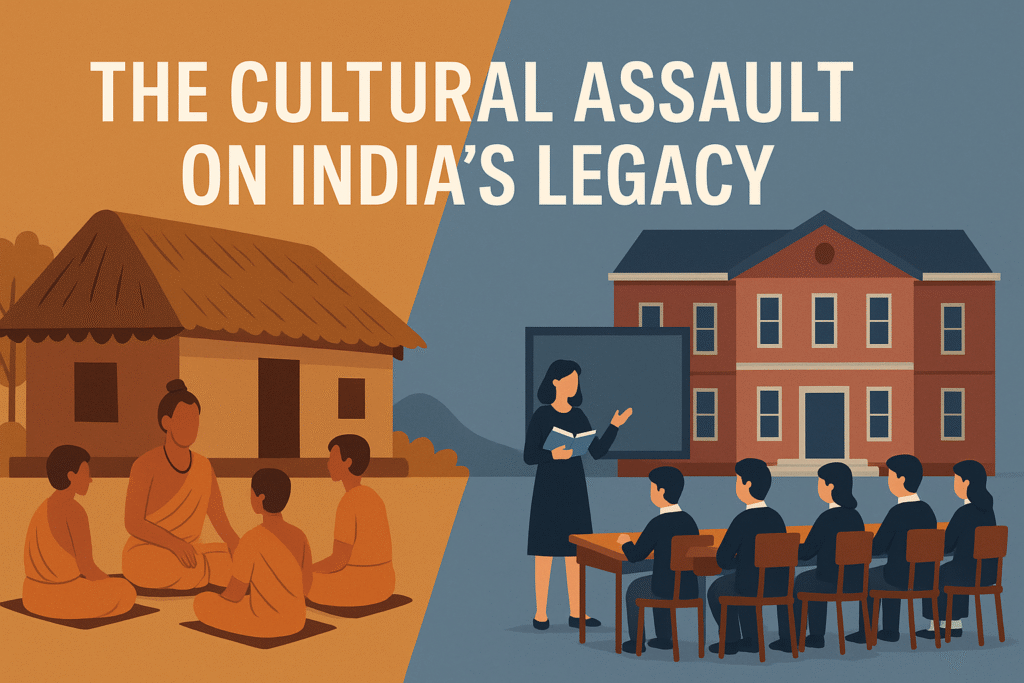
Before colonial meddling, India’s Gurukuls, Madrasahs, and Pathshalas were thriving. Education was free and inclusive, focused on holistic growth—logic, grammar, science, metaphysics, and values.
Great centers of learning like Nalanda and Takshashila weren’t just Indian icons—they were international universities attracting scholars from Korea, China, and the Middle East. These weren’t fringe outposts—they were Ivy Leagues of their time.
But Macaulay’s model labeled all that obsolete. Sanskrit and Persian texts were deemed useless. Scholarly traditions refined over millennia were mocked and marginalized.
Even foundational concepts—like zero, decimal math, surgical techniques by Sushruta, and governance models from the Arthashastra—were never taught to the Indian child post-1835. Our intellectual backbone was snapped.
The Language Divide: English as the Gatekeeper
Macaulay’s policies created a linguistic class war. English became the gateway to jobs, social mobility, and respect. Indigenous languages were downgraded, even within their own homelands.
This divide lives on today. Fluency in English often determines one’s access to higher education, employment, and prestige. Meanwhile, children learning in regional languages are frequently stigmatized and underestimated.
Producing Clerks, Not Creators
The British didn’t want innovation; they wanted order. They wanted clerks, not changemakers. The Macaulay-inspired education system trained Indians to memorize rather than question, obey rather than create.
The results were devastating. For decades, India’s scientific and entrepreneurial potential was stifled. Original thought took a back seat to colonial conformity. Creativity was sidelined. Critical thinking? Discouraged.
Mahatma Gandhi later remarked, “It is worth noting that English education in India has enslaved us.” He understood that this wasn’t just about language—it was about mindset.
A System Built to Divide and Dominate
Downward Filtration: A Failed Theory
Macaulay promoted the idea that educating an elite few in English would trickle down to the masses. But in reality, it concentrated power among a select urban elite while leaving the majority educationally stranded.
Neglect of Indigenous Institutions
Despite early 19th-century proposals to support oriental learning, the British pushed their Eurocentric agenda. The General Committee of Public Instruction, formed in 1823, increasingly turned away from funding Sanskrit and Arabic schools.
Even the Sanskrit College in Calcutta—championed by visionaries like Raja Rammohan Roy—was treated as an intellectual relic. This neglect was not passive. It was policy.
The Cultural Fallout: An Identity Rewritten
A Nation Disconnected From Its Soul
Generations of Indians grew up admiring Shakespeare but were never taught Kalidasa. They could quote Milton but not the Bhagavad Gita. They knew of Caesar and Socrates, but not Chanakya or Aryabhatta.
This deliberate re-education engineered a nation that was culturally unsure of itself. Western customs were glorified, while Indian practices were branded superstitions. Even festivals, languages, and rituals began to feel foreign in their own land.
Erasing the Arts and Philosophy
Indian classical arts, spiritual philosophy, and storytelling traditions were systematically excluded from mainstream education. Adi Shankaracharya’s non-dualism, Patanjali’s Yoga Sutras, and the Ramayana’s moral blueprint were no longer taught as serious philosophy.
Instead, these were portrayed as outdated folklore—pushing generations away from profound wisdom in favor of colonial literature.
Reclaiming Our Place as Vishwaguru
A Blueprint for Cultural Renaissance
The New Education Policy (NEP) has opened doors, but we need bold steps to truly reclaim our legacy:
- Curriculum Overhaul: Teach Indian discoveries, philosophies, and historical texts alongside global knowledge.
- Linguistic Empowerment: Promote regional languages in primary education to deepen cultural connection.
- Cultural Confidence: Reinforce Indian identity through arts, storytelling, and heritage education.
Revival Through Indian Institutions
Institutes like the Rashtriya Sanskrit Sansthan and Bharatiya Vidya Bhavan are leading the way in reviving ancient texts, translating manuscripts, and restoring dignity to Indian knowledge systems. There’s momentum—but we need national willpower to scale these efforts.
India must not just look forward—it must also look within.
Conclusion: Remembering Who We Are
Macaulay didn’t just change what we learned. He changed how we saw ourselves. That legacy still lingers—in our schools, in our institutions, and in our minds.
But the story isn’t over. We still have the power to write the next chapter.
We are not a nation built on borrowed brilliance. We are the land of Panini, Patanjali, Aryabhatta, Gargi, and Shankaracharya. We are the origin of algebra, surgery, grammar, logic, yoga, and spiritual introspection.
Let us stop measuring our worth through a colonial lens. Let us build a future where a child can learn both the Mahabharata and modern science—with equal pride.
Swami Vivekananda once said, “Take up one idea, make that one idea your life.” That idea today must be this: to restore the soul of Indian education and reawaken the spirit of Bharat.
It’s not about turning back time. It’s about moving forward—with roots deep in our own soil.