Osho wasn’t just another spiritual teacher — he was a storm dressed in silence. Born as Rajneesh Chandra Mohan Jain in 1931, his life journey was filled with rebellion, enlightenment, exile, and eternal questions about freedom. He broke rules, mocked blind belief, and dared to say that life itself is the temple we’ve been searching for. From his early days as a fiery professor in Jabalpur to the creation of the infamous Rajneeshpuram commune in Oregon, Osho’s life reads like a screenplay — equal parts brilliance and controversy, wisdom and chaos. Yet, behind the headlines and the Rolls-Royces lay a simple message: “Be awake, be alive, be free.”
1. The Early Seed – 1931-1953
Born on 11 December 1931 in the village of Kuchwada in what is now Madhya Pradesh, India, Osho (then named Chandra Mohan Jain) was the eldest of eleven children of a Jain cloth-merchant family. oshoworld.com+2Encyclopedia Britannica+2
From his earliest years, he was described as an independent, questioning child who chafed at the conventions of society, religion and schooling. osholifeandvision.com+1
A key moment: At age seven his maternal grandfather died in his lap on a bullock-cart journey — an event Osho later said triggered a deeper urge in him to explore life and death. satrakshita.com+1
He pursued his studies. In 1953, at age 21, he says he experienced a profound awakening or enlightenment while studying philosophy. oshoworld.com+1
This period laid the foundation for his later teaching: that truth is not something handed down, but something to be lived and discovered.
2. The Professor and the Rebel – 1954-1966
After his MA in Philosophy (with first-class honours) and being the All-India debating champion, Osho became a professor at Jabalpur University. osholifeandvision.com+1
However: his rebellious streak didn’t vanish. He challenged his teachers, questioned accepted religious and social norms, and enjoyed provoking those who claimed knowledge without genuine insight. osholifeandvision.com
In 1966 he resigned his academic post and set out fully on the path of a spiritual teacher. Encyclopedia Britannica+1
At this stage he was drafting his style: a mix of Eastern mysticism, intense meditation, and a radical critique of religious orthodoxy and institutionalism.
3. The Rise of the Teacher – 1966-1974
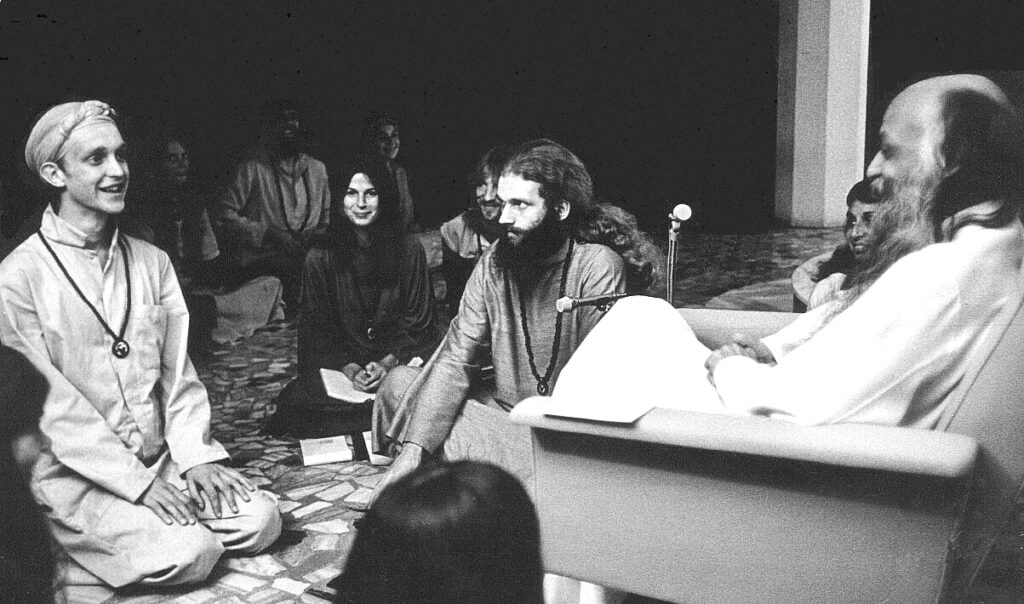
Following his resignation, Osho travelled across India, gave public talks (in large open-air gatherings of 20,000-50,000), and initiated what he called “neo-sannyas” in 1970: a new kind of spiritual seeker who did not renounce the world in the conventional sense but lived consciously within it. oshoworld.com+1
He introduced his now-famous meditation technique, Dynamic Meditation, which began with chaotic movement and catharsis, followed by silence and stillness. oshoworld.com
In 1974 he settled in Pune (then Poona) and established an ashram that would draw Western seekers as well as Indian ones. Encyclopedia Britannica+1
This period solidified his reputation: a bold mystic who combined spiritual intensity with a willingness to shake up accepted norms.
4. The Global Ambition and Oregon Saga – 1974-1985
As his following grew, Osho’s movement made a bold leap: in 1981 the community shifted to the United States, to a rural area in Wasco County, Oregon, where the commune was named Rajneeshpuram. Encyclopedia Britannica
The commune was ambitious: land acquisition, towns-building, legal battles. But tensions with local residents, state authorities and within the movement itself began mounting. In 1984 a food-poisoning attack (to influence county elections) happened, and in 1985 legal troubles culminated in Osho’s deportation from the US after pleading to immigration-related charges. Wikipedia+1
This era remains one of the most debated: on one hand, a bold experiment in conscious community living; on the other, a cautionary tale of power, group dynamics and conflict with external systems.
5. Return to India, Final Years and Death – 1986-1990
After leaving the US, Osho returned to India (Mumbai, then back to Pune in 1987) and re-established his ashram there. Encyclopedia Britannica
He continued to give discourses, to attract international visitors, and to build the infrastructure of his movement. He changed his name to “Osho” (derived from the Japanese Oshō, meaning “master”). Wikipedia
On 19 January 1990 he died in Pune at the age of 58. Encyclopedia Britannica
His funeral was attended by many of his followers; his legacy in physical form became the Osho International Foundation and the now-very famous Osho International Meditation Resort in Pune. Wikipedia+1
6. Teachings & Philosophy – The Heart of Osho
One of the core themes in Osho’s philosophy: the individual’s direct experience of life, rather than adherence to dogma. He often said that spiritual experience cannot be shaped into institutional religion. Wikipedia+1
He rejected asceticism in the conventional sense: instead of renouncing life, he said, live fully—but without attachment. This was a radical twist on classical spiritual traditions. Encyclopedia Britannica
His meditative techniques (especially Dynamic Meditation) blend movement, catharsis, silence — acknowledging the tensions within modern life and offering a path that integrates body, emotion, mind and spirit. oshoworld.com
He was also frank about sexuality, freedom, societal norms — which in India earned him the label “sex guru” in some media. The Financial Express+1
7. Controversies – The Shadow Side
No life of such intensity is without its shadows. Osho’s journey includes a heavy load of controversy.
- The Oregon commune’s legal and political clashes have been widely documented. Encyclopedia Britannica+1
- The role of his close associates (e.g., Ma Anand Sheela) in criminal activities, and the eventual deportation of Osho himself from the US, are parts of the saga. Wikipedia
- Critics argue about the interplay of money, power, charisma and the potential for manipulation in such groups. For example, Reddit users have noted: “He also ran a crazy cult and accumulated a ton of cars… He basically repackaged a lot of ideas from vedic scriptures / buddhism.” Reddit
And:
“He said himself: my whole work is to confuse you; the truth is in total silence… it is up to you…” Reddit
It’s worth noting that different perspectives exist: some see Osho as a visionary and liberator; others as a controversial guru who flirted with excess. The truth likely lies somewhere in between.
8. Legacy – What Remains
Today, Osho’s teachings continue to attract seekers globally. The Meditation Resort in Pune remains a hub of meditation and retreat. His many books and discourses (in English and other languages) continue to be read widely.
His influence on “new age” thought, on alternative spiritualities, on how meditation is taught in the West, is widely acknowledged. Wikipedia+1
At the same time, the controversies continue to generate reflection: about how spiritual charisma is managed, the dangers of community dynamics, the interplay of individual freedom and group structure.
9. Reflections – What We Can Learn
From Osho’s story we might draw a few reflections relevant even today:
- Authenticity over dogma: His early rebelliousness reminds us to ask: am I living what I believe, or just repeating what I’ve been told?
- Integration rather than renunciation: Osho’s call to embrace life fully—but without attachment—is a powerful invitation in our busy, modern world.
- Teacher-student dynamics: The life of Osho raises caution: even powerful spiritual movements are vulnerable to personality cults, power imbalances, and organisational hazards.
- The boundary of freedom: Radical freedom is beautiful — but unmanaged freedom can become chaos. The Oregon episode is a stark reminder.
- Legacy and complexity: Rarely is a life wholly good or wholly bad. Osho’s life invites nuance, critical reflection and careful appreciation.
10. Concluding Note
In the end, Osho was a mystic, a provocateur, a philosopher, a community-builder, a controversial figure. He strove to awaken in people a deeper experience of being alive. Whether one fully embraces all his teachings or not, his life invites a confrontation with our assumptions: about belief, authority, freedom, meditation, society, and the nature of the self.
His journey from rural India to global consciousness, from professor to guru, from calm seeker to epicenter of controversy, offers a mirror: what are we seeking, how are we living, where might our own growth lead?