Introduction: The Awakening of a Soul
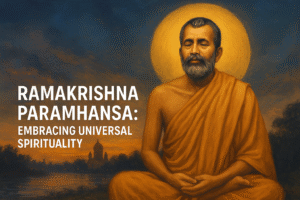
In the heart of 19th century Bengal, a luminous figure emerged from the humble village of Kamarpukur—Ramakrishna Paramhansa, a spiritual luminary whose profound teachings resonate even today. But what made Ramakrishna such a transformative force in Indian spirituality? Was it merely his mystic experiences, or was it something deeper—the realization of oneness with the universe? Imagine walking through the vibrant streets of Kolkata, where the air is thick with the scent of incense and the sounds of devotion echo from every corner. Here, one can almost feel the divine presence that Ramakrishna embodied, as he taught that the essence of all religions is a singular truth, a universal spirituality that transcends dogma and division.
The Early Life of Ramakrishna
Born on February 18, 1836, to a humble family, Ramakrishna exhibited spiritual inclinations from a young age. As a boy, he was captivated by the divine, often losing himself in prayer and worship. His early life was marked by a deep longing for God, which would shape his path. The young Ramakrishna often found solace in nature, where he would meditate under the shade of trees, listening to the whispers of the wind that seemed to carry the voice of the divine.
The Call to Spirituality
At the tender age of 16, Ramakrishna became the priest of the Dakshineswar Kali Temple, where his life took a decisive turn. The temple became the backdrop for his spiritual quest, where he would spend hours in fervent devotion, seeking the divine Mother Kali. His deep yearning led him into mystical experiences that transcended the physical realm, merging him into states of ecstasy and bliss.
Experiencing Oneness
In a world captivated by dualism, Ramakrishna experienced a profound realization of oneness with everything around him. He famously stated, “As per the different types of water, the taste changes; so it is with God. Regardless of the name or form, the essence is the same.” This profound insight is a cornerstone of his teachings, emphasizing that all paths lead to the same truth.
The Spiritual Journey: From Dualism to Non-Dualism
Ramakrishna’s teachings navigate the intricate landscape between dualism and non-dualism. His life was a living testament to the idea that one could experience multiple religious practices without losing sight of the ultimate truth. His spiritual journey included deep practices of various faiths, from Hinduism to Christianity, Islam to Tantra, demonstrating that divinity can be approached from numerous angles.
The Unity of Religions
Ramakrishna’s dialogues with his Western disciples, such as Swami Vivekananda, served to amplify his message of universalism. He taught that despite the apparent differences among religions—ceremonies, rituals, and beliefs—underneath them lay a common thread of love, compassion, and the pursuit of the divine. To illustrate this, he would often use the parable of the ‘many rivers flowing into the same ocean.’ Each river, he asserted, represents a different religion, yet they all merge into the same expanse of spiritual realization.
Practical Teachings: Simplicity and Devotion
One of the most powerful aspects of Ramakrishna’s teachings is their simplicity. He urges seekers to cultivate a devotional practice that resonates with their heart. Here are practical steps to embrace his teachings:
- Daily Prayer and Meditation: Set aside time each day for quiet reflection. Ramakrishna emphasized the importance of dedicating this time to sincere prayer and meditation.
- Practice Bhakti (Devotion): Engage in devotional practices that resonate with you, be it through singing, chanting, or simply offering love to the divine.
- Serve Others: Ramakrishna believed that serving humanity is akin to serving God. Look for opportunities to help those in need, fostering a spirit of compassion.
- Read Sacred Texts: Explore the teachings of various spiritual traditions. Ramakrishna himself delved into the scriptures of Hinduism, Christianity, and Islam, gaining wisdom from each.
Real-World Examples: The Impact of Ramakrishna’s Teachings
The legacy of Ramakrishna Paramhansa is not confined to his lifetime; it echoes through the lives transformed by his teachings. Swami Vivekananda, perhaps his most famous disciple, took the essence of Ramakrishna’s message to the global stage. His speech at the Parliament of Religions in Chicago in 1893 introduced the world to the idea of universal spirituality.
Case Study: The Ramakrishna Mission
Founded by Vivekananda in 1897, the Ramakrishna Mission continues to embody Ramakrishna’s teachings. It focuses on social service, education, and spiritual growth, demonstrating how spirituality can lead to positive action in the world. The mission has been pivotal in addressing social issues, providing healthcare, and uplifting the downtrodden.
Why It Matters: The Relevance of Ramakrishna’s Teachings Today
In a world often divided by religious, cultural, and ideological differences, Ramakrishna’s realization of oneness is more pertinent than ever. His teachings remind us that at the core of every belief system lies a shared humanity and a common quest for truth. Embracing this universal spirituality can foster greater understanding, compassion, and peace.
Key Takeaways
- Spirituality is a personal journey; embrace what resonates with you.
- All religions ultimately reflect the same divine truth.
- Compassion and service to others are essential aspects of spiritual practice.
- Acknowledge the beauty in simplicity as a pathway to understanding the divine.
Conclusion: A Call to Inner Exploration
As we reflect on the life and teachings of Ramakrishna Paramhansa, we are called to embark on our spiritual journeys with an open heart. His message of universal spirituality and simplicity invites us to look beyond the surface, toward a deeper connection with the divine and each other. In a world yearning for unity, let us take his teachings to heart, exploring the oneness that binds us all. What steps can you take today to live a life enriched by this profound understanding? The journey toward realization begins with a single step—may yours be a step toward love, service, and unity.