
📜 Indian National Days
Constitution Day of India: Why 26 November Matters
Last updated: September 26, 2026
Constitution Day remembers the adoption of India's Constitution and the democratic promise to secure justice, liberty, equality, and fraternity for all citizens.
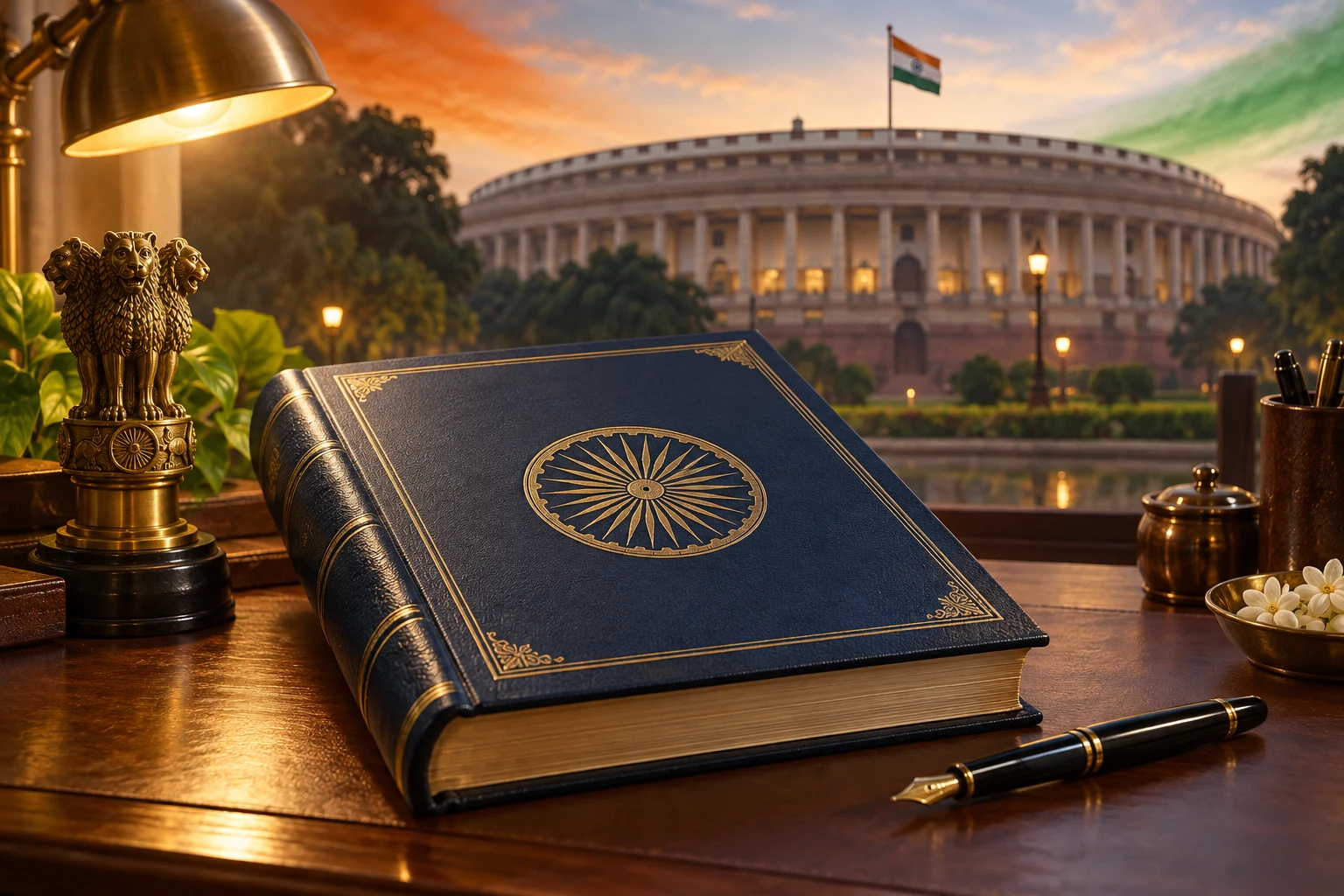
India observes Constitution Day, or Samvidhan Divas, on 26 November. The Constituent Assembly adopted the Constitution on 26 November 1949. Most of it came into force on 26 January 1950, the date now celebrated as Republic Day. Keeping adoption and commencement distinct makes the meaning of both observances clearer.
Constitution Day facts at a glance
| Question | Answer |
|---|---|
| Annual date | 26 November |
| Also called | Samvidhan Divas |
| Event remembered | Adoption of the Constitution on 26 November 1949 |
| Constitution commenced | 26 January 1950 |
| Official annual observance announced | 2015 |
The Government’s 2015 Constitution Day announcement confirms the date, adoption, commencement, and purpose of the observance.
From Constituent Assembly to Constitution
The Constitution emerged from sustained debate, committee work, drafting, revision, and disagreement in the Constituent Assembly. Dr Rajendra Prasad presided over the Assembly, while Dr B. R. Ambedkar chaired the Drafting Committee. B. N. Rau served as Constitutional Adviser. Women including Hansa Mehta, Durgabai Deshmukh, Dakshayani Velayudhan, Rajkumari Amrit Kaur, and others contributed to the Assembly’s work.
Remembering only one person would obscure this collective process; ignoring Ambedkar’s leadership would also be inaccurate. Constitution Day is an opportunity to study how a diverse body debated citizenship, representation, rights, minority protections, federal relations, and the structure of democratic institutions.
Why the Constitution matters
The Constitution creates and limits public power. It establishes the Union and state structures, legislatures, executives, courts, elections, public finance, and other institutions. It recognises Fundamental Rights, sets Directive Principles of State Policy, and lists Fundamental Duties.
These categories have different legal roles. Fundamental Rights can be enforced through constitutional remedies, while Directive Principles guide the state in governance and lawmaking. Fundamental Duties address citizens but are not a substitute for rights. Civic education is clearer when these parts are not treated as interchangeable slogans.
The Preamble
The Preamble begins with “We, the People of India,” locating constitutional authority in the people. It describes India as a sovereign, socialist, secular, democratic republic and sets out commitments to justice, liberty, equality, and fraternity. The words “socialist,” “secular,” and “integrity” were added by the 42nd Amendment in 1976; noting that history helps readers distinguish the original 1949 text from its present form.
Reading the Preamble is a beginning, not the whole of constitutional literacy. Each value raises practical questions. Equality concerns discrimination and equal protection; liberty includes freedoms exercised within constitutional limits; fraternity asks how equal dignity and national unity can be sustained across difference.
Constitution Day and Republic Day are not the same
Constitution Day looks back to adoption on 26 November 1949. Republic Day marks the Constitution’s commencement on 26 January 1950 and India’s becoming a republic under the new constitutional order. Independence Day, 15 August, commemorates the end of British rule in 1947.
This distinction avoids a common classroom error. Read the Republic Day history and significance for the related story of 26 January.
A day for civic learning
Schools, courts, government offices, and civic groups often read the Preamble, conduct quizzes, and organise lectures. These activities are more useful when participants understand the words rather than only recite them.
A class can choose one short Constituent Assembly debate and identify the competing arguments. Students can map which institution handles a local concern, compare a Fundamental Right with a related Directive Principle, or design an accessible explanation of the Preamble in a local language. Adults can learn how to find legislation, approach a public authority, or distinguish a constitutional claim from a general political preference.
Discussion should welcome evidence-based disagreement. The Constitution provides procedures for legislating, adjudicating, amending, and peacefully contesting state action. Constitutional commitment does not require citizens to agree on every policy; it requires disagreement to respect equal citizenship and lawful democratic institutions.
The Constitution is a living framework. Courts, legislatures, governments, and constitutional amendments shape its application, while citizens sustain its democratic culture through participation and mutual respect. Continue with the Independence Day story to see how freedom and constitutional government connect.
Frequently Asked Questions
When is Constitution Day celebrated in India?
Constitution Day, or Samvidhan Divas, is observed every year on 26 November, the date on which the Constituent Assembly adopted the Constitution in 1949.
What is the difference between Constitution Day and Republic Day?
Constitution Day marks adoption on 26 November 1949. Republic Day on 26 January marks the Constitution's commencement in 1950 and India's transition to a republic.
When did Constitution Day become an official observance?
The Government of India decided in 2015 to observe 26 November as Constitution Day, during the 125th birth-anniversary year of Dr B. R. Ambedkar.
How can students observe Constitution Day?
Students can read the Preamble with explanation, study a Constituent Assembly debate, compare Fundamental Rights and Duties, and discuss how constitutional values apply to a real local issue.