
🌊 Festivals
Ganga Dussehra Story and Significance: The Descent of the Ganges
Last updated: September 26, 2026
Ganga Dussehra remembers the descent of the sacred river Ganga to earth and the devoted effort of Bhagiratha to free his ancestors.
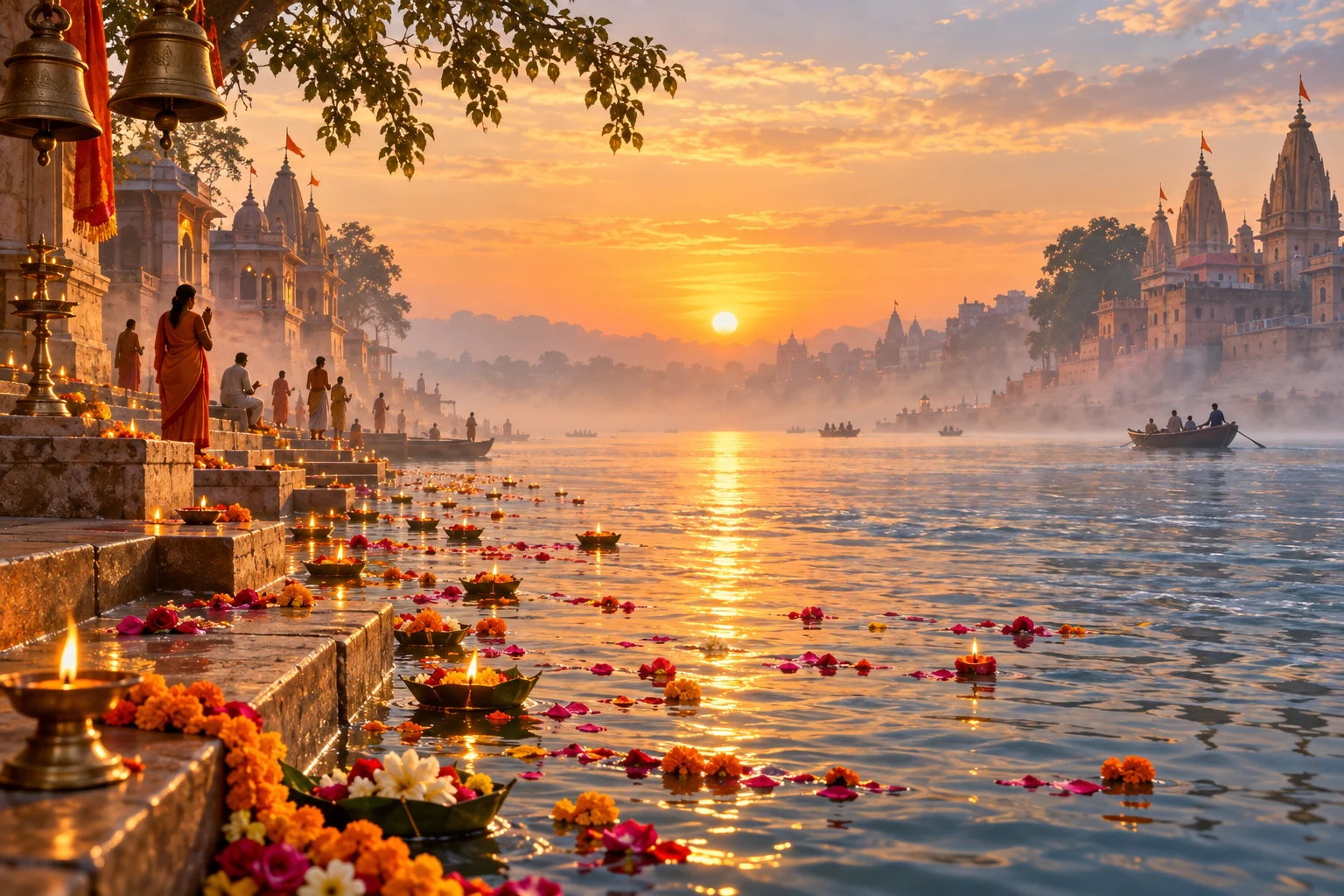
Ganga Dussehra celebrates the sacred descent of Ganga from heaven to earth. It falls on the tenth lunar tithi of the bright half of Jyeshtha and is observed through prayer, bathing, charity, lamps, and offerings. The festival’s story joins determined effort with a warning: immense power must be received and guided carefully if it is to nourish life.
When is Ganga Dussehra?
The observance falls on Jyeshtha Shukla Dashami. Because it follows a lunisolar calendar, the civil-calendar date changes and local tithi timings may differ. A regional panchang or temple calendar is the best guide for the year of observance.
The word dussehra here is commonly related to the tenth day and to the removal of ten forms of wrongdoing or impurity in devotional explanations. It should not be confused with Vijayadashami, the autumn festival also widely called Dussehra.
Bhagiratha’s determination
The Ramayana and Puranic traditions tell of King Sagara’s descendants and King Bhagiratha’s effort to bring liberation to his ancestors. Bhagiratha performs long austerities so that Ganga will descend. Yet her fall from heaven would be too powerful for the earth to bear. He therefore seeks Shiva’s help.
Shiva receives the descending river in his matted hair, containing her tremendous force, and then releases her in a form that can flow across the land. Ganga follows Bhagiratha toward the place connected with his ancestors. The narrative has different details across texts and retellings, but Bhagiratha’s perseverance, Ganga’s purifying presence, and Shiva’s mediation remain its best-known elements.
The story joins three forms of power: Bhagiratha’s persistence, Ganga’s life-giving flow, and Shiva’s capacity to hold what would otherwise destroy. The expression “Bhagiratha effort” consequently evokes sustained labour toward an extraordinarily difficult goal.
The meaning of Ganga’s descent
Ganga is simultaneously river, goddess, sacred geography, and source of livelihood. Her descent links heaven, earth, ancestors, and future generations. Water carries memory and ritual meaning, but also drinking supply, agriculture, transport, biodiversity, and the daily work of river communities.
Shiva’s role adds a practical spiritual lesson. Good intention is not enough; force requires wise channels. Knowledge, technology, authority, and emotion can all become destructive when released without restraint. Bhagiratha also shows that a goal serving others may demand patience across setbacks.
How Ganga Dussehra is observed
Devotees may bathe at sacred ghats, offer water and flowers, light lamps, recite Ganga prayers, remember ancestors, and give food or useful items in charity. Major gatherings occur in river cities and pilgrimage places, while families elsewhere perform simple worship at home or beside a local water body.
A safe home observance can include a clean vessel of water, a lamp placed away from fabric, flowers, and a short recitation. Remember Ganga and Shiva, read the descent story, offer gratitude for water, and make a concrete conservation promise. The Om Namah Shivaya guide offers a simple related practice.
Those visiting a ghat should follow local safety instructions. Strong currents, crowding, heat, and slippery steps create real risks. Children and non-swimmers need close supervision, and no one should enter restricted or visibly dangerous water to prove devotion.
A river as sacred responsibility
The Ganges is sacred to millions, but reverence must include protection. Plastic packaging, synthetic cloth, painted objects, foam, food waste, and oil should not be left in a river. Even materials described as natural can burden a crowded urban waterway when offered in large quantities. Use a symbolic quantity, retrieve non-biodegradable items, and follow municipal guidance.
River care is more than a one-day clean-up. It includes sanitation, responsible disposal, reduced chemical runoff, wetland protection, reliable environmental monitoring, and respect for people whose livelihoods depend on the river. Do not photograph bathers or ritual participants without permission.
Observing away from the Ganges
You do not need to travel to participate. Offer water respectfully at home, conserve water for the day, support a trustworthy river-restoration effort, or help clean a local water source with appropriate safety arrangements. The spiritual principle is not geographic consumption but gratitude expressed through care.
For broader context, read stories of Lord Shiva and the Hindu festivals calendar guide. Ritual and ecological responsibility reinforce each other when reverence changes behaviour.
Frequently Asked Questions
What is Ganga Dussehra?
Ganga Dussehra is a Hindu festival celebrating the sacred descent of Ganga to earth. It is observed on the tenth tithi of the bright half of Jyeshtha through prayer, bathing, charity, and river worship.
What is the story of Bhagiratha and Ganga?
King Bhagiratha undertakes severe austerities so Ganga will descend and liberate his ancestors. Because her force could overwhelm the earth, Shiva receives her in his matted hair and releases her in streams.
Why is Shiva connected with Ganga Dussehra?
In the descent story, Shiva makes Ganga's tremendous force bearable by catching her in his matted hair. He represents the capacity to hold and channel power so it nourishes rather than destroys.
Can Ganga Dussehra be observed without visiting the Ganges?
Yes. A devotee can offer clean water at home, recite a prayer, give charity, learn the story, and support care for a local river or water source. No ritual requires polluting a waterway.