
Mantra · Dhanvantari
Dhanvantari Mantra (Om Dhanvantaraye Namah)
Last updated: November 23, 2026
Edited by Anurag Goel
Om Dhanvantaraye Namah, the mantra for Dhanvantari, the god of Ayurveda — Sanskrit, meaning, how to chant it, and an honest note on limits and side effects.
ॐ धन्वन्तरये नमः
Om Dhanvantaraye Namah
Meaning
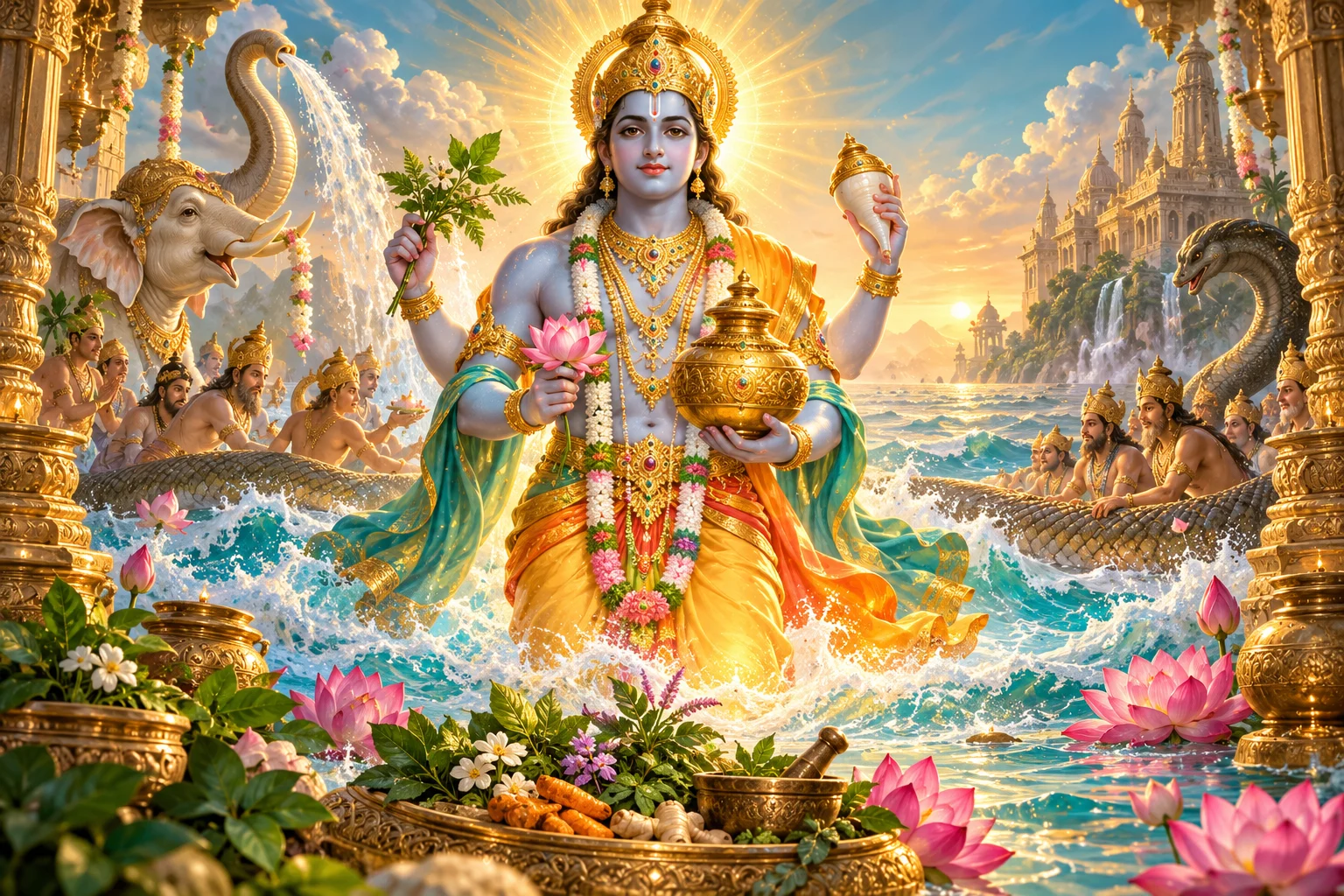
"I bow to Dhanvantari." Dhanvantari is regarded as the physician of the gods and the divine source of Ayurveda, traditionally described as having emerged during the churning of the cosmic ocean (Samudra Manthan) carrying the nectar of immortality. This mantra is chanted for good health, recovery from illness, and successful healing.
मैं भगवान धन्वंतरि को नमन करता हूँ, जो आयुर्वेद और चिकित्सा के देवता हैं। यह मंत्र अच्छे स्वास्थ्य, रोगमुक्ति और उपचार की प्राप्ति के लिए जपा जाता है।
Benefits
- Chanted for health, recovery from illness, and successful medical treatment or surgery.
- Traditionally recited before starting a course of Ayurvedic treatment.
- Central to Dhanteras and Dhanvantari Jayanti, both associated with health and wellbeing.
- Often chanted on behalf of a family member who is unwell, alongside the Mahamrityunjaya Mantra.
How to Chant
Om Dhanvantaraye Namah is commonly chanted during illness, before medical procedures, and on Dhanvantari Jayanti (also observed as Dhanteras, the day before Diwali). It is traditionally repeated 108 times using a mala, and is often chanted alongside the [Mahamrityunjaya Mantra](/mantras/mahamrityunjaya-mantra/) for combined healing intent.
Recommended count: 108 times (1 mala), especially during illness or before treatment
Origin
Dhanvantari appears in Puranic accounts of the Samudra Manthan (the churning of the ocean of milk), emerging from the ocean carrying Amrita, the nectar of immortality, and is regarded as an avatar of Vishnu associated specifically with medicine and healing. He is considered the origin of Ayurveda, the traditional Indian system of medicine.
Word-by-word breakdown
| Sanskrit | Meaning |
|---|---|
| Om | The primordial sound |
| Dhanvantaraye | To Dhanvantari, the divine physician |
| Namah | Salutations, I bow to |
When it is chanted
Widely chanted on Dhanteras (Dhanvantari Jayanti), during illness or before medical treatment, and by practitioners and students of Ayurveda as an invocation before beginning treatment or study.
How to chant the Dhanvantari Mantra
Chant Om Dhanvantaraye Namah 108 times with a mala, often on Dhanteras or on behalf of someone who is unwell. It is commonly recited together with the Mahamrityunjaya Mantra for combined healing intent. For the festival context, see the Dhanteras story and significance. A simple starting routine is described in the guide to starting a daily mantra practice.
This is a devotional practice offered in hope of wellbeing. It should accompany proper medical care, not replace it.
Frequently asked questions
Who is Dhanvantari?
Dhanvantari is regarded as the physician of the gods and the divine origin of Ayurveda. Puranic accounts describe him emerging from the churning of the cosmic ocean carrying the nectar of immortality. He is considered an avatar of Vishnu associated with medicine.
What is the Dhanvantari Mantra used for?
It is chanted for good health, recovery from illness, and successful treatment, and is traditionally recited before beginning a course of Ayurvedic care.
When is the Dhanvantari Mantra chanted?
Especially on Dhanteras, which is also observed as Dhanvantari Jayanti, and during illness or before a medical procedure.
Sources and editorial note
The origin story above follows the traditional accounts of the Samudra Manthan told in the Vishnu Purana, the Bhagavata Purana, and related Puranic retellings. A plain-English overview of that episode is on our Samudra Manthan page. Festival context is in the Dhanteras story.
This page was reviewed on 23 November 2026 by Anurag Goel, who publishes VedicVani. English explanations are original to this site. The mantra is a prayer, not a therapy, and nothing here is medical advice. Corrections are welcome through the About page.
Frequently Asked Questions
What does Dhanvantari Mantra (Om Dhanvantaraye Namah) mean?
"I bow to Dhanvantari." Dhanvantari is regarded as the physician of the gods and the divine source of Ayurveda, traditionally described as having emerged during the churning of the cosmic ocean (Samudra Manthan) carrying the nectar of immortality. This mantra is chanted for good health, recovery from illness, and successful healing.
How many times should Dhanvantari Mantra (Om Dhanvantaraye Namah) be chanted?
The traditional recommendation is 108 times (1 mala), especially during illness or before treatment.
What are the benefits of chanting Dhanvantari Mantra (Om Dhanvantaraye Namah)?
Chanted for health, recovery from illness, and successful medical treatment or surgery. Traditionally recited before starting a course of Ayurvedic treatment.
Does the Dhanvantari mantra have side effects?
Chanting Om Dhanvantaraye Namah is a devotional practice, not a medicine, so it does not have drug-like side effects. It also cannot cause a medical cure by itself. Do not delay, stop, or change prescribed treatment because of chanting. If you are unwell, seek qualified medical or Ayurvedic care. People who find intense repetition agitating or who have a history of religious scrupulosity should keep the practice short and gentle.
Can the Dhanvantari mantra replace medical treatment?
No. On this site the mantra is presented as a prayer for wellbeing that may accompany treatment, never as a substitute for it. VedicVani does not give medical advice.