
🔱 Practice Guides
Om Jai Shiv Omkara: Meaning, Lyrics, and When to Sing It
Om Jai Shiv Omkara is the aarti sung at the close of nearly every Shiva puja. Here's what its verses actually praise, and why they're structured the way they are.
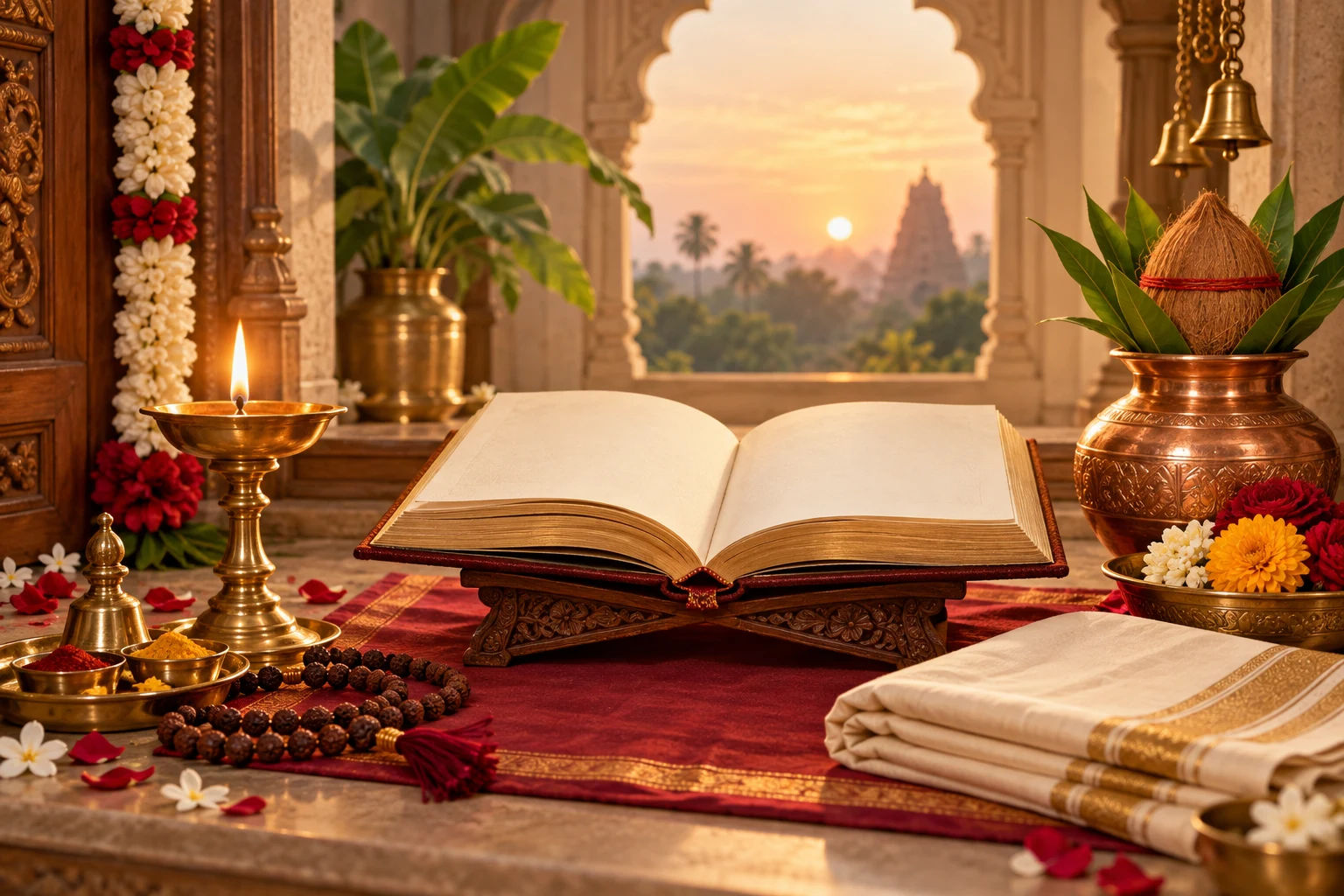
Om Jai Shiv Omkara is the aarti sung at the close of Shiva puja in temples and homes across India, especially on Mondays, during Shravan month, and on Maha Shivratri. For the complete Hindi lyrics and verse-by-verse translation, see the full Om Jai Shiv Omkara Aarti.
What the aarti praises
The hymn addresses Shiva as Omkara — the embodiment of the sacred syllable Om — and praises him in his form as the trinity alongside Brahma and Vishnu, describing him as Sadashiv, the eternal, auspicious one. It moves through his many forms: one-faced, four-faced, five-faced; two-armed, four-armed, ten-armed — a way of expressing that Shiva’s true nature exceeds any single image, even as devotees worship specific representations of him. The aarti celebrates his role as creator, sustainer, and protector of the universe, and closes with a promise that whoever sings it with devotion receives the fulfillment of their heartfelt wishes.
Why the many-faced, many-armed imagery matters
Describing a deity through a range of forms rather than one fixed image is common in Hindu devotional literature — it signals that the deity being praised is beyond ordinary limitation, present in every form simultaneously rather than confined to one. Read this way, the aarti’s verses aren’t describing several different beings but expressing the same idea from several angles: Shiva’s power and presence exceed any single depiction.
When and how it’s sung
Om Jai Shiv Omkara is traditionally sung while circling a lit diya in front of a Shiva lingam or idol, accompanied by a bell. It’s most closely associated with Mondays (widely observed as Shiva’s day), the monsoon month of Shravan when many devotees observe fasts and visit Shiva temples, and Maha Shivratri, the major festival dedicated to Shiva. After the aarti, the flame is typically offered to those present, who pass their hands over it and touch their forehead as a gesture of receiving blessings.
Common questions
When is Om Jai Shiv Omkara traditionally sung?
Most closely on Mondays, throughout Shravan month, and during Maha Shivratri, though it’s also sung at the close of any Shiva puja.
Why does the aarti describe Shiva with different numbers of faces and arms?
This is a common device in Hindu devotional literature to express that the deity’s true nature is beyond any single form — the varying descriptions point to the same limitless being, not several different ones.
Who is Sadashiv?
Sadashiv refers to Shiva’s eternal, formless, auspicious nature — the aspect the aarti invokes alongside his role in the trinity with Brahma and Vishnu.
Where can I find the complete lyrics?
The full Om Jai Shiv Omkara Aarti page has the complete Hindi lyrics with meaning.