
👑 Ancient India
The Teacher and the Outcast Prince: How Chanakya and Chandragupta Maurya Built an Empire
Before Ashoka, there was Chandragupta — a young man with no kingdom, guided by a teacher who had been humiliated at court and never forgot it. Together they built the first empire to unite most of the Indian subcontinent.
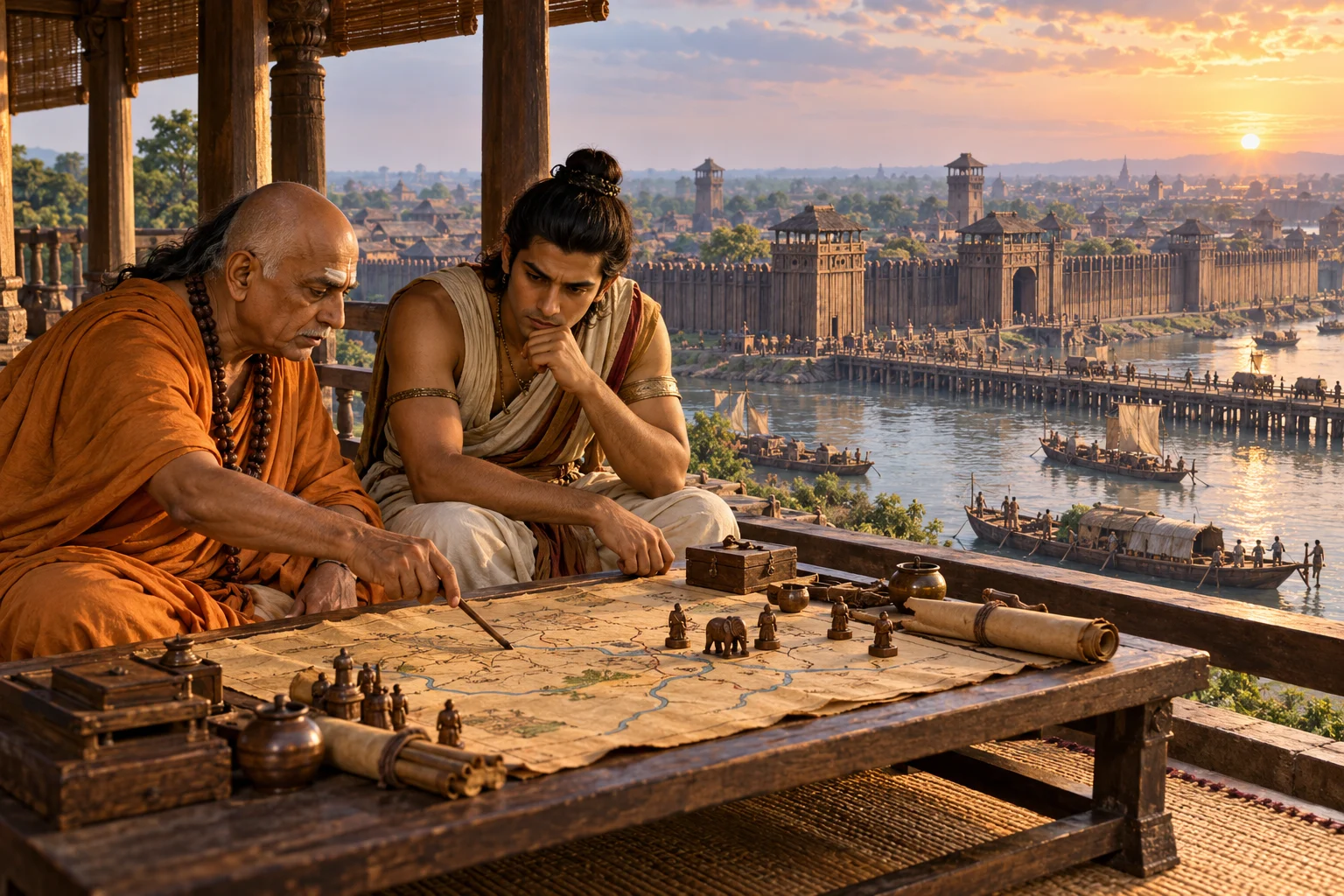
Every empire needs an origin story, and most of them begin with someone who already had power. The Mauryan Empire did not. It began with a teacher who had been thrown out of a royal court, and a young man who — depending on which ancient account you trust — had no throne, no army, and possibly not even elite birth to his name. Between them, they ended a dynasty and built the first empire to bring most of the Indian subcontinent under a single rule.
An insult that was never forgotten
Sometime in the mid-4th century BCE, the kingdom of Magadha — the dominant power of northern India — was ruled by the Nanda dynasty, wealthy, well-armed, and widely resented for taxing their subjects heavily. Into the Nanda court came a scholar named Chanakya, also known by the name Kautilya, a teacher from the great university city of Takshashila.
The traditional accounts differ on exact details, but they agree on the shape of the story: Chanakya was insulted or humiliated at the Nanda court — some versions say he was denied a seat of honour, others that he was mocked for his appearance and thrown out entirely. Whatever the precise offence, Chanakya is said to have made a vow on the spot: he would not tie his hair back into its topknot again until the Nanda dynasty had fallen.
It is tempting to read this as a minor grievance blown into legend. But what happened next suggests Chanakya took it as seriously as the stories claim.
Finding the right person to build around
A teacher with a grievance and a plan for revenge is not, on its own, a threat to an empire. Chanakya needed someone to place on the throne once the Nandas were gone — and this is where Chandragupta enters the story.
The ancient sources disagree sharply on Chandragupta’s origins. Some traditions describe him as a member of a minor Kshatriya clan associated with peacocks (the Mauryas’ name is sometimes linked to mayura, peacock); others, particularly Buddhist and Jain sources, describe more modest beginnings. What the accounts agree on is that Chandragupta was young, capable, ambitious, and — crucially — not from the Nanda line himself, which meant he had nothing to lose and an empire to gain.
Chanakya recognised something in him. He took Chandragupta under his instruction, reportedly training him not only in military strategy but in the patient, methodical political thinking later associated with the Arthashastra — the treatise on statecraft, economics, and administration traditionally attributed to Chanakya himself. It remains one of the most detailed surviving works on ancient Indian political theory, covering everything from taxation and diplomacy to espionage and the qualities of a good minister.
Learning to lose before learning to win
The military campaign against the Nandas did not succeed on the first attempt. Tradition holds that Chandragupta and Chanakya’s early assaults on the Nanda capital of Pataliputra failed, in part because they attacked the heart of Nanda power before building sufficient strength around it.
There is a well-known story — likely more parable than precise history, but instructive regardless — of Chanakya overhearing a mother scold her child for eating from the middle of a bowl of hot porridge and burning himself, telling him to eat from the edges first, where the food had cooled. Chanakya is said to have recognised the same mistake in his own strategy: he had struck at the centre of Nanda power too early, instead of first securing the outlying regions.
Whether or not the porridge story happened exactly this way, the strategic shift it describes is consistent with what the historical record suggests: Chandragupta’s campaign moved from the frontier inward, steadily building a base of territory and allied support before finally taking Pataliputra itself. Around 321 BCE, the Nanda dynasty fell, and Chandragupta Maurya became the ruler of Magadha.
Turning a conquest into an empire
Winning a throne and holding an empire are different problems, and this is where Chanakya’s contribution becomes harder to separate from Chandragupta’s own ability as a ruler. The new Mauryan state pushed outward, eventually absorbing large parts of the Indian subcontinent, and in a further consolidating move, Chandragupta confronted the Greek general Seleucus I Nicator — one of Alexander the Great’s successors, who had inherited Alexander’s eastern territories.
The resulting settlement, rather than prolonged war, is one of the more remarkable diplomatic outcomes of the ancient world: Chandragupta gained substantial territory in the northwest, and in exchange Seleucus reportedly received a gift of war elephants, along with a marriage alliance binding the two powers together. A Greek ambassador, Megasthenes, was sent to the Mauryan court and left behind descriptions of Pataliputra as a large, well-organised city — one of the earliest outside accounts of Indian civic life to survive in any detail.
An empire built to be inherited
Chandragupta’s reign did not last forever, and one of the striking things about his later life, according to Jain tradition, is how it ended: he is said to have abdicated the throne, become a Jain ascetic, and travelled south to Shravanabelagola in present-day Karnataka, where he undertook a fast unto death in the ascetic practice of sallekhana.
Whatever the precise historical accuracy of that final chapter, the political inheritance he left behind is not in dispute. His son Bindusara expanded the empire further, and Bindusara’s son — a young prince named Ashoka — would go on to inherit territory vast enough that when he turned his own army toward the kingdom of Kalinga, the resulting war would haunt him for the rest of his reign and reshape how he understood the very idea of conquest.
None of that — Ashoka’s edicts, his Dhamma, the lion capital that eventually became the emblem on India’s national flag — would exist without the empire two generations earlier built by an outcast prince and the teacher who never forgot an insult.
A story that still gets told for a reason
It is worth asking why the Chanakya–Chandragupta story has endured for over two thousand years, retold across Buddhist, Jain, and later Sanskrit traditions, including the classical Sanskrit political drama Mudrarakshasa, which dramatises Chanakya’s political manoeuvring after the Nandas’ fall.
Part of the answer is simply good storytelling — a wronged teacher, an unlikely protégé, a failed first attempt, a lesson learned from something as ordinary as a bowl of porridge. But part of it is also what the story insists on: that empires are not only built by those born to inherit them, and that patient strategy, applied without illusions about how power actually works, can outlast armies far larger than one’s own.
Frequently Asked Questions
Who was Chandragupta Maurya?
Chandragupta Maurya (reigned roughly 321–297 BCE) founded the Mauryan Empire, the first political power to unite most of the Indian subcontinent under one rule. He overthrew the Nanda dynasty of Magadha with the guidance of his teacher and strategist, Chanakya (also called Kautilya).
Who was Chanakya and why is he significant?
Chanakya was a scholar and political strategist, traditionally identified as the author of the Arthashastra, an ancient treatise on statecraft, economics, and military strategy. He is remembered for engineering Chandragupta's rise from outsider to emperor, and for the political and administrative principles that shaped the Mauryan state.
How is Chandragupta Maurya related to Ashoka?
Chandragupta Maurya was Ashoka's grandfather. Chandragupta founded the Mauryan Empire; his son Bindusara expanded it further; and Bindusara's son Ashoka inherited an empire large enough that his conquest of Kalinga could still shock him with its scale.