
🏛️ Ancient India
The Kingdom That Changed an Emperor: The History of Kalinga and Odisha
Ashoka won the Kalinga War — and the defeated kingdom changed the conqueror. From Kharavela's forgotten empire to the temples of Puri and Konark, this is the 2,000-year story of Kalinga and Odisha.
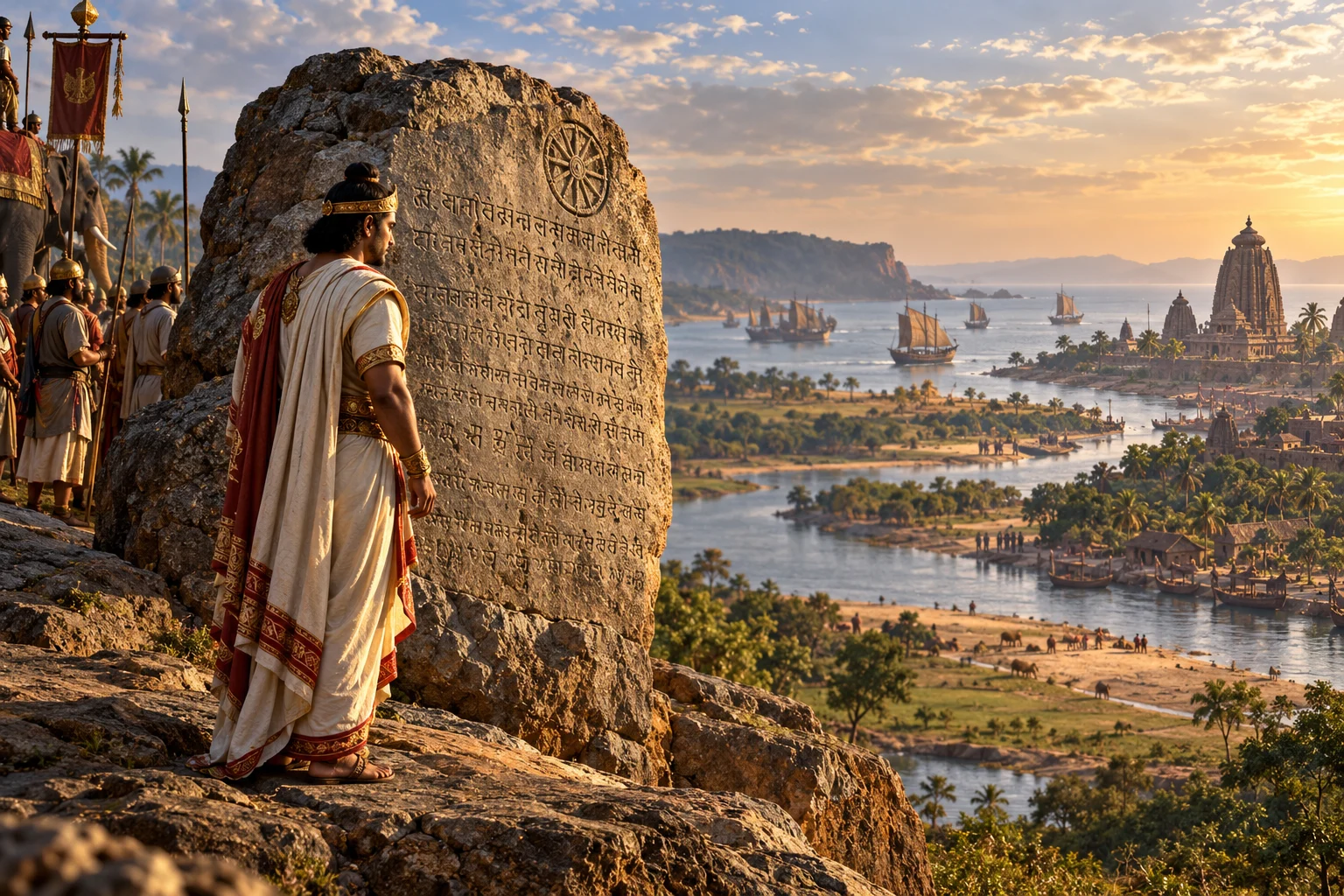
Ashoka won the Kalinga War. But something strange happened after the victory: the defeated kingdom changed the conqueror. And that was only one chapter in Odisha’s extraordinary history.
There are wars that change borders, wars that destroy kingdoms, and — much more rarely — wars that change the person who won them. More than 2,200 years ago, one of the most powerful emperors India had ever seen marched toward a fiercely independent kingdom on the eastern coast. His name was Ashoka. His empire already covered an enormous part of the Indian subcontinent. The kingdom standing in his way was Kalinga.
Ashoka eventually won. Kalinga lost tens of thousands of people, its independence disappeared, and its land became part of the Mauryan Empire. By every conventional definition, Kalinga had been defeated. Except the story did not end there — Ashoka looked at what his victory had produced and publicly expressed remorse. His own inscriptions describe the killing, deportation, and suffering caused by the conquest: Rock Edict XIII records roughly 100,000 killed, 150,000 deported, and many more dead from the consequences of war. The emperor had conquered the kingdom, but the kingdom had done something perhaps even more extraordinary — it had changed the emperor.
And if that sounds like the greatest story in Odisha’s history, it is barely the first chapter.
Kalinga was not simply the old name of Odisha
This is where most quick histories of Odisha become too simple. People often say “Odisha was earlier called Kalinga,” which is useful shorthand but historically incomplete. The territory of modern Odisha was associated at different times with several names and political regions — Kalinga, Utkala, Odra or Odradesha, Tosali, and Kosala — and their boundaries shifted constantly as kingdoms rose, expanded, fragmented, and disappeared.
Kalinga was one of the most important of these, particularly along the eastern and southern coastal region. So modern Odisha is not merely Kalinga with a new name; it is the historical product of several ancient regions gradually becoming part of a shared political, linguistic, and cultural identity. Odisha’s own official historical accounts describe the region as having been known at different times as Kalinga, Utkal, and Odradesha. And long before the famous battle with Ashoka, Kalinga was already important in its own right.
Before Ashoka arrived, Kalinga was looking toward the sea
Look at a map of Odisha and one geographical fact stands out immediately: the sea. For kingdoms trapped deep inside the subcontinent, wealth often moved along roads and rivers. For Kalinga, another highway existed — the Bay of Bengal.
Its coastal position connected eastern India with maritime networks stretching toward Sri Lanka and Southeast Asia. For generations, merchants from the eastern coast sailed with goods, ideas, beliefs, and cultural influences. Odisha’s historical traditions preserve this maritime memory even today through festivals such as Boita Bandana, when small boats are floated in remembrance of the region’s seafaring past. Government histories of Odisha describe trading connections with places including Java, Sumatra, Borneo, and Bali.
More than two thousand years before container ships and global supply chains, people from India’s eastern coast were already thinking beyond the horizon. Kalinga was not simply a piece of territory waiting for a larger empire to conquer it — it had resources, ports, trade, military strength, and, perhaps most dangerously from the perspective of Magadha, independence. That independence would eventually bring Ashoka east.
261 BCE: the war Ashoka won and could never forget
We remember Ashoka today through pillars, lions, Buddhist history, and the chakra at the centre of India’s national flag. It is therefore easy to forget that Ashoka was, first of all, an emperor — and empires expand. Around 261 BCE, roughly eight years after his coronation, Ashoka invaded Kalinga.
Why Kalinga? Its location mattered. A strong independent state on the eastern coast sat between Mauryan territory and important southern routes; bringing Kalinga under control would strengthen imperial connectivity and eliminate a significant independent power. But Kalinga did not surrender quietly, and the fighting became catastrophic. Then something almost unique in ancient imperial history happened: the winner recorded his own regret.
Ashoka’s Rock Edict XIII does not read like the traditional victory monument of a conqueror boasting about crushed enemies. It speaks about sorrow — about people killed, people removed from their homes, families separated, and the wider human suffering created when one country conquers another. That makes the Kalinga War remarkable for another reason: we know the conqueror’s reaction largely because the conqueror himself had it carved into stone.
After Kalinga, Ashoka increasingly presented Dhamma and moral conquest as superior to military conquest. The relationship between the war and Ashoka’s turn toward Buddhism is more complicated than the schoolbook version that says he “became Buddhist on the battlefield,” but there is little doubt his inscriptions present Kalinga as a profound moral turning point in his ideas about conquest. Odisha’s own official history captures the idea neatly: the conquered Kalinga conquered her conqueror. Few defeated kingdoms have left a legacy like that.
But Kalinga did not stay defeated
Empires appear permanent when you are living inside them; they rarely are. Ashoka died in 232 BCE, the Mauryan Empire weakened, and Kalinga returned. Roughly two centuries after Ashoka’s invasion, another ruler emerged whose story deserves far more attention outside Odisha: Kharavela.
If Ashoka is the most famous king connected with Kalinga, Kharavela may be its great forgotten emperor.
Kharavela: the king whose biography is written on a cave
Travel to the Udayagiri hills near Bhubaneswar and you can stand before one of ancient Odisha’s greatest historical documents — the Hathigumpha inscription. “Hathigumpha” means Elephant Cave, and carved into the rock is an account of the reign of Kharavela, a ruler of the Mahameghavahana line generally placed in the 1st century BCE.
The inscription reads almost like the résumé of an ancient king: military expeditions, public works, city repairs, water infrastructure, patronage of music and entertainment, religious activity, diplomacy. Kharavela appears not simply as a warrior but as a ruler concerned with displaying the prosperity and prestige of Kalinga. The symbolism is hard to miss — the kingdom Ashoka had once conquered was independent again, and it was projecting power far beyond its borders.
Kharavela was particularly associated with Jainism, and the Udayagiri-Khandagiri cave complex remains one of the great physical reminders of that religious world. Odisha at this point was already showing a characteristic that would remain visible throughout its history: different religious traditions — Jainism, Buddhism, Shaivism, Shaktism, Vaishnavism — overlapping rather than appearing in neat chronological boxes. Odisha’s stone would remember them all.
Then came the age of temples
Political history usually tells us who ruled. Architecture tells us what a civilization believed it was capable of building — and medieval Odisha built on an astonishing scale. Regional dynasties came and went — the Bhauma-Karas, the Somavamsis, and others shaped different parts of the region — before the Eastern Gangas arrived and Odisha entered one of the most spectacular phases of its history.
Puri: when a temple became bigger than a temple
Under Anantavarman Chodaganga Deva and his successors, the Ganga realm consolidated substantial parts of Odisha. Around this period, construction of the monumental Jagannath Temple at Puri took shape; Odisha’s official chronology places the beginning of construction around 1115 CE.
Explaining Jagannath as merely a temple misses almost everything important about it. Over time, Jagannath became intertwined with the identity of Odisha itself — religion, kingship, culture, food, art, poetry, pilgrimage, and politics all converged in Puri. The ruler was powerful, but before Jagannath he could present himself as a servant, which created an unusual political idea: the earthly king governed, but sovereignty ultimately belonged to the deity. Centuries changed, dynasties disappeared, invaders arrived, colonial governments took control, and modern democracy replaced monarchy — Jagannath remained. That is one reason the temple cannot be understood merely as an old building; it became an institution capable of surviving political systems.
And then Odisha built a stone chariot for the Sun
About a century later, Odisha created something even more audacious: Konark. The Sun Temple at Konark was built during the reign of Narasimhadeva I of the Eastern Ganga dynasty in the 13th century, and UNESCO describes it as the culmination of Kalinga temple architecture.
Calling Konark “a temple” is technically correct and also inadequate. The structure was conceived as the cosmic chariot of Surya, the Sun God — twenty-four monumental wheels, seven horses, and stone surfaces filled with movement, musicians, dancers, animals, divine figures, and scenes from human life. The architecture itself becomes mythology: the Sun does not merely have a shrine inside the building, the entire building becomes his vehicle moving across the heavens. UNESCO calls Konark an exceptional testimony to the 13th-century kingdom of Odisha and notes that its carved wheels are roughly three metres in diameter — an extraordinary feat of stone engineering with no cranes, no reinforced concrete, and no modern structural simulation.
The part of Odisha’s history most Indians barely hear about
Ask someone to name major medieval Indian powers and you will probably hear the Delhi Sultanate, Vijayanagara, the Mughals, the Marathas, maybe the Bahmanis. Far fewer people will immediately say the Gajapatis of Odisha — a remarkable omission, because in the 15th century, Odisha became an imperial power in its own right.
Kapilendra Deva and the rise of the Gajapati Empire
Around 1435, Kapilendra Deva established the Suryavamsi Gajapati dynasty and expanded it aggressively. Odisha’s official historical chronology records that by the 1460s his conquests extended from the Ganges in the north deep into southern India toward the Trichinapalli region, with other Odisha historical records describing his sphere of conquest reaching toward the Cauvery.
That does not mean every kilometre of this enormous territory was governed with identical direct control — medieval empires rarely worked like modern nation-states, and political influence could mean direct administration in one area, tributary relationships in another, military occupation somewhere else, and contested control on the frontier. But the larger point remains extraordinary: for a period, the political centre in Odisha commanded one of the most formidable powers on India’s eastern coast. Kapilendra fought forces connected with Bengal, the Bahmani Sultanate, and southern kingdoms, and this was not a small regional state hiding between stronger neighbours — it was one of the neighbours everyone else had to think about.
Its rulers adopted the title Gajapati, literally associated with “lord of elephants,” carrying enormous imperial prestige. The Gajapati state was deeply linked to Jagannath: the king could command armies across eastern India, yet ritually remained subordinate to the deity at Puri. Power and devotion existed side by side.
How does an empire like that disappear from popular memory?
This is one of the most fascinating questions in Indian history, and part of the answer is simple: empires do not remain at their peak. Kapilendra’s successors faced rebellions, succession struggles, and powerful southern rivals; territories were lost and political pressure increased. By the 16th century, Odisha was no longer the expansive imperial power it had been under Kapilendra, and in 1568 another major turning point arrived — Mukunda Deva was defeated as forces from the Bengal Sultanate pushed into Odisha. Odisha’s government history marks 1568 as the end of its long phase of independent Hindu political rule before subsequent control by other powers.
The region then passed through another complicated sequence: Afghan and Bengal power, Mughal expansion, Maratha rule, and eventually the British.
1803: another empire arrives
In 1803, during the Second Anglo-Maratha War, the British East India Company occupied the principal coastal parts of Odisha from the Marathas. For Odisha, colonial rule created a different kind of problem — it was not merely that another power controlled the territory, but that Odia-speaking people were administratively divided. Different Odia-speaking regions found themselves attached to different British administrative units. Imagine speaking the same language, sharing overlapping cultural traditions and historical memories, yet being governed from different provinces. The question was no longer who will rule Odisha, but whether Odisha could even exist as one political unit again.
The battle was now for a language
This chapter of Odisha’s history contains no giant cavalry charge and no emperor looking at corpses, but it may be one of its most important struggles — and the weapon was language. During the 19th and early 20th centuries, intellectuals, writers, rulers, and political leaders began pushing for the unification of Odia-speaking territories. Among the major figures associated with this movement were Madhusudan Das, Gopabandhu Das, Krushna Chandra Gajapati, Fakir Mohan Senapati, Nilakantha Das, and many others. The Utkal Sammilani, formed in 1903, became an important organisation in the movement for unification.
Centuries earlier, Odisha had defended itself with armies. Now it defended itself with identity: literature, language, newspapers, and political organisation all mattered. The argument was essentially this — a people who share a language and culture should not remain permanently fragmented simply because a colonial bureaucracy drew different administrative boundaries around them. It took decades, but the movement succeeded.
1 April 1936: Odisha returns to the map
On 1 April 1936, a separate province of Orissa was created, bringing together major Odia-speaking areas previously administered through different British provinces. Its original six districts were Cuttack, Puri, Balasore, Sambalpur, Ganjam, and Koraput, with Cuttack as the capital — which is why Odisha celebrates 1 April as Utkala Dibasa, or Odisha Day.
There is something poetic about this moment. Kalinga had once fought to preserve political independence; modern Odisha fought to restore cultural unity. The battlefield had changed, but the instinct had not.
Independence did not immediately create today’s Odisha
India became independent in 1947, but Odisha’s modern territorial shape still required the integration of princely states. Through the late 1940s, numerous princely territories merged into the province, with Odisha taking roughly its present form by 1949, including the integration of Mayurbhanj. The political capital also moved from historic Cuttack to the newly planned city of Bhubaneswar.
That creates one of the most fascinating juxtapositions in India: modern government buildings stand in a city whose surroundings contain monuments from civilizations thousands of years older. Drive around Bhubaneswar and time seems layered rather than linear — modern offices, Lingaraj, Udayagiri, Dhauli, ancient inscriptions, new highways, temple towers, and glass buildings, twenty-first-century India built almost on top of ancient Kalinga.
Orissa becomes Odisha
For much of modern English-language history, the state was written as Orissa and its language as Oriya — spellings institutionalised under colonial usage. In 2011, the official English names changed to Odisha and Odia, bringing the English spelling closer to the native pronunciation and historical name. The word itself carries something much older, connected with Odra or Odra-desha, one of the ancient names associated with the region — so even the modern name contains a fragment of antiquity.
Perhaps Odisha’s greatest historical achievement is survival
Think about everything this land has experienced. Ashoka invaded it. Mauryan power absorbed it. Kharavela restored its prestige. Ancient kingdoms fragmented and new dynasties appeared. Buddhism, Jainism, Shaivism, Shaktism, and Vaishnavism all flourished here in turn. The Eastern Gangas built monumental temples. The Gajapatis built an empire. Bengal’s armies arrived, then the Mughals, then the Marathas, then the British. Its language was administratively fragmented, its political boundaries were broken apart, its kings disappeared, its capital changed, and even its English name changed.
And yet the cultural identity survived. Jagannath survived. The language survived. The festivals survived. The temples survived. The memory of maritime voyages survived. The name Kalinga survived. Even Ashoka’s remorse survived, literally carved into stone.
That may be the most astonishing thing about Odisha’s history — not that it produced one great empire, not that it resisted one famous emperor, not that it built one magnificent temple, but that after more than two thousand years of political earthquakes, something recognisably Odia remained.
Ashoka won the battle. History gave Kalinga the last word
Return once more to 261 BCE. Imagine the battlefield after the fighting ended — the Mauryan army had won, Kalinga had lost. If you had stood there that evening and tried to predict the future, the conclusion would have seemed obvious: Ashoka would be remembered as the victor, and Kalinga would become another conquered kingdom.
History did something stranger. More than two millennia later, millions know Ashoka partly because of what happened in Kalinga — the war became the moral turning point associated with his reign, his message of Dhamma became central to his legacy, and the lion capital associated with him became the emblem of modern India, its chakra now on India’s national flag. And Kalinga? It returned under new rulers, built cities, carved caves, sent merchants across the sea, raised Jagannath’s temple, turned stone into the chariot of the Sun, created an empire reaching deep into southern India, lost that empire, was divided again, then reunited itself around language, and eventually entered modern India as Odisha.
Perhaps the history of Odisha should not begin with the sentence “Odisha is a state on the eastern coast of India.” It deserves a better introduction — something closer to this: on India’s eastern coast lies a land that once resisted Ashoka, changed his idea of conquest, produced one of ancient India’s most remarkable rulers, built some of the greatest temples on Earth, created a medieval empire stretching across the eastern subcontinent, lost its political unity, and then fought its way back onto the map through language.
That land was called Kalinga. Utkala. Odra. Orissa. And today, Odisha.
Frequently Asked Questions
What was the Kalinga War and why does it matter?
The Kalinga War (around 261 BCE) was Emperor Ashoka's invasion of the independent eastern kingdom of Kalinga, in present-day Odisha. Ashoka won, but the scale of the killing and suffering — recorded in his own Rock Edict XIII — left him with such remorse that he turned toward Dhamma and moral rule over further military conquest. It is one of the few instances in ancient history where a conqueror publicly recorded regret for his own victory.
Is Odisha the same as ancient Kalinga?
Not exactly. Modern Odisha's territory was historically associated with several overlapping regions and names — Kalinga, Utkala, Odra (or Odradesha), Tosali, and Kosala — whose boundaries shifted over centuries. Kalinga was the most prominent of these, especially along the coast, but Odisha is the product of all of them gradually coming together into one identity.
Who was Kharavela?
Kharavela was a 1st-century-BCE king of Kalinga from the Mahameghavahana dynasty, known largely through the Hathigumpha ("Elephant Cave") inscription at Udayagiri near Bhubaneswar. It records his military campaigns, public works, and patronage of the arts, and shows Kalinga as a fully independent, prosperous power roughly two centuries after Ashoka's conquest.
What was the Gajapati Empire?
The Gajapati Empire was a 15th-century Odisha-based power founded by Kapilendra Deva around 1435. At its height it extended from the Ganges in the north deep into southern India, making Odisha one of the major imperial forces on India's eastern coast until internal succession struggles and external pressure weakened it through the 16th century.