
🛡️ Freedom Movement
"I Shall Not Give Up My Jhansi": The Story of Rani Lakshmibai
Widowed, denied her adopted son's right to the throne, and ordered to surrender her kingdom, Rani Lakshmibai chose to fight instead. Her defence of Jhansi made her one of the most enduring symbols of resistance in Indian history.
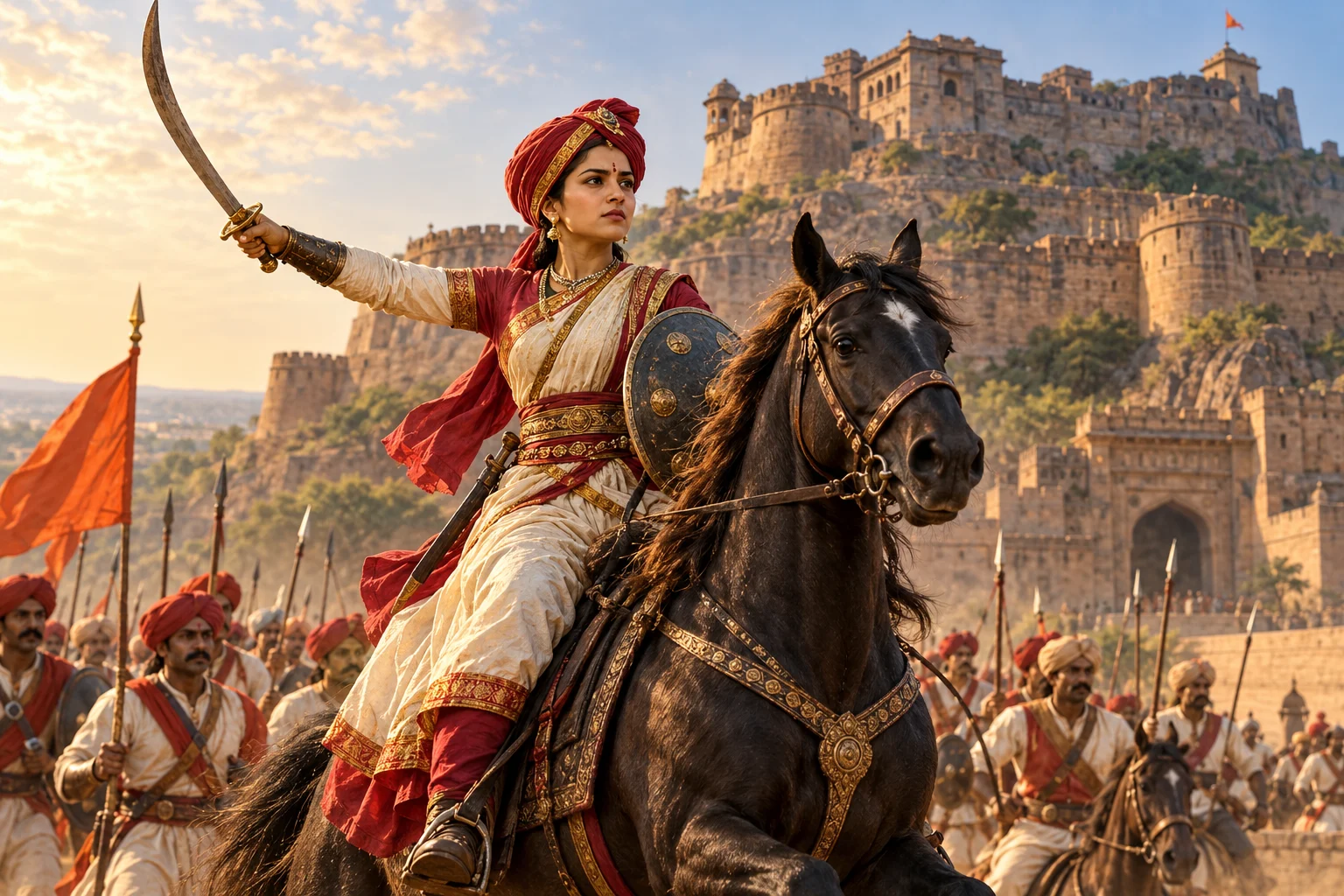
In 1857, a British political agent arrived in the small princely state of Jhansi with an ultimatum dressed up as policy: the queen’s adopted son would not be recognised as heir, and her kingdom would be absorbed into the territories of the East India Company. The queen’s reply, according to tradition, was a single defiant sentence that has outlived the empire that provoked it: Main apni Jhansi nahi doongi — I shall not give up my Jhansi.
A childhood that did not prepare her for a quiet life
She was born Manikarnika Tambe, called Manu by her family, in Varanasi around 1828, and raised for part of her childhood in the court of the Peshwa Baji Rao II at Bithoor after her mother’s early death. There, alongside boys her own age, she reportedly learned horse riding, sword fighting, and archery — unusual training for a girl in that era, and one that later accounts credit for the martial skill she would need decades sooner than anyone could have predicted.
She married Raja Gangadhar Rao of Jhansi in 1842 and took the name Lakshmibai. The marriage produced a son who died in infancy, a loss that, under existing succession customs, would ordinarily have been addressed by adoption — and indeed, shortly before his death in 1853, Gangadhar Rao formally adopted a boy named Damodar Rao as his heir, following recognised practice.
A policy designed to take kingdoms without a fight
The British East India Company, however, did not recognise the adoption. Under a policy known as the Doctrine of Lapse, championed by Governor-General Lord Dalhousie, a princely state whose ruler died without a biological male heir could be annexed directly into Company territory, regardless of an adopted successor legitimate under Hindu law. It was, in effect, a mechanism for absorbing kingdoms without the expense or risk of conquest — and Jhansi, along with several other states in the period, was annexed under its terms.
Lakshmibai petitioned the Company to recognise her son’s claim. The petition was rejected. She was ordered to leave the palace and given a pension in exchange for her kingdom — an offer she did not accept quietly.
When resistance became rebellion
The following years brought growing unrest across northern and central India, culminating in the widespread uprising of 1857, which began among Company sepoys and spread rapidly into a broader rebellion against British rule, drawing in rulers, soldiers, and civilians across the region. Jhansi became one of its centres, and Lakshmibai — whether by initial choice or by the pressure of surrounding events, historians still debate the precise sequence — took command of its defence.
What is well documented is what came next: through 1857 and into 1858, Lakshmibai organised Jhansi’s defences, raised and trained a fighting force that reportedly included women among its ranks, and prepared the fortress city against the British forces sent to retake it. When General Hugh Rose’s army laid siege to Jhansi in March 1858, the resistance was fierce enough that even accounts written from the British side describe the defence with a measure of grudging respect.
The final battle
Jhansi eventually fell after a brutal siege, but Lakshmibai did not surrender — she escaped with a small band of loyal soldiers, reportedly riding through the night with her young son strapped to her back, and made her way to join other rebel forces, eventually reaching Gwalior. There, in June 1858, in fighting near the city, she was killed in battle.
The accounts of her final engagement, drawn largely from the memoirs and reports of the British officers who fought against her, describe her dressed in male attire and fighting on horseback to the end. General Hugh Rose himself, in a widely quoted assessment, is recorded as calling her the most dangerous of all the rebel leaders — a striking admission from an opposing commander, and one of the reasons her memory survived so vividly even in the colonial record that had every institutional reason to diminish it.
Why her story kept being told
Rani Lakshmibai died with the immediate rebellion crushed and her kingdom lost — by any narrow military measure, a defeat. And yet she became one of the most enduring figures of the entire uprising, remembered in ballads, folk retellings, and later in the formal narrative of India’s independence movement nearly a century afterward, when 1857 itself was recast by nationalist historians as India’s First War of Independence rather than a suppressed mutiny.
Part of the reason is simple: a young widowed queen, denied her son’s inheritance through a policy transparently designed to strip rulers of their kingdoms without the trouble of conquering them, chose to fight rather than accept a pension and quiet obscurity. It is not a subtle story, and it did not need to be — the facts alone carried it. The Rani of Jhansi remains, to this day, one of the clearest answers India’s history offers to the question of what defiance looks like when it has almost nothing left to work with, and refuses to be quiet about it anyway.
Frequently Asked Questions
Who was Rani Lakshmibai?
Rani Lakshmibai (born Manikarnika Tambe, c. 1828–1858) was the queen of the princely state of Jhansi. After the British East India Company refused to recognise her adopted son as heir and moved to annex her kingdom under the Doctrine of Lapse, she led an armed resistance during the 1857 uprising and died in battle defending Gwalior.
What was the Doctrine of Lapse and how did it affect Jhansi?
The Doctrine of Lapse was a British East India Company policy that allowed it to annex a princely state if its ruler died without a biological male heir, regardless of any adopted heir recognised under Hindu law. When Lakshmibai's husband, Raja Gangadhar Rao, died in 1853, the Company invoked this policy to reject the succession of their adopted son and annexed Jhansi.
How did Rani Lakshmibai die?
Rani Lakshmibai was killed in June 1858 during fighting near Gwalior, reportedly while dressed in men's clothing and fighting on horseback with her adopted son strapped to her back. Even British officers who fought against her, including General Hugh Rose, are recorded as having praised her courage and skill as a commander.