
🐍 Mythology
Neither Side Could Win Alone: The Myth of Samudra Manthan, the Churning of the Ocean
To win back their lost power, the devas needed help from the very asuras they were losing to. Samudra Manthan is the Puranic story of what it costs to churn an ocean for immortality — and who ends up drinking the poison along the way.
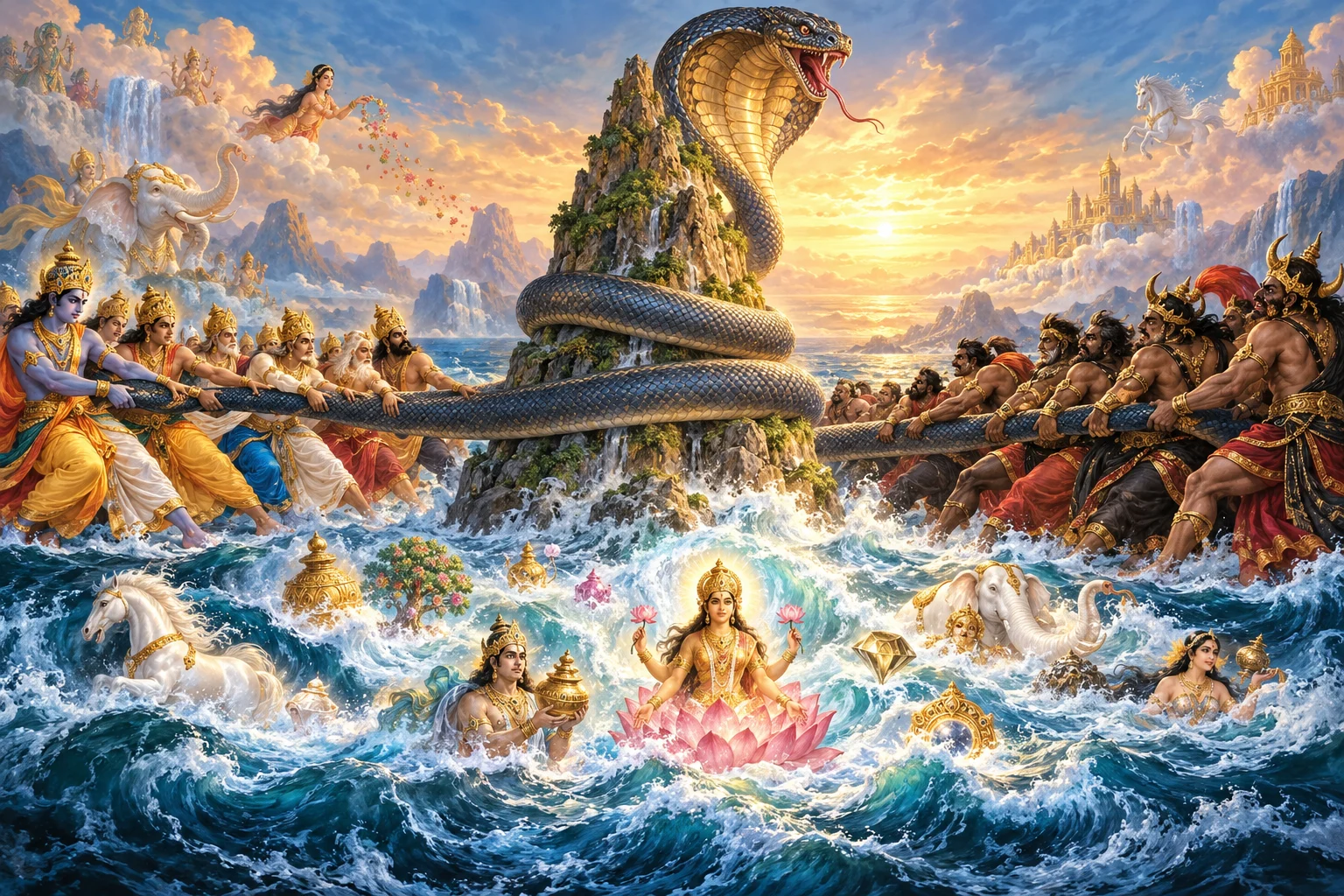
Some myths teach through triumph. Samudra Manthan teaches through an uncomfortable partnership — because its central event only happens when two sides that despise each other realise neither can get what they want alone. It is one of the foundational stories of the Puranas, and it is far stranger, and more morally complicated, than the single image most people know it by: gods and demons pulling on opposite ends of a giant serpent, churning an ocean of milk.
A curse that started it all
The story, as told across the Vishnu Purana, Bhagavata Purana, and other texts, begins with the devas at a low point. The sage Durvasa, known for a temper as legendary as his spiritual power, offers Indra, king of the gods, a garland as a mark of respect. Indra, in a moment of carelessness, places the garland on his elephant Airavata, who — uninterested in cosmic etiquette — tramples it underfoot.
Durvasa, insulted, curses Indra and the devas with the loss of their strength and prosperity. It is a curse that lands immediately: weakened, the devas find themselves losing ground to the asuras, their perennial rivals, in the ongoing struggle for control of the three worlds. Indra turns, humbled, to Vishnu for help — and Vishnu’s advice is the story’s first surprise. The devas cannot win this alone. They will need the asuras.
An alliance neither side wants
Vishnu’s solution is to propose churning the cosmic ocean of milk to produce amrita, the nectar of immortality — a task large enough that it requires cooperation on a staggering scale. Mount Mandara becomes the churning rod, and the great serpent Vasuki agrees to be wound around it as the churning rope. But the mountain needs a base to rest on in the boundless ocean, and the churning itself needs far more strength than the weakened devas possess on their own.
So Vishnu proposes the unthinkable: invite the asuras to help churn, and promise to share the amrita once it emerges. The asuras, drawn by the promise of immortality themselves, agree — an alliance built entirely on mutual self-interest, with neither side trusting the other for a moment. The devas take the tail end of Vasuki; the asuras, in some versions insisting on what they take to be the more prestigious end, take the head, unaware — or unconcerned — that the serpent’s fiery breath will fall directly on them throughout the churning.
Even the mountain itself needs help. As Mount Mandara begins to sink into the churning ocean, unable to find purchase, Vishnu descends in his second avatar as Kurma, a giant tortoise, and lets the mountain rest on his back — providing, quite literally, the stable foundation the entire enterprise depends on.
The poison that came before the nectar
Here is the detail that separates Samudra Manthan from a simple treasure hunt: before anything good emerges from the churning, the ocean produces Halahala, a poison so virulent it threatens to destroy all of creation. It is a detail worth sitting with — the myth insists that any process powerful enough to produce immortality is also powerful enough to produce annihilation, and the two arrive from the exact same churning, in the exact same ocean.
Neither the devas nor the asuras can deal with the poison. It falls to Shiva, appealed to by the terrified assembly, to save creation from a danger that was never his doing. He swallows the poison to protect the universe, and his consort Parvati, in most tellings, grips his throat to keep the poison from descending further into his body — leaving it lodged there permanently. This is the origin of Shiva’s epithet Neelakantha, “the blue-throated one,” and one of the most recognisable images in the entire tradition: a god who accepted a wound that was not his to take, so that the churning could continue.
What else came out of the ocean
With the immediate crisis survived, the churning resumes, and a series of treasures — traditionally counted as fourteen ratnas — begin to emerge. Kamadhenu, the wish-fulfilling cow, arrives, along with Airavata, the magnificent white elephant who becomes Indra’s mount, and Uchchaihshravas, a seven-headed divine horse. The Kaustubha, a radiant jewel, emerges and is claimed by Vishnu. Varuni, goddess of wine, and the celestial tree Parijata follow. The apsaras, celestial dancers, rise from the ocean as well.
Then Lakshmi herself emerges — goddess of fortune and prosperity, born from the very ocean the devas and asuras spent so long churning — and chooses Vishnu as her consort, a moment celebrated across Hindu tradition and closely associated with the imagery invoked every Diwali, when Lakshmi is welcomed anew into homes and businesses.
Finally, Dhanvantari, the physician of the gods and the figure traditionally regarded as the origin of Ayurvedic medicine, rises from the ocean bearing a pot containing amrita itself.
A promise broken exactly as expected
The moment amrita appears, the fragile cooperation the entire episode was built on collapses instantly. The asuras, having done half the labour, move to claim their share — and the devas, through Vishnu, ensure they never get the chance.
Vishnu takes the form of Mohini, an enchantress of overwhelming beauty, and offers to distribute the nectar fairly between both groups. The asuras, captivated, agree to let her manage the distribution — and Mohini proceeds to serve the amrita only to the devas, leaving the asuras with nothing despite their equal share of the churning’s labour. One asura, Rahu, manages to disguise himself among the devas and steal a sip before the Sun and Moon gods notice and alert Vishnu, who beheads him before the nectar can pass his throat. His head, having tasted immortality, survives as Rahu; his body becomes Ketu — and together they are still blamed, in traditional astrology, for periodically swallowing the sun and moon during eclipses, in eternal revenge for being cheated of the nectar they helped create.
What the myth is actually about
Read as a plot, Samudra Manthan is a story about gods getting their power back. Read more carefully, it is a story about what cooperation between genuine adversaries actually costs — and about who ends up drinking the poison so the rest of the process can continue.
The devas and asuras never stop being enemies. Their alliance lasts exactly as long as it is useful to both sides, and dissolves the instant the prize appears, with the more powerful party keeping every promise it finds convenient and breaking the rest. It is not, in the end, a myth about how virtue is rewarded — the devas win because they are cleverer and Vishnu takes a side, not because the asuras were undeserving of the same nectar they laboured equally to produce. What the myth offers instead is something closer to the mechanics of the world as it actually is: that immortality and poison rise from the same churning, that necessary alliances are rarely equal ones, and that somebody — a Shiva, a Dhanvantari — has to be willing to absorb what the rest of creation cannot survive, so that everyone else gets to reach the nectar at all.
Frequently Asked Questions
What is Samudra Manthan?
Samudra Manthan, the Churning of the Ocean, is a major Puranic myth in which the devas (gods) and asuras (demons), unable to defeat each other after the devas lost their strength to a sage's curse, jointly churned the cosmic ocean of milk using Mount Mandara and the serpent Vasuki to produce amrita, the nectar of immortality, along with many other treasures.
What emerged from the churning of the ocean?
Tradition lists fourteen treasures (ratnas) emerging from the churning, including Lakshmi (goddess of fortune), Kamadhenu (the wish-granting cow), Airavata (Indra's elephant), Kaustubha (a divine jewel), Dhanvantari (the physician of the gods, bearing the pot of amrita), and finally the deadly poison Halahala, which Shiva swallowed to save creation.
Why did Vishnu take the form of Mohini during Samudra Manthan?
After the amrita emerged, a dispute broke out between the devas and asuras over who would drink it. Vishnu took the form of the enchantress Mohini to distract the asuras and distribute the nectar only to the devas, ensuring the asuras — who had done half the labour of the churning — were denied its benefit.