
⚔️ Medieval India
The Boy Who Was Crowned King of a Kingdom That Didn't Exist Yet: Shivaji and the Rise of the Marathas
At sixteen, Shivaji began capturing forts with a small band of followers. By the time he was crowned king at Raigad, he had built an empire that would outlast the Mughals — using terrain, timing, and an idea called Swarajya, self-rule.
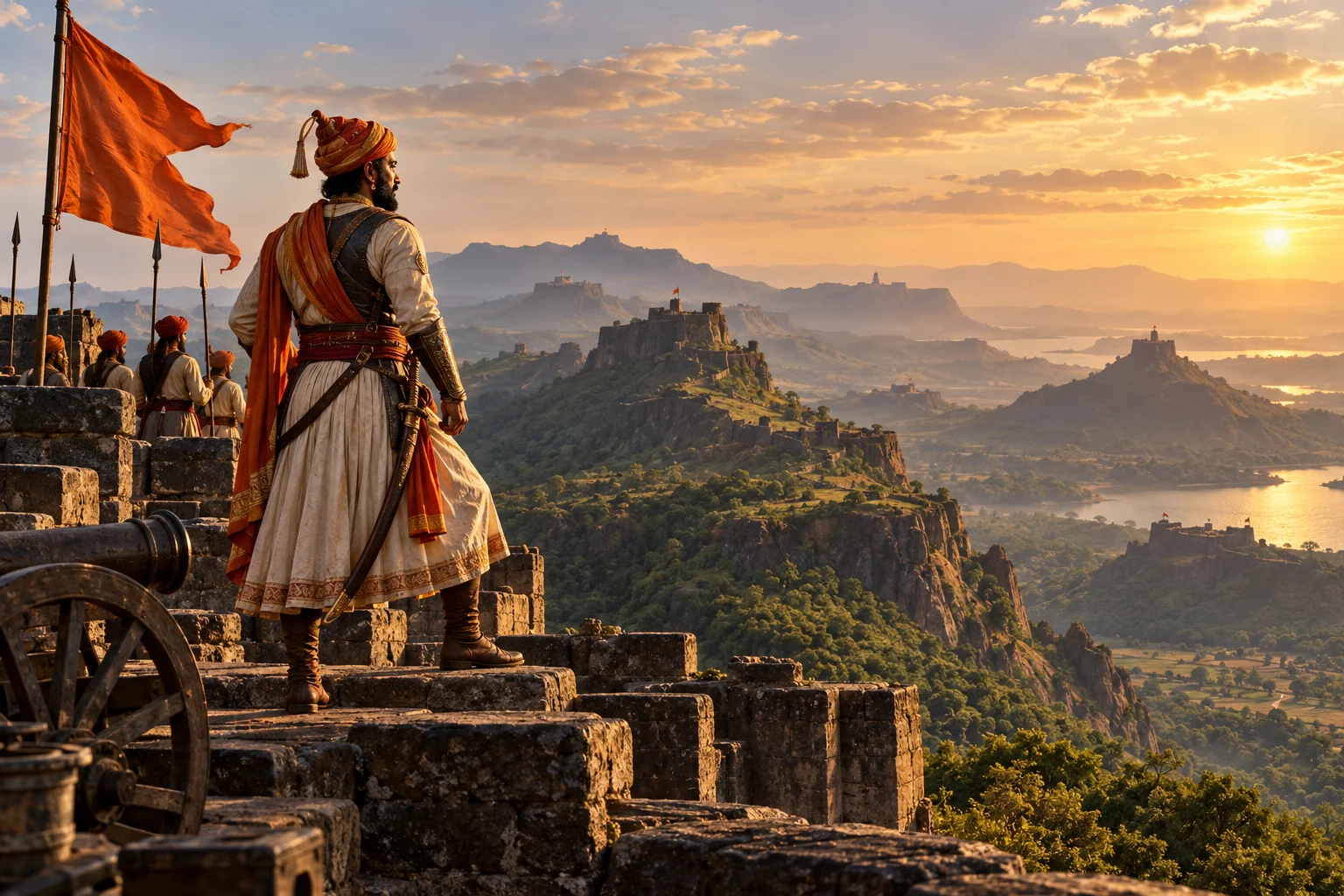
Most founders of empires inherit an army, a treasury, or at least a title. Shivaji Bhosale started with a handful of hill forts in the rugged Sahyadri mountains of western India, a small band of loyal followers, and an idea that had no name yet but would eventually be called Swarajya — self-rule. By the time he died, he had built a kingdom capable of standing up to the two most powerful forces in the region: the Adilshahi Sultanate of Bijapur, and the Mughal Empire itself.
A childhood shaped by absent power
Shivaji was born in 1630 at Shivneri Fort, at a time when the region around Pune was contested territory between competing Sultanates and local chieftains, with the distant but looming presence of the Mughal Empire to the north. His father, Shahaji Bhosale, was a capable military commander who served the Adilshahi Sultanate and spent much of his career away from home on campaigns in the Deccan.
Shivaji’s upbringing fell largely to his mother, Jijabai, a figure remembered in Maratha tradition as a decisive influence on his character and values. Traditional accounts describe her instilling in him not only religious devotion but a sense of pride in the region’s own traditions and a clear-eyed awareness of the injustices of the administrations then ruling over it. Whatever the precise details, what is not in dispute is the direction Shivaji took by his mid-teens: rather than serving an existing power the way his father had, he began building one of his own.
Taking forts before taking on an empire
Shivaji’s early strategy was not to challenge the Adilshahi Sultanate head-on — a hopeless proposition for a teenager with no army — but to quietly seize a scatter of hill forts around Pune, some through negotiation, some through surprise attacks, and some by simply outmanoeuvring underprepared garrisons. Torna Fort, captured when Shivaji was around sixteen, is traditionally marked as the beginning of this campaign.
This is where the terrain of the Sahyadri mountains became, in effect, Shivaji’s greatest ally. The steep, forested, fort-studded landscape of the Western Ghats was poorly suited to the large, slow-moving armies favoured by the Sultanates and the Mughals, and extremely well suited to smaller, fast-moving forces that knew the ground intimately. Shivaji built an approach to warfare around this asymmetry — rapid raids, strategic retreats into fortified high ground, and a refusal to fight on an enemy’s preferred terms — that would define Maratha military doctrine for generations.
The killing of Afzal Khan
By 1659, Shivaji’s growing power had become impossible for the Adilshahi Sultanate to ignore, and it dispatched a formidable general, Afzal Khan, with a large force to end the rebellion. Rather than meet this army in open battle, where he stood little chance, Shivaji agreed to a personal meeting with Afzal Khan, ostensibly to negotiate.
What happened at that meeting has become one of the most retold episodes in Maratha history: accounts describe both men arriving armed, whether out of mutual distrust or premeditation on one or both sides, and the encounter ending with Afzal Khan’s death at Shivaji’s hands, using a concealed weapon known as a bagh nakh, or tiger claw. Whatever the precise sequence of events, the outcome shattered the Sultanate’s invading force, which collapsed into disarray without its commander, and it marked the point where Shivaji stopped being a regional irritant and became a power the neighbouring states had to take seriously.
Outwitting an emperor
Shivaji’s most audacious escape came in 1666, after he travelled to the Mughal court at Agra under a guarantee of safe conduct from Emperor Aurangzeb. The visit did not go as planned — accounts describe Shivaji feeling publicly humiliated by his placement in the court’s hierarchy, a serious matter in the highly status-conscious Mughal court — and he was placed under house arrest shortly afterward.
Escape from Agra, deep in Mughal territory, would have been a formidable challenge for anyone. Tradition holds that Shivaji arranged for baskets of sweets to be sent out regularly to holy men and the poor as a gesture of piety, familiarising the guards with the routine — and then, when the moment came, had himself and his young son Sambhaji smuggled out concealed inside those very baskets. He made his way back to Maharashtra travelling largely in disguise, a journey of hundreds of miles through hostile territory, and returned home to rebuild and expand his kingdom.
Building a state, not just an army
What separates Shivaji from many successful military commanders of the era is how deliberately he built institutions to outlast any single campaign. He organised an efficient administration with clearly defined ministerial roles, reformed revenue collection to reduce the burden on peasants, and — in a decision unusual for a landlocked power of his time — built a navy, recognising the strategic and commercial importance of the Konkan coastline and its vulnerability to raids and colonial trading powers.
In 1674, this state-building culminated in a formal coronation at Raigad Fort, where Shivaji was crowned Chhatrapati — sovereign king — in an elaborate ceremony conducted according to Vedic rites, explicitly asserting an independent Hindu kingship not subordinate to the Adilshahi Sultanate or the Mughal Empire. It was, in effect, the formal declaration of Swarajya as a functioning state rather than an aspiration.
A legacy that outlasted the man
Shivaji died in 1680, but the state he built did not die with him. The Maratha Empire his successors expanded would go on to become the dominant power across large parts of the Indian subcontinent through the 18th century, at times posing a serious challenge to Mughal authority itself and shaping the political landscape that the British East India Company would later have to navigate.
Centuries later, the idea of Swarajya that Shivaji had used to describe his own kingdom’s independence would be picked up again — this time as a rallying word for a very different independence movement, against a very different empire. Few founders leave behind both a functioning state and a piece of vocabulary still doing political work hundreds of years later. Shivaji managed both.
Frequently Asked Questions
Who was Shivaji Maharaj?
Chhatrapati Shivaji Maharaj (1630–1680) was the founder of the Maratha Empire. Starting from a small territory around Pune, he built a kingdom in western India through a combination of guerrilla warfare, fort-building, naval power, and administrative reform, and was formally crowned king (Chhatrapati) at Raigad Fort in 1674.
What does 'Swarajya' mean and why is it associated with Shivaji?
Swarajya means self-rule. Shivaji used it to describe his vision of an independent Maratha kingdom free from the authority of the Adilshahi Sultanate of Bijapur and the Mughal Empire, both of which dominated the wider region in his lifetime. The term was later revived during India's independence movement.
How did Shivaji escape from Aurangzeb's court at Agra?
In 1666, Shivaji travelled to Agra under a Mughal guarantee of safety, was placed under house arrest after a dispute over his treatment at court, and escaped by having himself and his son smuggled out concealed in large baskets said to be carrying sweets for distribution to holy men and the poor — a story still widely told in accounts of his reign.