
🏰 Medieval India
Hampi's Ruins Were Once a Living Empire: The Story of Vijayanagara
Founded by two brothers on the losing side of a war, Vijayanagara grew into an empire whose capital city amazed foreign travellers with its wealth. Its ruins at Hampi are what remain of one of medieval India's great civilizations.
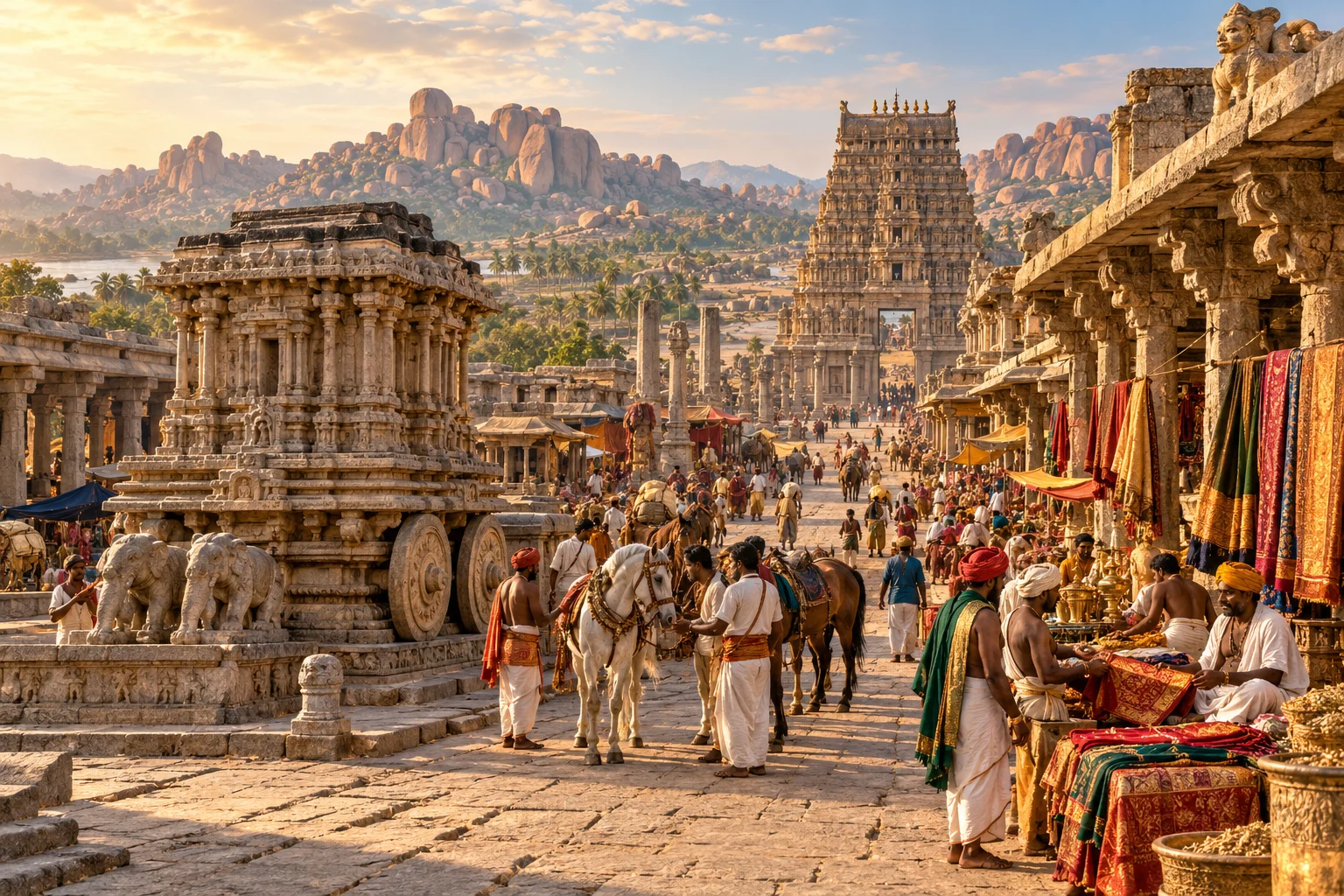
Walk through Hampi today and you are walking through the bones of a city that foreign visitors once compared favourably to Rome. Boulders the colour of rust rise around the ruins of temple towers, royal platforms, and a stone chariot carved so finely it looks capable of rolling forward. It is easy to see Hampi now as a scenic ruin. It is much harder to picture it as it was — a living capital of perhaps half a million people, at the centre of an empire that controlled most of South India for over two centuries. That empire had a name: Vijayanagara, “the City of Victory.” Its founding, fittingly, grew directly out of defeat.
Founded by two brothers on the losing side
In the 1330s, South India was in turmoil. The Delhi Sultanate’s armies, under Muhammad bin Tughlaq, had pushed deep into the Deccan and the far south, and regional powers were being overrun. Traditional accounts describe two brothers, Harihara and Bukka, serving under one of these embattled regional rulers before eventually being captured, and — in the more dramatic versions of the story — converted to Islam and sent back south as administrators loyal to the Sultanate.
What happened next depends on which account you follow, but the outcome is consistent: the brothers broke from Delhi’s authority, returned to their own tradition, and in 1336 founded a new capital and a new kingdom on the southern bank of the Tungabhadra river. They are traditionally said to have been guided and encouraged in this by the sage Vidyaranya, whose blessing gave the new kingdom’s founding a spiritual legitimacy that outlasted the political circumstances of its birth.
It is a striking origin for an empire: not a triumphant conquest, but a recovery from capture and collapse, built by two brothers who decided the story did not have to end where it seemed to be heading.
An empire that ran on temples and trade
Vijayanagara grew quickly, and its rulers understood something that many conquerors miss — that an empire needs more than an army to last. They invested heavily in irrigation, agriculture, and trade, and just as heavily in monumental temple building, which served religious, political, and economic purposes all at once. Endowing a temple was a way to display royal legitimacy, redistribute wealth, and create an institution that would outlive any single ruler’s reign — the same logic, in a different region and century, that had once bound the Gajapati kings of Odisha to the deity at Puri.
The empire’s location also mattered. Vijayanagara sat astride profitable trade routes, and its markets dealt in horses, spices, textiles, and precious stones on a scale that drew foreign travellers from remarkably far away. Portuguese traveller Domingo Paes, visiting in the early 16th century, described a city so large and prosperous that he struggled to compare it to anything in Europe, writing admiringly of its markets, its irrigation, and the wealth on open display.
The empire’s greatest king
Vijayanagara’s high point came under Krishnadevaraya, who ruled from 1509 to 1529 and is remembered as one of medieval India’s most capable monarchs. He expanded the empire’s territory through successful military campaigns, strengthened its administration, and became one of the era’s great patrons of literature, art, and temple architecture — himself a poet in Telugu and Sanskrit, and a famous patron of the eight Telugu poets known as the Ashtadiggajas.
Under Krishnadevaraya, Vijayanagara’s court became a centre of cultural production to rival any in the subcontinent. Foreign accounts from his reign, including that of the Portuguese traveller Domingo Paes, describe not only the wealth of the empire but the personal energy and involvement of the king himself in its administration — a ruler who, by these accounts, was as comfortable inspecting irrigation works as commanding an army. It is under his reign that Vijayanagara most closely resembled the golden empire that its ruins still hint at today.
The battle that ended an empire
Empires built on military dominance eventually meet a coalition strong enough to challenge them, and for Vijayanagara that moment came in 1565. A group of neighbouring Deccan Sultanates — often in conflict with one another — set aside their rivalries long enough to unite against Vijayanagara at the Battle of Talikota.
The result was catastrophic. Vijayanagara’s forces were defeated, and in the aftermath the capital city was sacked over a period of months, its monuments deliberately damaged, its wealth carried away. The devastation was thorough enough that Vijayanagara as a great imperial capital never recovered; the empire’s rulers relocated and continued in a much-reduced form for decades, eventually fragmenting into smaller successor states, including the Nayaka kingdoms that inherited pieces of its territory and administrative traditions.
What the ruins still tell us
What survives at Hampi today is not the living city Domingo Paes described, but its skeleton — extraordinary in scale even in ruin. The Vitthala Temple’s stone chariot, carved from a single block of granite, and its musical pillars, said to produce different notes when struck, remain among the most celebrated pieces of Vijayanagara-era architecture. The Virupaksha Temple, older than the empire itself, still functions as an active place of worship, a rare thread of continuity running from the pre-Vijayanagara period straight through to today.
Hampi’s designation as a UNESCO World Heritage Site reflects something beyond its individual monuments: it is one of the most complete surviving pictures of a medieval South Indian capital, its royal enclosures, market streets, and irrigation works still legible on the ground more than four centuries after the empire that built them fell.
Vijayanagara’s story runs from defeat, to founding, to unmatched prosperity, to catastrophic collapse — and then to a strange kind of permanence in ruin. Few empires leave behind a capital city that visitors can still walk through in anything like its original layout. Hampi is one of the places where you can.
Frequently Asked Questions
What was the Vijayanagara Empire?
The Vijayanagara Empire (1336–1646 CE) was a major South Indian power founded by the brothers Harihara I and Bukka Raya. At its height under rulers like Krishnadevaraya, it controlled most of South India and was renowned for its wealth, its patronage of temples and the arts, and its capital city, Vijayanagara, whose ruins survive today at Hampi in Karnataka.
Why is Hampi famous?
Hampi, in present-day Karnataka, was the capital of the Vijayanagara Empire. Its ruins — temples, royal enclosures, market streets, and the famous stone chariot at the Vitthala Temple — are a UNESCO World Heritage Site and one of the largest surviving archaeological sites from medieval India.
How did the Vijayanagara Empire end?
In 1565, a coalition of neighbouring Deccan Sultanates defeated Vijayanagara at the Battle of Talikota. The capital city was subsequently sacked and largely abandoned, though a much-reduced Vijayanagara state and its successor Nayaka kingdoms continued for decades afterward.