
🙏 Hanuman
108 Names of Lord Hanuman with Meanings
A reader-friendly list of 108 Hanuman names, from Anjaneya and Maruti to Ramaduta and Sankatamochana, with meanings and guidance for devotional recitation.
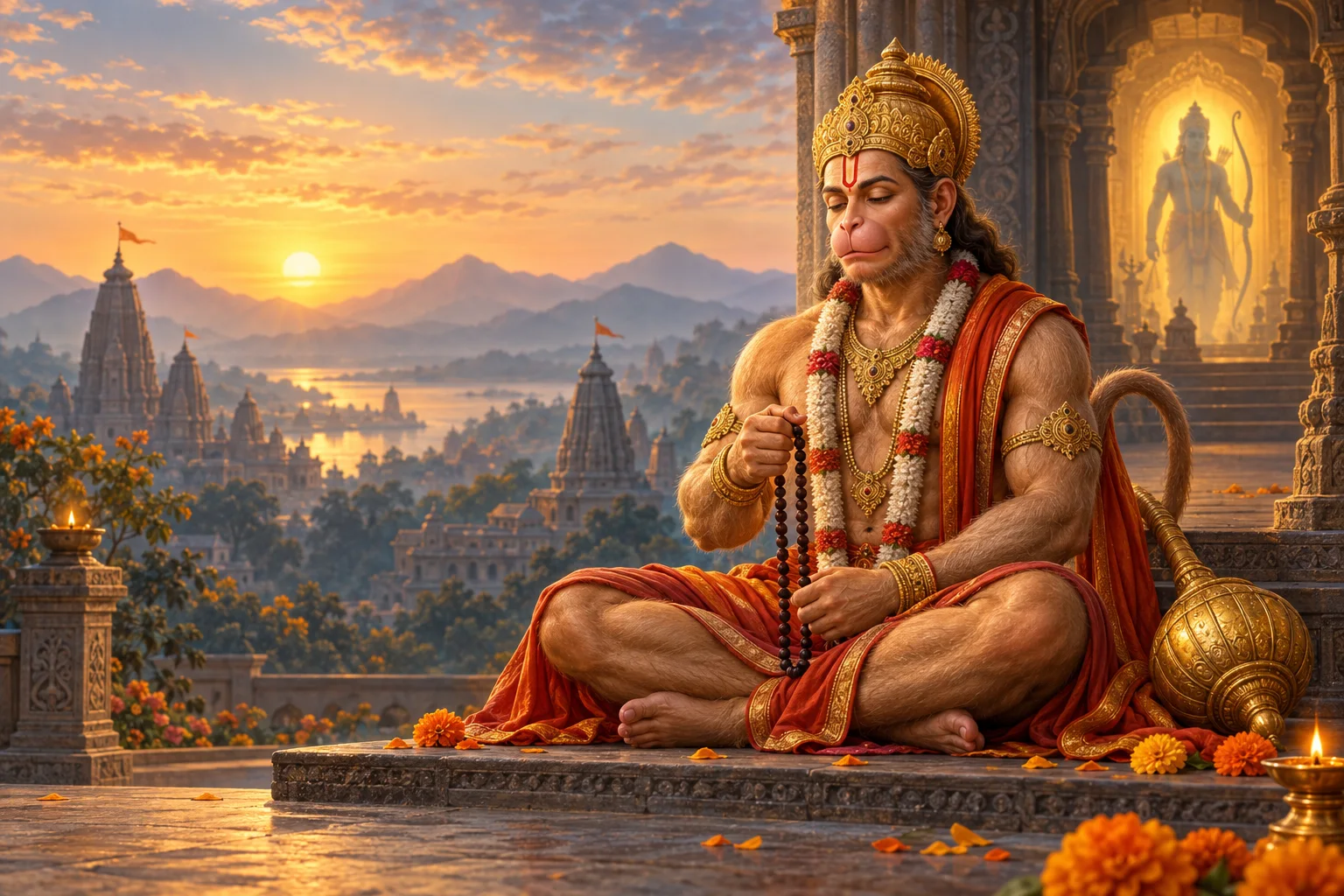
The 108 names of Lord Hanuman praise many dimensions of one beloved deity: the devoted servant of Rama, the courageous messenger who crossed the ocean, the wise speaker, the disciplined yogi, and the protector remembered in times of fear. Hanuman is also widely known as Anjaneya, Maruti, Bajrangbali, Mahavira, and Ramaduta.
This list gives each name in a simple Roman transliteration followed by an accessible English meaning. Spellings and the order of names can differ among temples, regions, languages, and family traditions. If you have received a particular Hanuman Ashtottara Shatanamavali from a teacher or temple, follow that version for formal worship.
108 Hanuman names and their meanings
- Anjaneya — Son of Anjana.
- Mahavira — The great hero.
- Hanuman — The revered name by which he is best known.
- Marutatmaja — Son of Maruta, the wind deity.
- Tattva-jnana-prada — Giver of knowledge of truth.
- Sita-devi-mudra-pradayaka — Giver of Rama’s signet ring to Sita.
- Ashoka-vanika-chhetta — One who laid waste to the Ashoka grove.
- Sarva-maya-vibhanjana — Destroyer of delusion.
- Sarva-bandha-vimokta — Liberator from every bondage.
- Raksho-vidhvamsa-karaka — Destroyer of hostile rakshasa forces.
- Para-vidya-parihara — One who counters harmful occult knowledge.
- Para-shaurya-vinashana — Destroyer of an enemy’s prideful valour.
- Para-mantra-nirakartha — One who renders hostile spells powerless.
- Para-yantra-prabhedaka — Breaker of hostile devices and snares.
- Sarva-graha-vinashi — One who dispels afflicting influences.
- Bhimasena-sahayakrit — Helper of Bhima.
- Sarva-duhkha-hara — Remover of sorrow.
- Sarva-loka-chari — One who can move through all worlds.
- Manojava — Swift as the mind.
- Parijata-druma-mulastha — One who dwells at the foot of the Parijata tree.
- Sarva-mantra-svarupavan — Embodiment of sacred mantras.
- Sarva-tantra-svarupi — Embodiment of sacred methods and disciplines.
- Sarva-yantratmaka — Inner power of sacred instruments and diagrams.
- Kapishvara — Lord among the vanaras.
- Mahakaya — The mighty-bodied one.
- Sarva-roga-hara — Remover of illness and affliction.
- Prabhu — The powerful lord.
- Bala-siddhi-kara — Giver of strength and accomplishment.
- Sarva-vidya-sampat-pradayaka — Bestower of the wealth of learning.
- Kapi-sena-nayaka — Leader of the vanara army.
- Bhavishya-chaturanana — One destined for the station of Brahma in a future age.
- Kumara-brahmachari — The youthful celibate.
- Ratna-kundala-diptiman — Shining with jewelled earrings.
- Chanchalad-vala-sannaddha-lambamana-shikhojjvala — Radiant, with a moving tail and shining topknot.
- Gandharva-vidya-tattvajna — Knower of music and refined arts.
- Mahabala-parakrama — One of immense strength and courage.
- Karagriha-vimokta — Liberator from imprisonment.
- Shrinkhala-bandha-mochaka — Releaser from chains and restraints.
- Sagarottaraka — One who crossed the ocean.
- Prajna — The wise and discerning one.
- Ramaduta — Messenger of Rama.
- Pratapavan — Full of splendour and heroic power.
- Vanara — The vanara hero.
- Kesari-suta — Son of Kesari.
- Sita-shoka-nivaraka — Remover of Sita’s sorrow.
- Anjana-garbha-sambhuta — Born from Anjana’s womb.
- Balarka-sadrishanana — Whose face shines like the rising sun.
- Vibhishana-priyakara — One dear to Vibhishana.
- Dasha-griva-kulantaka — Ender of Ravana’s dynasty.
- Lakshmana-prana-data — Restorer of Lakshmana’s life.
- Vajra-kaya — One whose body is strong as a thunderbolt.
- Mahadyuti — The greatly radiant one.
- Chiranjivi — The long-living, ever-present one.
- Rama-bhakta — Devotee of Rama.
- Daitya-karya-vighataka — Obstructor of destructive forces.
- Aksha-hanta — Slayer of Aksha Kumara.
- Kanchanabha — Golden-hued one.
- Pancha-vaktra — The five-faced form.
- Maha-tapa — The great ascetic.
- Lankini-bhanjana — Subduer of Lankini.
- Shriman — The glorious and auspicious one.
- Simhika-prana-bhanjana — Destroyer of Simhika.
- Gandhamadana-shailastha — One associated with Mount Gandhamadana.
- Lanka-pura-vidahaka — Burner of the city of Lanka.
- Sugriva-sachiva — Minister and counsellor of Sugriva.
- Dhira — Steadfast and courageous.
- Shura — The valiant one.
- Daitya-kulantaka — Ender of demonic forces.
- Surarchita — Worshipped by the devas.
- Mahatejas — Possessor of immense spiritual brilliance.
- Rama-chudamani-prada — Deliverer of Sita’s crest jewel to Rama.
- Kamarupi — Able to assume a form at will.
- Pingalaksha — The tawny-eyed one.
- Vardhi-mainaka-pujita — Honoured by Mainaka while crossing the ocean.
- Kabalikrita-martanda-mandala — One who, as a child, reached for the sun.
- Vijitendriya — Master of the senses.
- Rama-sugriva-sandhata — Maker of the alliance between Rama and Sugriva.
- Mahiravana-mardana — Vanquisher of Mahiravana in later Ramayana traditions.
- Sphatikabha — Clear and radiant like crystal.
- Vagadhisha — Master of eloquent speech.
- Nava-vyakarana-pandita — Scholar of the nine systems of grammar.
- Chaturbahu — The four-armed form.
- Dina-bandhu — Friend of those in distress.
- Mahatma — The great-souled one.
- Bhakta-vatsala — Tenderly devoted to his worshippers.
- Sanjivana-nagaharta — Bearer of the mountain of life-restoring herbs.
- Shuchi — The pure one.
- Vagmin — The eloquent speaker.
- Dridha-vrata — Firm in his vows.
- Kalanemi-pramathana — Destroyer of Kalanemi.
- Hari-markata — The vanara devoted to Hari, Rama.
- Danta — Self-controlled.
- Shanta — Peaceful and composed.
- Prasannatma — Serene and gracious in spirit.
- Shata-kantha-madapaha — Destroyer of the pride of the many-necked foe.
- Yogi — The disciplined, spiritually absorbed one.
- Rama-katha-lola — One who delights in the story of Rama.
- Sita-anveshana-pandita — The skilful seeker who found Sita.
- Vajra-damshtra — One with thunderbolt-like teeth.
- Vajra-nakha — One with thunderbolt-like nails.
- Rudra-virya-samudbhava — Born from the power of Rudra.
- Indrajit-prahita-amogha-brahmastra-vinivaraka — One who endured the unfailing Brahmastra sent by Indrajit.
- Partha-dhvajagra-samvasi — One who dwelt on Arjuna’s battle standard.
- Sharapanjara-bhedaka — Breaker of an enclosure of arrows.
- Dasha-bahu — The ten-armed form.
- Loka-pujya — Honoured by the world.
- Jambavat-priti-vardhana — One who increased Jambavan’s joy.
- Sita-sameta-Shri-Rama-pada-seva-dhurandhara — Foremost in serving the feet of Rama together with Sita.
What do the different names of Hanuman reveal?
The names are not merely synonyms. Together, they form a compact devotional portrait.
- Family and origin: Anjaneya, Anjana-garbha-sambhuta, Kesari-suta, and Marutatmaja remember Hanuman as the son of Anjana and Kesari, with a sacred connection to Vayu or Maruta.
- Devotion to Rama: Rama-bhakta, Ramaduta, Rama-katha-lola, and the final name place service to Rama at the centre of Hanuman’s identity.
- Ramayana deeds: Sagarottaraka, Sita-shoka-nivaraka, Lanka-pura-vidahaka, and Lakshmana-prana-data recall major moments in the search for Sita and the war in Lanka.
- Character and wisdom: Prajna, Dhira, Vagmin, Vijitendriya, and Dridha-vrata praise discernment, eloquence, self-control, and resolve—not physical power alone.
- Protection and courage: Mahavira, Vajra-kaya, Bhakta-vatsala, and Sarva-duhkha-hara express the confidence devotees place in Hanuman during adversity.
This balance is important. Hanuman’s strength is repeatedly joined to humility, intelligence, and service. The story of Hanuman and Rama shows how his extraordinary abilities are directed toward a purpose larger than himself.
Popular names of Lord Hanuman
Several Hanuman names are especially common in everyday prayer and conversation:
- Anjaneya means “son of Anjana” and is widely used in South India.
- Maruti or Marutatmaja remembers his connection with Maruta, the wind deity.
- Bajrangbali combines the idea of a body strong as the thunderbolt (vajra) with mighty strength (bali).
- Mahavira means “great hero.”
- Ramaduta means “messenger of Rama.”
- Sankatamochana means “reliever of distress” and is a beloved devotional title, although it does not appear as a separate entry in every 108-name sequence.
- Pavanaputra means “son of the wind” and expresses the same relationship as Marutatmaja.
For a prayer centred on these qualities, read the Hanuman Chalisa with text and meaning or explore the Hanuman Chalisa meaning in English.
How to chant the Hanuman Ashtottara Shatanamavali
Ashtottara shata means “one hundred and eight,” while namavali means a garland or sequence of names. A simple home practice does not need to be elaborate:
- Choose a clean, quiet place and sit comfortably.
- Bring Hanuman’s qualities—courage, humility, discipline, and service—to mind.
- Read one name at a time. In a formal namavali, a name commonly appears between Om and Namah, with its grammatical form adjusted for recitation.
- If you use a 108-bead japa mala, move one bead after each name without rushing.
- Close with a short prayer, a moment of silence, or a practical intention to help someone.
Pronunciation matters, but attentive devotion matters more than performing the list at speed. Sanskrit endings can change when names are placed into the formula “Om … Namah,” so use a trusted liturgical text or learn from a knowledgeable teacher if you want the complete Sanskrit recitation form.
Some devotees read Hanuman’s names on Tuesdays or Saturdays, but they may be remembered on any day. You can also use the site’s guide to beginning Hanuman devotion at home or Hanuman Tuesday puja guide to build a simple routine.
Why is 108 considered sacred?
The number 108 appears across several Indian religious and contemplative traditions—in name lists, japa malas, and patterns of recitation. Different traditions offer different symbolic explanations, so it is best not to reduce the number to one universal formula. In practice, 108 provides a complete, sustained cycle of remembrance: each repetition returns the mind to the deity and the virtue named.
The purpose is not to complete a large number mechanically. Even a few names recited with understanding can become a meaningful reflection. The list becomes especially useful when a devotee chooses one quality—such as Manojava (swift as the mind), Vijitendriya (master of the senses), or Rama-bhakta (devotee of Rama)—and considers how to practise it in daily life.
Frequently asked questions
What are the 12 names of Lord Hanuman?
A shorter twelve-name hymn is also popular, but its exact wording can vary by tradition. Commonly remembered names include Hanuman, Anjana-suta, Vayu-putra, Mahabala, Rameshta, Phalguna-sakha, Pingaksha, Amitavikrama, Udadhikramana, Sita-shoka-vinashana, Lakshmana-prana-data, and Dashagriva-darpaha. Use the version preserved by your family, temple, or teacher when reciting it liturgically.
Which Hanuman name is best for daily chanting?
There is no single compulsory choice. “Om Hanumate Namah” is a brief and widely used remembrance. Names such as Rama-bhakta, Ramaduta, Anjaneya, and Sankatamochana may also be chosen according to the quality that inspires your devotion. For mantra-specific guidance, see the Hanuman Beej Mantra.
Are Anjaneya, Maruti, and Bajrangbali the same as Hanuman?
Yes. They are different names or titles of Hanuman. Anjaneya refers to his mother Anjana; Maruti refers to his association with Maruta or Vayu; and Bajrangbali celebrates thunderbolt-like strength.
Are all lists of 108 Hanuman names identical?
No. The order, spelling, grammatical form, and even some included names differ among printed prayer books, temples, languages, and lineages. This does not make one familiar regional list invalid. For formal worship, consistency with the text used in your tradition is more useful than trying to force every list into one sequence.
Can I read the 108 names without a mala?
Yes. A mala can help maintain rhythm and count, but it is not required. You may read from the page, pause after each meaning, or recite only a small group of names attentively.
What is the difference between Hanuman’s 108 names and the Hanuman Chalisa?
The 108 names form a namavali: a sequence of titles used for praise and remembrance. The Hanuman Chalisa is a forty-verse Awadhi hymn traditionally attributed to Tulsidas. Both praise Hanuman, but their structures and modes of recitation are different.