
📖 Bhagavad Gita
Bhagavad Gita and the Mahabharata: Context, Story, and Teaching
Last updated: August 31, 2026
The Bhagavad Gita is a focused dialogue inside the Mahabharata. Its battlefield setting gives the teachings on duty, action, and spiritual freedom their dramatic context.
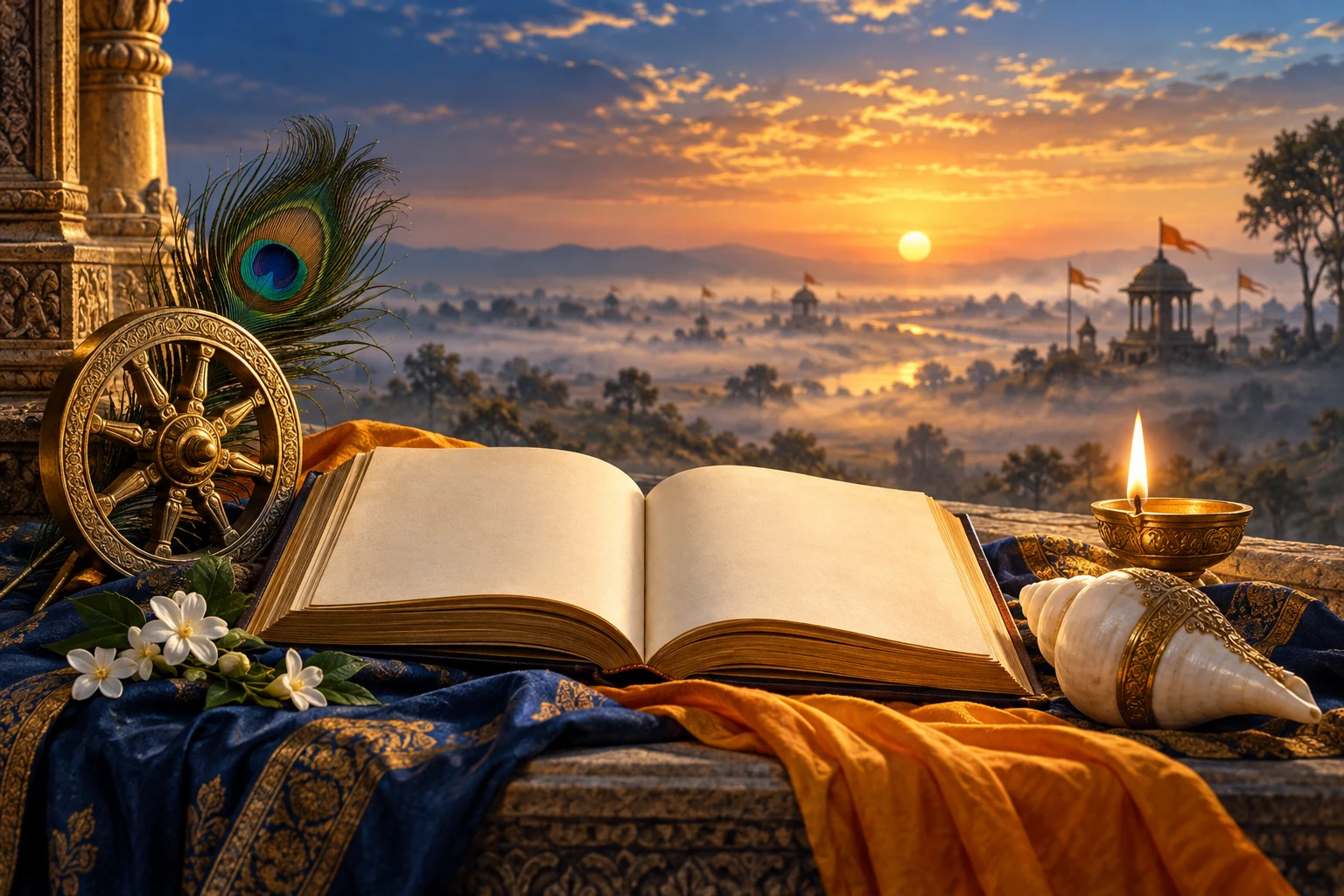
The relationship between the Bhagavad Gita and the Mahabharata is simple to state and easy to overlook: the Gita is a self-contained dialogue set inside the larger epic. The Bhagavad Gita appears in the Bhishma Parva, the sixth of the Mahabharata’s eighteen books, just before the major battle at Kurukshetra begins. Its seven hundred verses form a concentrated conversation between Krishna and Arjuna, traditionally attributed, like the rest of the epic, to the sage Vyasa.
The Mahabharata setting
The Pandavas and Kauravas are cousins whose conflict has grown over years through questions of inheritance, a rigged game of dice, a thirteen-year exile, and a broken promise to return the Pandavas’ share of the kingdom. When every attempt at negotiation fails, including a final peace mission by Krishna, both sides gather enormous armies on the field of Kurukshetra. Arjuna, the third Pandava and the finest archer of his generation, asks Krishna, who has agreed to serve as his charioteer, to place the chariot between the two armies so he can see who has come to fight.
The Gita begins at that moment. Everything before it in the epic explains why the war is happening; everything after it narrates the eighteen days of battle and its long aftermath. The dialogue itself is heard by the whole battlefield only through Sanjaya, who narrates it to the blind king Dhritarashtra far from the field.
The Gita’s dramatic question
Arjuna’s crisis asks whether action can be righteous when it brings painful consequences. Krishna responds through several connected teachings: the nature of the self, responsible action, disciplined meditation, devotion, and the divine ground of existence.
How the Mahabharata context shapes the Bhagavad Gita
Without the Mahabharata context, lines about duty can sound like generic motivation. Within the story, they are part of a difficult conversation about violence, family, justice, and responsibility. Context does not produce one automatic interpretation, but it prevents shallow readings.
A useful reading order
Begin with the Chapter 1 summary, read the Chapter 2 summary, and then use the 18-chapter guide as a map. It also helps to know who Arjuna is within the epic. Read selected Sanskrit verses with translation and note what question each answer addresses.
The Gita is a small section within a much larger epic, yet its central question remains immediate: how should a person act when every available choice carries responsibility?
Frequently asked questions
Is the Bhagavad Gita part of the Mahabharata?
Yes. The Gita is chapters 23 to 40 of the Bhishma Parva, the sixth book of the Mahabharata. It is often printed and studied on its own, but in the epic it is a single continuous dialogue on the eve of the Kurukshetra war.
Who wrote the Bhagavad Gita and the Mahabharata?
Tradition attributes both to the sage Vyasa, who is also a character within the epic. For a fuller discussion, see who wrote the Bhagavad Gita.
When in the story does the Gita take place?
It takes place after the armies have assembled at Kurukshetra but before the first weapon is used. Arjuna’s doubt halts everything, and Krishna’s teaching fills that pause.
Do I need to read the whole Mahabharata first?
No. The Gita can be read on its own, but a short summary of the family conflict and the failed peace talks makes the teaching on duty and grief land more clearly.