
📖 Bhagavad Gita
Who Wrote the Bhagavad Gita? Vyasa, Krishna, and the Complete Answer
Last updated: September 24, 2026
The Bhagavad Gita is traditionally attributed to Sage Vyasa, while Krishna is its teacher and Arjuna its listener. Here is how authorship and transmission fit together.
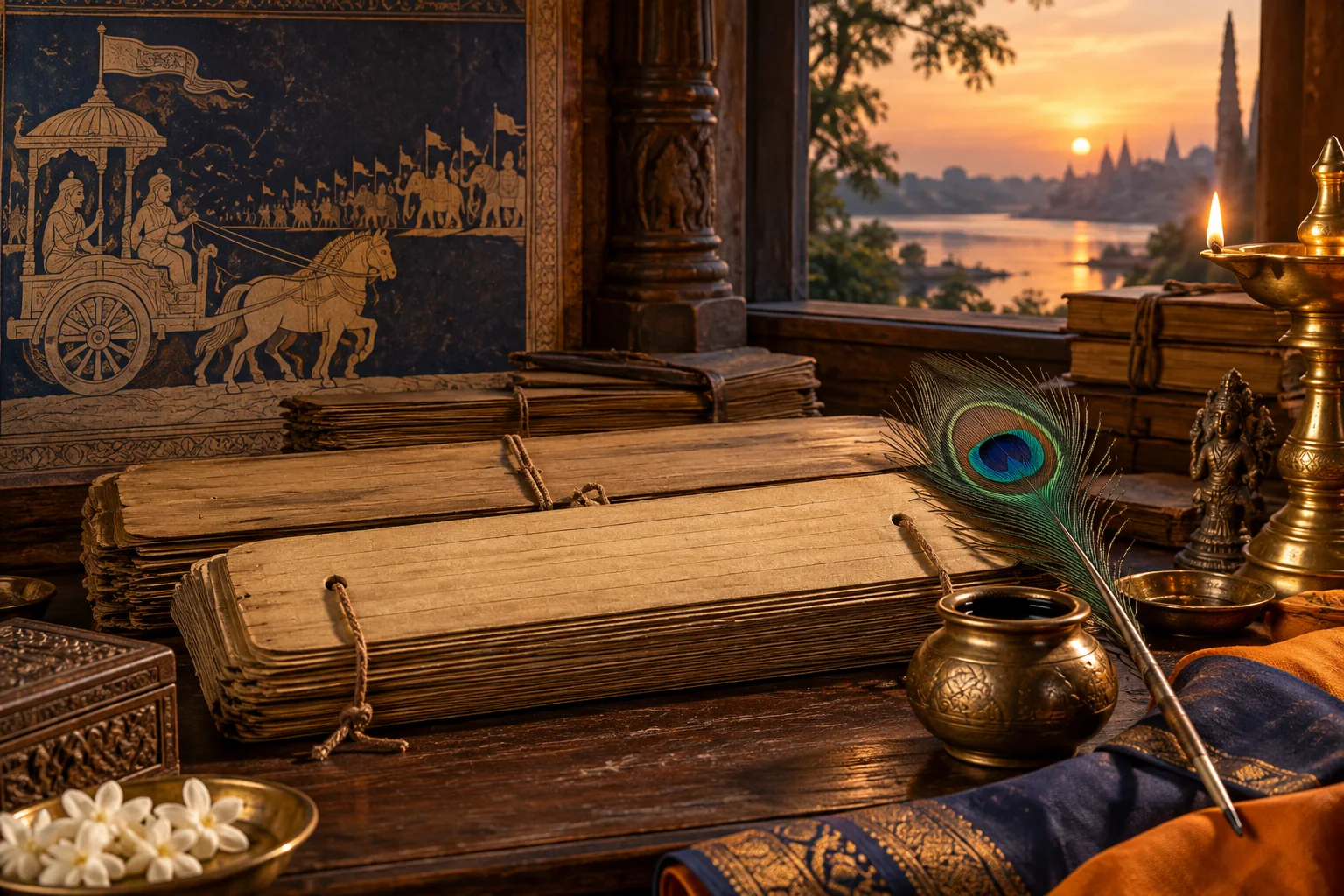
The Bhagavad Gita is traditionally attributed to Sage Vyasa, also called Veda Vyasa. Krishna does not write the book within the story: he speaks its teachings to Arjuna on the battlefield of Kurukshetra. Sanjaya then narrates their dialogue to King Dhritarashtra. The simplest complete answer is therefore: Vyasa is the traditional author or compiler, Krishna is the teacher and speaker, and Arjuna is the listener.
Who wrote the Bhagavad Gita? The roles at a glance
| Person | Role in the Bhagavad Gita |
|---|---|
| Sage Vyasa | Traditional author or compiler of the Mahabharata and the Gita within it |
| Krishna | Divine teacher who speaks the Gita’s instruction |
| Arjuna | Warrior and student whose questions lead to the teaching |
| Sanjaya | Narrator who reports the battlefield dialogue to Dhritarashtra |
| Dhritarashtra | King who listens to Sanjaya’s account |
| Ganesha | Revered in a later tradition as the scribe who wrote down the Mahabharata as Vyasa dictated it |
This distinction explains why different short answers appear online. “Vyasa” answers the question of traditional authorship. “Krishna” answers who delivered the spiritual teaching. “Ganesha” refers to the traditional story about the Mahabharata’s scribe.
Why is Vyasa considered the author?
The Bhagavad Gita is traditionally attributed to Sage Vyasa, also called Veda Vyasa. It appears within the Mahabharata, the Sanskrit epic traditionally associated with Vyasa. In the story, however, Vyasa is not the person speaking the teaching on the battlefield.
The name Vyasa is associated with arranging, compiling, or dividing sacred knowledge. Hindu tradition remembers him as the composer or compiler of the Mahabharata and as a central figure inside its story. Calling Vyasa the author does not mean the text makes the modern claim that one person sat down and produced a printed book in its present form. Ancient Indian works were transmitted through recitation, teaching, manuscript copying, and commentary over long periods.
Within the Mahabharata’s narrative, Vyasa also gives Sanjaya the extraordinary vision through which he can follow the events at Kurukshetra. Near the end of the Gita, Sanjaya says that by Vyasa’s grace he heard the supreme and secret teaching directly from Krishna. This gives Vyasa a role both outside and inside the narrated event.
Was Krishna the writer of the Bhagavad Gita?
Krishna is the speaker and divine teacher of the Gita, not its conventional literary author. Arjuna’s despair about fighting begins the dialogue, and Krishna responds with teachings on the self, dharma, action, knowledge, meditation, devotion, the nature of God, and liberation.
Calling Krishna the author can still make sense in devotional speech because devotees understand the wisdom as his direct revelation. But when a school question asks, “Who wrote the Bhagavad Gita?”, the expected traditional answer is usually Maharishi Veda Vyasa.
Read who Krishna is in the Bhagavad Gita for a closer look at his roles as Arjuna’s friend, charioteer, teacher, and the divine reality revealed in Chapter 11.
Did Ganesha write the Bhagavad Gita?
A famous tradition says that Vyasa dictated the Mahabharata while Lord Ganesha served as his scribe. In popular retellings, Ganesha agrees to write without stopping, while Vyasa asks him to understand every verse before recording it. Vyasa then uses especially intricate verses to gain time to compose what comes next.
This account belongs to the traditional history surrounding the Mahabharata. It does not change the usual attribution: Vyasa is the composer or compiler, Ganesha is the scribe, and Krishna is the speaker of the Bhagavad Gita within the epic.
Where does the Bhagavad Gita appear?
The Gita appears in the Bhishma Parva of the Mahabharata, immediately before the Kurukshetra battle. King Dhritarashtra asks Sanjaya what the assembled armies did. Sanjaya’s answer leads into the battlefield scene, where Arjuna asks Krishna to place their chariot between the two sides.
Seeing teachers, relatives, friends, and elders in both armies, Arjuna is overcome by grief and refuses to fight. That crisis begins Chapter 1, Arjuna’s Dilemma. Krishna’s response unfolds through eighteen chapters and approximately seven hundred verses. See the summary of all 18 Bhagavad Gita chapters for the progression of the teaching.
The exact chapter numbering of the Gita within the larger Mahabharata can vary between editions, which is why responsible references usually identify its location as the Bhishma Parva instead of relying only on one set of Mahabharata chapter numbers.
When was the Bhagavad Gita written?
There are two different ways readers approach this question:
- Traditional chronology: Hindu sacred tradition places the dialogue at the beginning of the Kali Yuga in the setting of the Mahabharata war.
- Academic textual history: Modern scholars study language, philosophy, manuscript traditions, and the Gita’s relationship with other Indian texts. Proposed dates vary, and no single precise year is universally accepted.
These approaches ask different questions. A devotional chronology concerns the sacred event remembered by tradition; historical scholarship investigates when the Sanskrit text reached forms recognizable in surviving transmission. It is better to state the distinction clearly than to present one disputed calendar year as certain.
What language was the Bhagavad Gita written in?
The Bhagavad Gita was composed in Sanskrit, primarily in verse. Its compact Sanskrit allows important terms such as dharma, yoga, atman, karma, bhakti, and moksha to carry layers of meaning that translations must explain rather than replace with a single English word.
This is why traditional study often places the Sanskrit verse beside transliteration, translation, and commentary. VedicVani follows that format in the complete Bhagavad Gita collection.
How was the Gita preserved?
The Gita was preserved through overlapping oral, manuscript, teaching, and commentary traditions. Sanskrit verses were recited and memorised, copied by hand, taught by teachers, interpreted in philosophical commentaries, printed in critical and traditional editions, and translated into many languages.
Influential commentators include Adi Shankaracharya, Ramanujacharya, and Madhvacharya, whose readings reflect different Vedanta traditions. Their disagreements do not imply that each wrote a different Bhagavad Gita; they interpret the same foundational dialogue through different philosophical frameworks.
Editions and translations can differ in punctuation, transliteration, word choice, commentary, and occasionally verse numbering. The commonly received Gita contains about 700 verses. Our guide to how many shlokas are in the Bhagavad Gita explains why readers sometimes encounter other counts.
Bhagavad Gita and Mahabharata: author versus speaker
The relationship becomes clearer when the Gita is not treated as an isolated modern book. It is a dialogue embedded in a much larger epic. The Mahabharata provides the families, vows, political conflict, exile, failed negotiations, and moral crisis that make Arjuna’s questions urgent.
The Bhagavad Gita and Mahabharata guide explains this narrative setting in detail. In short:
- Vyasa is traditionally credited with the epic that contains the dialogue.
- Krishna speaks the spiritual instruction.
- Arjuna asks the questions as a participant in the crisis.
- Sanjaya narrates the exchange to Dhritarashtra.
- Later teachers and translators explain the text for new audiences.
Frequently asked questions
Who wrote the Bhagavad Gita?
Hindu tradition attributes the Bhagavad Gita, as part of the Mahabharata, to Sage Vyasa. Krishna speaks the teaching to Arjuna, while Sanjaya narrates the dialogue to Dhritarashtra.
Did Krishna write the Bhagavad Gita?
Krishna is its divine speaker and teacher. Vyasa is its traditional author or compiler. Calling Krishna the source of the teaching and Vyasa the author preserves both roles.
Did Lord Ganesha write the Bhagavad Gita?
A widely loved tradition describes Ganesha as the scribe who wrote the Mahabharata while Vyasa dictated it. Ganesha is therefore associated with writing the epic, but Vyasa remains its traditional composer and Krishna the Gita’s speaker.
Is the Bhagavad Gita part of the Mahabharata?
Yes. Its eighteen chapters form a dialogue in the Bhishma Parva of the Mahabharata, set immediately before the Kurukshetra battle.
Who translated the Bhagavad Gita into English first?
Charles Wilkins produced the first published English translation in 1785. Many later translations reflect devotional, literary, academic, and philosophical approaches, so readers should check whether a book separates the translated verse from the translator’s commentary.
What language was the original Bhagavad Gita written in?
The original text is in Sanskrit. Transliteration helps readers pronounce the Sanskrit in Roman letters, while a translation explains its meaning in another language.
Sources and further reading
Frequently Asked Questions
Who wrote the Bhagavad Gita?
Hindu tradition attributes the Bhagavad Gita, as part of the Mahabharata, to Sage Vyasa. Within the narrative, Krishna speaks the teaching to Arjuna, Sanjaya reports the dialogue to Dhritarashtra, and Vyasa is the traditional composer or compiler who preserves it.
Did Krishna write the Bhagavad Gita?
Krishna is the divine speaker and teacher of the Bhagavad Gita, not its conventional literary author. The work is traditionally attributed to Vyasa, who presents Krishna's dialogue with Arjuna within the Mahabharata.
Did Lord Ganesha write the Bhagavad Gita?
A later and widely loved tradition says Ganesha served as Vyasa's scribe while Vyasa dictated the Mahabharata. In that sense Ganesha may be called the scribe, but Vyasa remains the traditional author or compiler and Krishna the speaker of the Gita.
Is the Bhagavad Gita part of the Mahabharata?
Yes. The Bhagavad Gita is an eighteen-chapter dialogue in the Bhishma Parva of the Mahabharata, set just before the Kurukshetra battle begins.
What language was the Bhagavad Gita originally written in?
The Bhagavad Gita was composed in Sanskrit. It has since been preserved through manuscripts, recitation, commentaries, printed editions, and translations into many languages.