
🔱 Mantras
Powerful Shiva Mantras: Meaning, Words and How to Chant
Six widely chanted Lord Shiva mantras, from the five-syllable Om Namah Shivaya to the Maha Mrityunjaya Mantra, with verified Sanskrit, transliteration and grounded meaning.
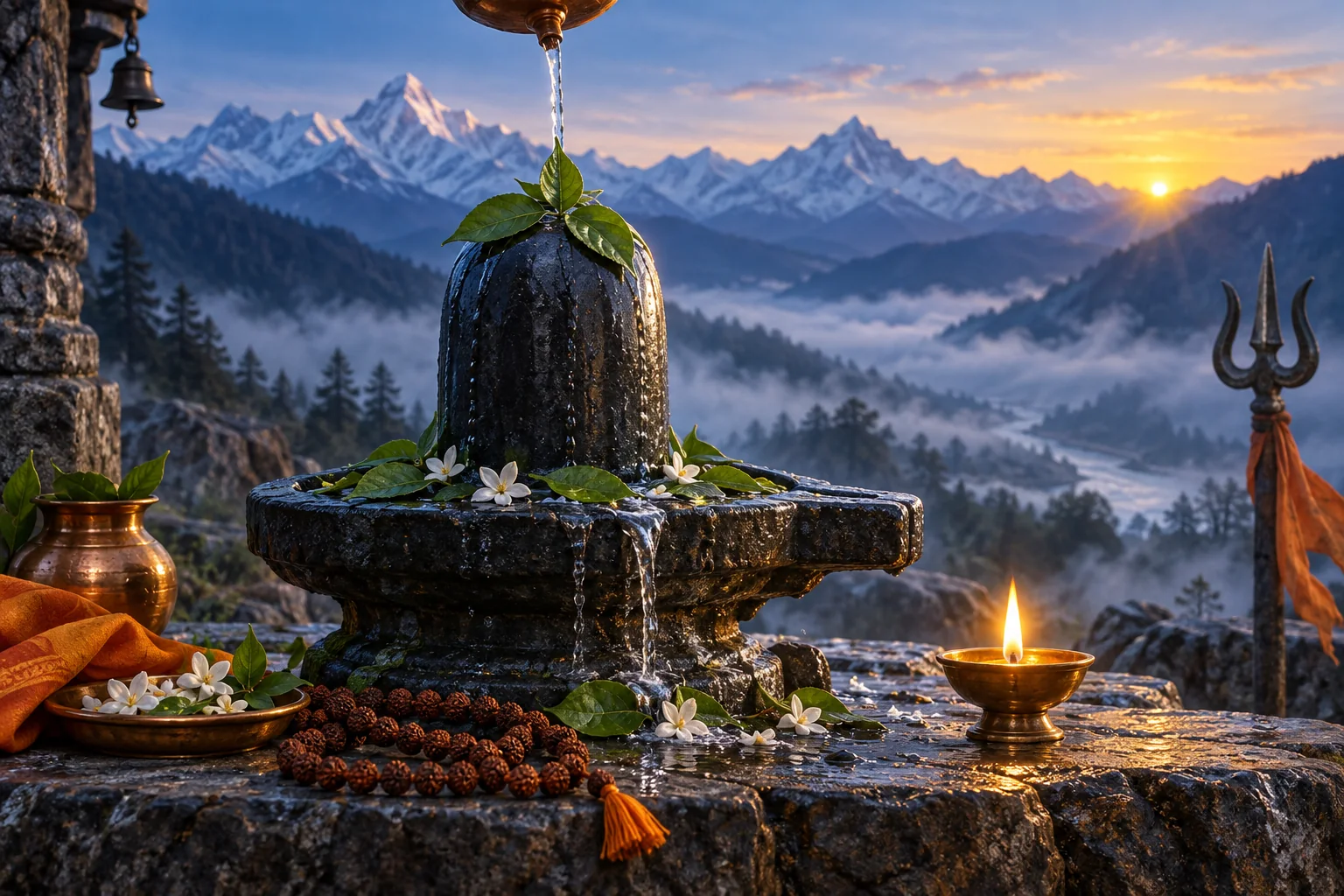
A powerful Shiva mantra is not a spell but a short, repeatable prayer that turns the mind toward Shiva — the auspicious one, the transformer within the Hindu trinity. This guide collects the Lord Shiva mantras that devotees chant most often, from the simple five-syllable Om Namah Shivaya to the longer Maha Mrityunjaya Mantra of the Rigveda. For each one you will find the Sanskrit, an IAST transliteration, a plain-English meaning and a line on how it is traditionally used. Devotional benefits are best understood as steadiness, focus and remembrance rather than guaranteed outcomes.
Shiva mantras
Om Namah Shivaya
ॐ नमः शिवाय
Oṃ Namaḥ Śivāya
“I bow to Shiva.” This is the Panchakshari, or five-syllable, mantra — Na, Mah, Shi, Va, Ya — with each syllable traditionally linked to one of the five elements: earth, water, fire, air and space. It appears in the Yajurveda’s Shri Rudram and is a mantra of surrender rather than a request for a specific result. It suits every level of practice and can be chanted aloud, whispered or repeated silently through the day.
The Maha Mrityunjaya Mantra
ॐ त्र्यम्बकं यजामहे सुगन्धिं पुष्टिवर्धनम्। उर्वारुकमिव बन्धनान्मृत्योर्मुक्षीय माऽमृतात्॥
Oṃ Tryambakaṃ Yajāmahe Sugandhiṃ Puṣṭivardhanam Urvārukamiva Bandhanān Mṛtyor Mukṣīya Māmṛtāt
Also called the Rudra Mantra or Tryambakam Mantra, this verse comes from the Rigveda (Mandala 7, Hymn 59, Verse 12). It means: “We worship the three-eyed Lord, fragrant, who nourishes all beings. As a ripe cucumber is freed from its creeper, may we be released from the bondage of death — toward immortality, not away from it.” It is traditionally recited for healing, resilience and freedom from the fear of death, and is often chanted for someone who is unwell alongside proper medical care.
Om Tryambakam Yajamahe
ॐ त्र्यम्बकं यजामहे
Oṃ Tryambakaṃ Yajāmahe
This is the opening line of the Maha Mrityunjaya Mantra — “We worship the three-eyed one.” Some practitioners use it as a brief invocation or as a repeated refrain when there is no time for the full verse, and some traditions prefix the complete mantra with the Pranava and the vyahritis (Om Bhur Bhuvah Svah). For a full practice, the complete two-line verse above is the standard form.
The Rudra Gayatri
ॐ तत्पुरुषाय विद्महे महादेवाय धीमहि। तन्नो रुद्रः प्रचोदयात्॥
Oṃ Tatpuruṣāya Vidmahe Mahādevāya Dhīmahi Tanno Rudraḥ Pracodayāt
Composed on the pattern of the Gayatri metre, this verse means roughly: “May we know the Supreme Person, may we meditate on the great god; may Rudra inspire our understanding.” It is chanted as part of daily sandhya practice by many Shaiva devotees and during Rudra Abhishek at Shiva temples. Like the Gayatri Mantra, it is a prayer for guided understanding rather than a material request.
Om Hraum Namah Shivaya
ॐ ह्रौं नमः शिवाय
Oṃ Hrauṃ Namaḥ Śivāya
This is the Panchakshari with the Shiva seed syllable Hrauṃ added after the Pranava. Devotees who follow a tantric or guru-given practice use this form; the added beej is said to concentrate the sound. If you have not received it from a teacher, the plain Om Namah Shivaya is the usual choice for household practice.
Om Shivaya Namah
ॐ शिवाय नमः
Oṃ Śivāya Namaḥ
The same words as the Panchakshari in a different order — “Om, salutations to Shiva.” Some lineages chant this arrangement, and it carries the same sense of reverence and surrender. Choosing between Om Namah Shivaya and Om Shivaya Namah is usually a matter of family or teacher tradition rather than meaning.
How to chant these mantras
Sit comfortably in a clean, quiet place, ideally in the early morning or at dusk. Mondays and the month of Shravan are considered especially auspicious for Shiva, as is Maha Shivratri. Take a few slow breaths first, then recite each word fully rather than rushing — the longer verses in particular need their syllables given full value. A common practice is one mala of 108 repetitions per sitting, though 11 or 21 careful repetitions are also considered worthwhile. Many people use a Rudraksha mala and link one repetition to each inhalation and exhalation. Pronunciation improves by listening to a trusted reciter rather than by speed; if you follow a specific lineage that has rules about initiation or Vedic recitation, follow that guidance.
Frequently asked questions
Which Shiva mantra is most powerful?
There is no single ranking that every tradition agrees on. Om Namah Shivaya is the most widely chanted and the most accessible, and the Maha Mrityunjaya Mantra is the one most often described as powerful because of its Vedic origin and its association with healing and courage. “Powerful” here refers to the depth of the practice and the focus it builds, not a guaranteed effect.
Can I chant the Maha Mrityunjaya Mantra daily?
Yes. Many practitioners include it in daily sadhana, often as one mala or in multiples of 11. It is also recited during a health crisis or before a medical procedure. It should accompany qualified medical care, not replace it.
What is the difference between Om Namah Shivaya and the Maha Mrityunjaya Mantra?
Om Namah Shivaya is a short five-syllable mantra of pure surrender to Shiva, suitable for continuous japa. The Maha Mrityunjaya Mantra is a longer Vedic verse with a specific theme — release from the bondage and fear of death — and is usually chanted as a seated, counted practice rather than as background repetition.
Do I need initiation to chant a Shiva mantra?
For Om Namah Shivaya and the Maha Mrityunjaya Mantra there is no initiation requirement in most household traditions. Seed-syllable forms such as Om Hraum Namah Shivaya are often taken from a teacher. If you follow a particular sampradaya, follow its guidance.
When is the best time to chant Shiva mantras?
They can be chanted at any time. Early morning and dusk are the traditional periods, Mondays are Shiva’s day, and Maha Shivratri and the month of Shravan are the most observed occasions.