
☸️ Hindu Concepts
What Is Dharma? Meaning and Why It Resists a Single Translation
Last updated: October 4, 2026
Dharma gets translated as 'duty,' 'righteousness,' or 'law,' but no single English word captures it. Here's why, and what the concept actually covers.
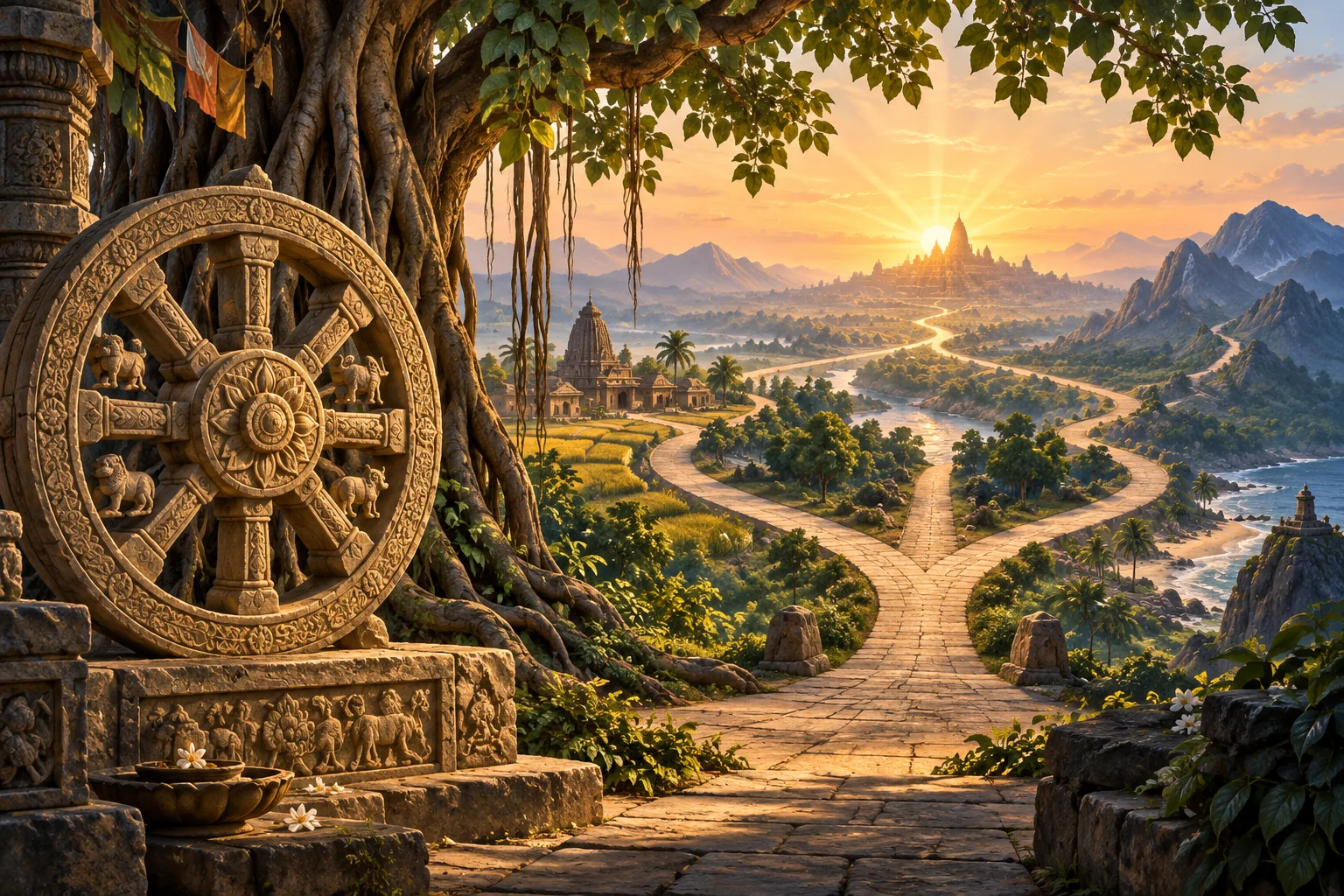
Dharma is one of the most important concepts in Hindu philosophy, and one of the hardest to translate into a single English word. “Duty,” “righteousness,” and “law” are all common approximations, but each captures only part of what dharma actually covers. Understanding what is dharma means holding several of these senses together at once.
Definition: dharma is the order that sustains the universe, society, and each individual life, and the right conduct that keeps a person in harmony with that order according to their nature, stage of life, and circumstances.
Why one word doesn’t capture it
Dharma comes from the Sanskrit root dhri, meaning “to hold” or “to sustain” — pointing toward dharma as whatever upholds order, whether at the level of the universe, society, or an individual life. This is broader than “duty,” which suggests an external obligation imposed from outside, and broader than “righteousness,” which suggests a fixed moral code that applies identically to everyone. Dharma includes both of these, but it also covers a person’s role-specific responsibilities, the natural order of things (the way fire has the dharma of heat), and the proper way of living in accordance with truth.
Because the word works on so many levels at once, translators often leave it untranslated. When a text says a king should protect dharma, it can mean lawful order, ethical conduct, religious tradition, and cosmic balance simultaneously.
Dharma is contextual, not universal
A key feature of dharma in classical Hindu thought is that it is not identical for everyone. A person’s dharma is shaped by their particular role, stage of life, temperament, and circumstances. This is sometimes called svadharma, “one’s own dharma.”
Classical texts often discuss dharma alongside the four stages of life (student, householder, forest-dweller, renunciate) and the four aims of life — dharma, artha, kama, and moksha — in which dharma is treated as the guiding constraint on the pursuit of prosperity and pleasure. What counts as right action for a student differs from what counts as right action for a parent or an elderly renunciate, even though the underlying commitment to truth and non-harm stays constant.
Dharma in the Bhagavad Gita
The Bhagavad Gita opens on a battlefield literally called “the field of dharma” (dharma-kshetra), and its central question is fundamentally about dharma: what is the right action for this specific person, in this specific situation, given their particular role and responsibilities?
Arjuna’s crisis is a conflict between two claims. His svadharma as a warrior calls him to fight a war against injustice; his personal love for the relatives and teachers on the opposing side makes him want to lay down his bow. Krishna’s teaching addresses exactly this tension rather than offering one universal rule. He argues that abandoning one’s proper duty out of confusion or fear is not the same as renunciation, and that right action performed without selfish attachment to its results is the steadier path — the teaching known as karma yoga. The Gita’s closing counsel, in verse 18.66, asks Arjuna to set aside anxiety about every competing dharma and act with trust.
How dharma connects to other Hindu concepts
Dharma rarely appears alone. It is closely tied to karma, the law of action and consequence — dharma describes which action is right, and karma describes how the results of action unfold over time. Both operate within samsara, the cycle of birth and rebirth, and living according to dharma is traditionally understood as part of what eventually leads toward moksha, liberation from that cycle. The quality of a person’s choices is also described through the three gunas — sattva, rajas, and tamas — with sattvic action aligning most naturally with dharma.
Frequently asked questions
What does “dharma” mean?
Roughly “that which upholds” or “that which sustains” — covering duty, righteousness, ethical conduct, natural order, and one’s proper role, without being fully captured by any single English word.
Is dharma the same for everyone?
No. Classical Hindu philosophy describes svadharma, one’s own dharma, shaped by individual role, stage of life, temperament, and circumstances, rather than one universal rule for all people.
How is dharma connected to the Bhagavad Gita?
The Gita is set on a battlefield called “the field of dharma,” and its central teaching addresses Arjuna’s specific dharma as a warrior in conflict with his personal reluctance to fight — see the complete Bhagavad Gita for the full text.
Is dharma the same as karma?
They are closely related but distinct. Dharma describes right action and one’s proper role; karma describes the law of action and consequence that follows from how one acts.
How does dharma relate to moksha?
Living in accordance with dharma is traditionally seen as preparing a person for moksha, liberation from samsara. Dharma orders life in the world; moksha is release from the cycle of rebirth altogether.