
☸️ Hindu Concepts
What Is Karma? The Hindu Concept Explained
Last updated: October 4, 2026
Karma has become a casual English word for cosmic payback, but the concept it comes from is more specific and less fatalistic than that. Here's what it actually means.
Karma has become a casual English word — shorthand for “what goes around comes around,” often used almost as a threat or a punchline. The concept it is borrowed from is more specific, and less fatalistic, than that popular usage suggests. Asking what is karma in its original sense leads into questions about action, intention, and the cycle of rebirth.
Definition: karma, from the Sanskrit for “action,” is the principle that every intentional action produces consequences that shape a person’s future experiences, in this life and, in Hindu thought, in future lives.
What the word means
Karma, from the Sanskrit root kri (“to do” or “to act”), literally means “action.” In its original sense it refers not to fate or luck but to the principle that every action carries a consequence — a law of cause and effect operating on moral and spiritual action the way physical laws operate on matter.
Classical texts often distinguish several layers: sanchita karma, the accumulated store of consequences from past actions; prarabdha karma, the portion of that store now unfolding in the present life; and kriyamana or agami karma, the fresh consequences a person is generating right now through current choices. This framing matters because the third layer is always in the person’s own hands.
Karma is not simply punishment or reward
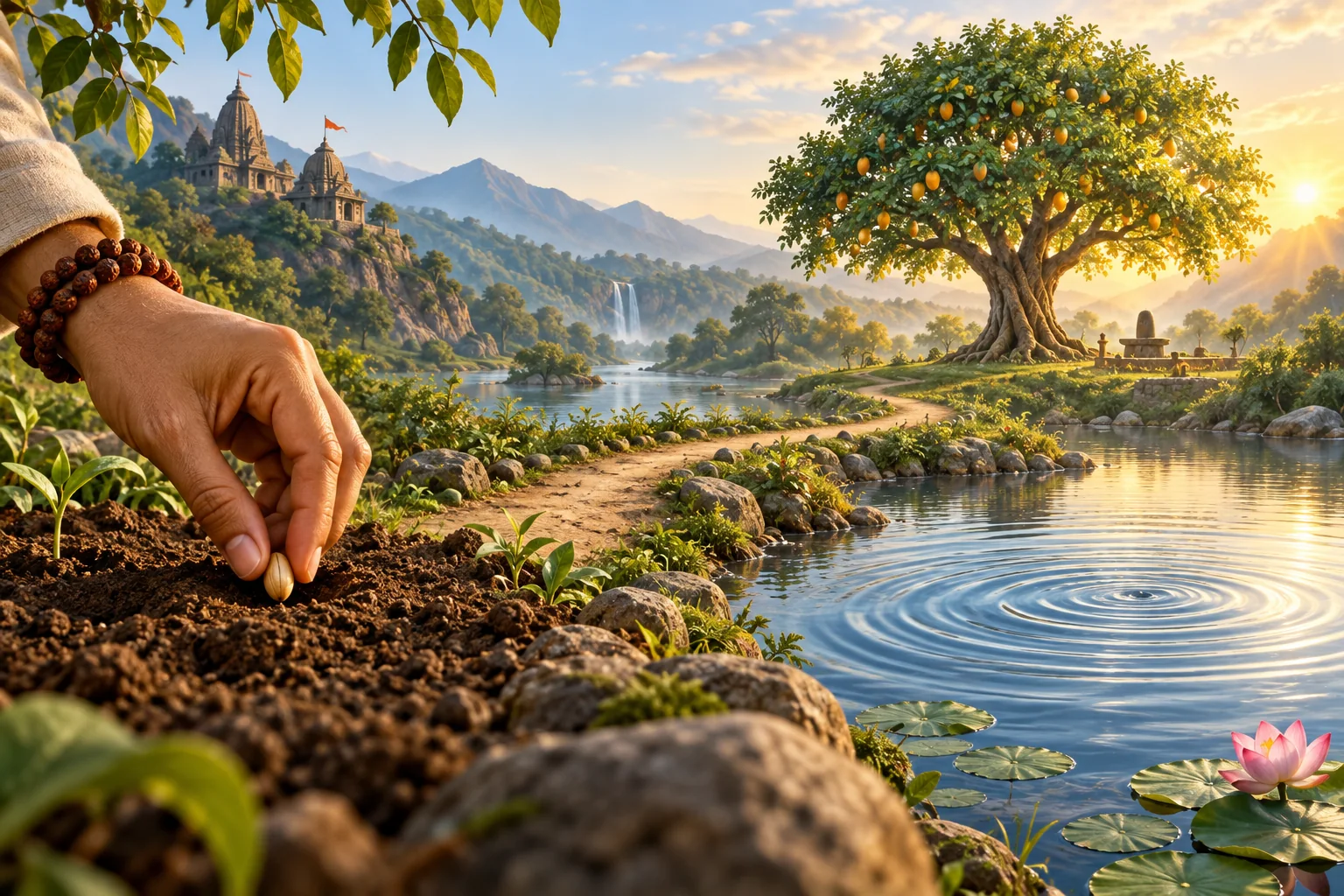
A common misreading treats karma as a cosmic scorekeeper doling out punishment and reward. Classical Hindu philosophy describes something closer to a natural law: actions generate consequences the way a seed generates a particular kind of plant — not because a judge decided so, but because that is how the process works.
Intention matters within this framework. An action done with care, honesty, and concern for others is understood to carry a different weight from the same outward act done with cruelty or greed. Karma is therefore less about external behaviour alone and more about the whole movement of will, intention, and deed. This shifts karma from “something that happens to you” to “something you are continuously creating.”
Karma and the cycle of rebirth
Karma is closely tied to samsara, the cycle of birth, death, and rebirth. Accumulated karma is traditionally understood to shape the circumstances of future lives, not just events within a single lifetime. Desire and attachment keep the cycle turning: action generates karma, karma shapes the next life, and that life generates fresh desire and action in turn.
Breaking free of this pattern entirely is the traditional goal called moksha. Karma also sits alongside dharma: dharma describes which action is right for a given person and situation, while karma describes how the results of action ripen over time.
Karma yoga: acting without attachment to results
The Bhagavad Gita offers one of the most influential teachings on how to relate to karma. Krishna’s counsel to Arjuna centres on performing right action without attachment to its fruits — see the famous verse on karma yoga, Bhagavad Gita 2.47.
This does not mean acting carelessly about outcomes. It means doing one’s duty with full effort while releasing the anxious grip on controlling results — which the Gita treats as both spiritually and practically wiser, because the grip itself produces agitation and clouded judgement. The quality of action is also described through the three gunas: action done in a calm, sattvic state binds a person less than action driven by restless craving or dull compulsion. See Bhakti, Karma, and Jnana Yoga for how this path fits alongside the Gita’s other approaches.
Frequently asked questions
Is karma the same as fate?
No. Karma describes a law of cause and effect shaped by one’s own actions, intentions, and choices, not a fixed, external fate imposed from outside. The consequences a person generates now are always within their own hands.
What does “karma yoga” mean?
The practice of performing right action without attachment to its results, a central teaching of the Bhagavad Gita. It is one of the three main paths the Gita describes, alongside devotion and knowledge.
How is karma connected to rebirth?
Traditional Hindu philosophy holds that accumulated karma shapes the circumstances of future lives within samsara, the cycle of birth and death. Liberation from that cycle is called moksha.
Does intention matter in karma?
Yes. Most classical accounts treat the intention behind an action as central — the same outward act carries different consequences depending on the care, honesty, or cruelty behind it.
Is karma unique to Hinduism?
The concept also appears, with variations, in Buddhist and Jain philosophy. The specific Hindu framing — closely tied to dharma and the Bhagavad Gita’s teaching on selfless action — has its own distinct character.