
Mantra · Krishna
Hare Krishna Maha Mantra
Last updated: August 31, 2026
The Hare Krishna Maha Mantra — Sanskrit text, meaning, origin in the Kali-Santarana Upanishad, benefits, and how to chant it correctly.
हरे कृष्ण हरे कृष्ण, कृष्ण कृष्ण हरे हरे। हरे राम हरे राम, राम राम हरे हरे॥
Hare Krishna Hare Krishna Krishna Krishna Hare Hare Hare Rama Hare Rama Rama Rama Hare Hare
Meaning
"O Hari (Krishna), O Rama!" The Maha Mantra repeats the names of Krishna and Rama alongside "Hare," a form of address to the Lord's divine energy (Hara/Radha). It is called the Maha ("great") Mantra because, according to the Kali-Santarana Upanishad, chanting these sixteen names is considered the most effective spiritual practice for the present age (Kali Yuga).
हे हरि (कृष्ण), हे राम! यह महामंत्र भगवान कृष्ण और राम के नामों की पुनरावृत्ति है, तथा भगवान की शक्ति (हरा या हरे) के प्रति समर्पण को दर्शाता है। इसे "महामंत्र" कहा जाता है क्योंकि यह कलियुग में आत्मिक उन्नति का सर्वोच्च साधन माना जाता है।
Benefits
- Considered a complete spiritual practice on its own — no other rituals are required to begin.
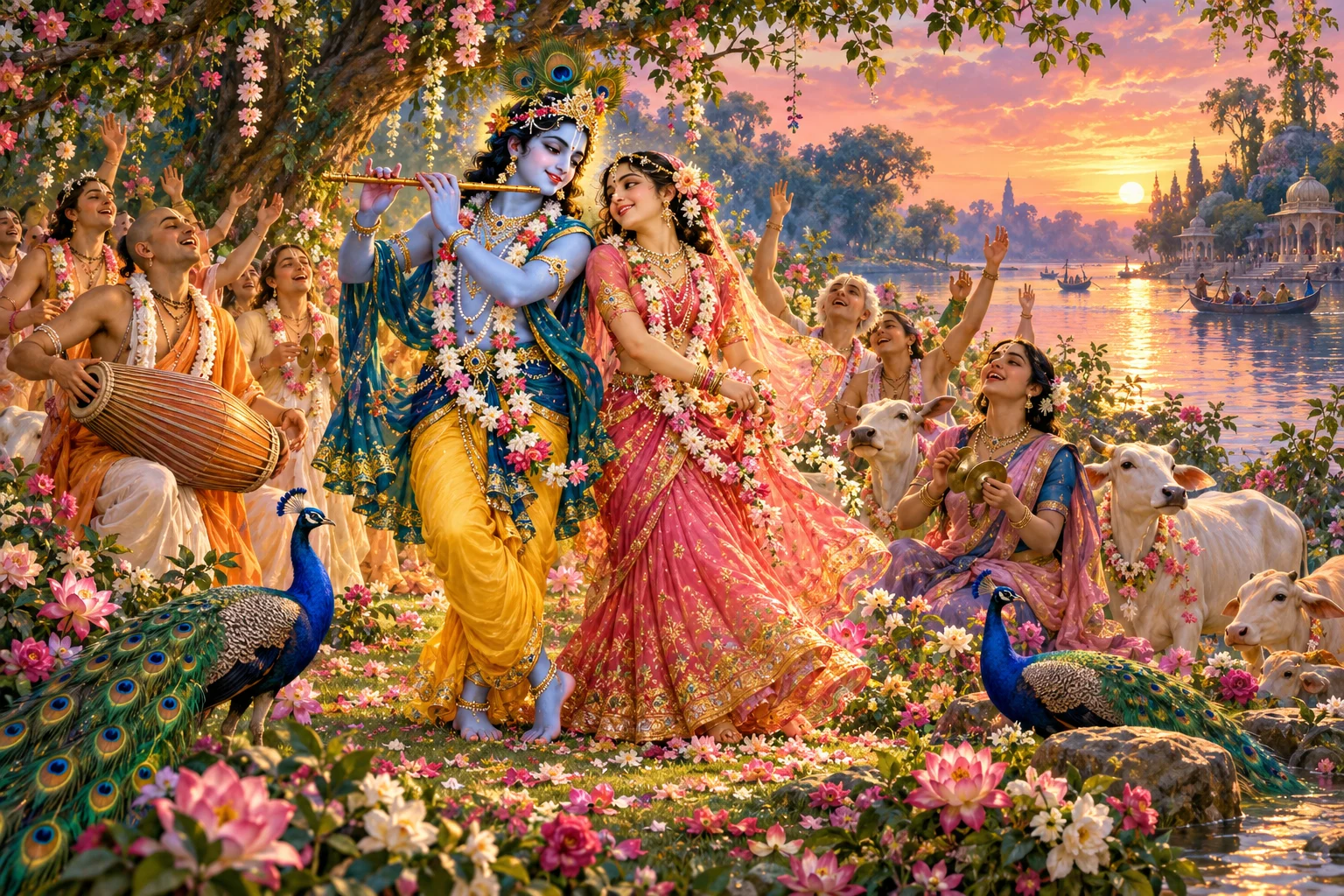
- Chanted congregationally (kirtan) as well as individually, making it central to Bhakti Yoga traditions.
- Believed to purify the mind, dissolve anxiety, and cultivate joy and devotion (bhakti).
- Open to anyone regardless of background — widely chanted by ISKCON devotees and Krishna Bhakti traditions worldwide.
How to Chant
The Maha Mantra can be chanted aloud, sung in kirtan with others, or repeated silently. Traditional practice uses a Tulsi mala of 108 beads, completing at least one round daily, though devotees often aim for 16 rounds (1,728 repetitions) as a full daily practice. Unlike many mantras, there are no strict rules about time or place — it can be chanted anywhere, at any time.
Recommended count: 108 times (1 mala) daily, or more for a full practice
Origin
The Hare Krishna Maha Mantra comes from the Kali-Santarana Upanishad and was popularized widely by Sri Chaitanya Mahaprabhu in 16th-century Bengal, who taught congregational chanting (sankirtan) as the primary spiritual practice for the age of Kali Yuga. In the 20th century, A.C. Bhaktivedanta Swami Prabhupada brought the mantra to a global audience through the International Society for Krishna Consciousness (ISKCON).
Word-by-word breakdown
| Sanskrit | Meaning |
|---|---|
| Hare | O divine energy of the Lord (vocative form of Hara) |
| Krishna | The all-attractive one, an avatar of Vishnu |
| Rama | One who gives pleasure/joy; also an avatar of Vishnu |
The sixteen-word mantra is simply these three names repeated in a fixed pattern, without any additional Sanskrit grammar to parse — the emphasis is on the sound and repetition (japa) itself, not on grammatical construction.
When it is chanted
The Maha Mantra is chanted at any time, individually with a mala or in group kirtan sessions, and is especially associated with Krishna Janmashtami, Gaura Purnima, and daily bhakti practice within Krishna-devotional and ISKCON communities worldwide.
How to chant the Hare Krishna Maha Mantra
You can chant aloud, sing it in kirtan with others, or repeat it silently. Traditional practice uses a Tulsi mala of 108 beads, completing at least one round a day; committed devotees aim for sixteen rounds. There are no restrictions on time or place. For the reasoning behind mala counts, see why mantras are chanted 108 times, and for a simple starting routine read the guide to starting a daily mantra practice.
Related Krishna practice includes the Krishna Beej Mantra, the Krishna mantra guide, and the Krishna aarti. Because the mantra also names Rama, some devotees add the Rama Mantra.
Frequently asked questions
What does the Hare Krishna Maha Mantra mean?
It repeats three names — Hare, Krishna, and Rama — in a fixed sixteen-word pattern. “Hare” addresses the Lord’s divine energy, while Krishna and Rama are names of the same divine reality. The focus is on the sound and repetition rather than on grammar.
How many rounds of the Maha Mantra should I chant daily?
Traditions within Krishna bhakti often recommend at least one round of 108 and, for a full practice, sixteen rounds. Beginners usually start with one round and build gradually.
Do I need initiation to chant Hare Krishna?
The Maha Mantra is generally taught as open to everyone, with no ritual prerequisite to begin. If you follow a particular teacher or lineage, follow their guidance on formal practice.
Frequently Asked Questions
What does Hare Krishna Maha Mantra mean?
"O Hari (Krishna), O Rama!" The Maha Mantra repeats the names of Krishna and Rama alongside "Hare," a form of address to the Lord's divine energy (Hara/Radha). It is called the Maha ("great") Mantra because, according to the Kali-Santarana Upanishad, chanting these sixteen names is considered the most effective spiritual practice for the present age (Kali Yuga).
How many times should Hare Krishna Maha Mantra be chanted?
The traditional recommendation is 108 times (1 mala) daily, or more for a full practice.
What are the benefits of chanting Hare Krishna Maha Mantra?
Considered a complete spiritual practice on its own — no other rituals are required to begin. Chanted congregationally (kirtan) as well as individually, making it central to Bhakti Yoga traditions.