
Shani · Chalisa
Shani Chalisa
Edited by Anurag Goel
Shani Chalisa full lyrics in Hindi with English transliteration and meaning — all forty verses, how to recite this hymn to Shanidev, and when it is traditionally read, especially on Saturday.
Significance
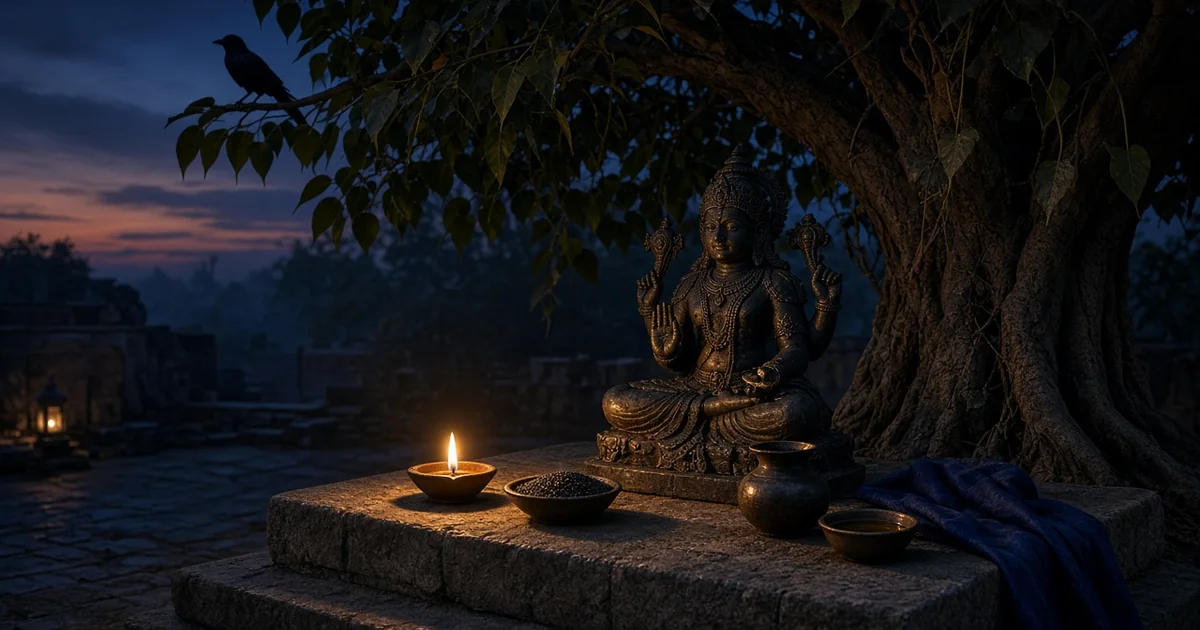
The Shani Chalisa is widely recited on Saturdays, during periods traditionally associated with Shani such as Sade Sati or Dhaiya, and on Shani Jayanti. Its tone is respectful rather than fearful: the hymn presents Shani as a strict but just teacher whose influence rewards honesty and effort. Many households read it at dusk, the time often linked with Shanidev, sometimes alongside a mustard-oil lamp and the short Shani mantra.
How to Perform
Recite after bathing, preferably on Saturday and often after sunset, facing a simple image or murti of Shani, with a lit diya. Some devotees offer water at a peepal tree on Saturday and keep a mustard-oil or sesame-oil lamp, both long associated with Shani worship. A common observance is to read the hymn daily for forty days, as the closing couplet describes. Recitation is a spiritual practice, not a substitute for medical, legal, financial or practical help, and no outcome is guaranteed.
The Shani Chalisa is a forty-verse Hindi devotional hymn to Shanidev, the deity associated with the planet Saturn. This page gives the widely recited text in Devanagari, a readable transliteration of the opening and closing couplets, and an original English meaning of each verse, written from the Hindi rather than copied from another translation. A shorter companion on themes and practice, without the full lyrics, is the Shani Chalisa meaning guide.
Opening Doha
जय गणेश गिरिजा सुवन, मंगल करण कृपाल। दीनन के दुख दूर करि, कीजै नाथ निहाल॥
Transliteration: Jaya Ganesh Girija Suvan, Mangal Karan Kripal. Dinan Ke Dukh Door Kari, Keejai Nath Nihal.
Meaning: Victory to Ganesha, son of Girija (Parvati), compassionate doer of what is auspicious. Lord, take away the sorrow of the humble and make them content.
जय जय श्री शनिदेव प्रभु, सुनहु विनय महाराज। करहु कृपा हे रवि तनय, राखहु जन की लाज॥
Transliteration: Jaya Jaya Shri Shanidev Prabhu, Sunahu Vinay Maharaj. Karahu Kripa He Ravi Tanay, Rakhahu Jan Ki Laj.
Meaning: Victory, victory to Lord Shanidev; hear this petition, O king. Be gracious, O son of the Sun, and protect the honour of your devotees.
Chaupai (Forty Verses)
जयति जयति शनिदेव दयाला। करत सदा भक्तन प्रतिपाला॥ चारि भुजा तनु श्याम विराजै। माथे रतन मुकुट छवि छाजै॥
परम विशाल मनोहर भाला। टेढ़ी दृष्टि भृकुटि विकराला॥ कुण्डल श्रवण चमाचम चमके। हिये माल मुक्तन मणि दमके॥
कर में गदा त्रिशूल कुठारा। पल बिच करैं अरिहिं संहारा॥ पिंगल कृष्णो छाया नन्दन। यम कोणस्थ रौद्र दुख भंजन॥
सौरी मन्द शनी दश नामा। भानु पुत्र पूजहिं सब कामा॥ जा पर प्रभु प्रसन्न ह्वैं जाहीं। रंकहुँ राव करैं क्षण माहीं॥
पर्वतहू तृण होई निहारत। तृणहू को पर्वत करि डारत॥ राज मिलत बन रामहिं दीन्हयो। कैकेइहुँ की मति हरि लीन्हयो॥
बनहूँ में मृग कपट दिखाई। मातु जानकी गई चुराई॥ लखनहिं शक्ति विकल करिडारा। मचिगा दल में हाहाकारा॥
रावण की गति-मति बौराई। रामचन्द्र सों बैर बढ़ाई॥ दियो कीट करि कंचन लंका। बजि बजरंग बीर की डंका॥
नृप विक्रम पर तुहि पगु धारा। चित्र मयूर निगलि गै हारा॥ हार नौलखा लाग्यो चोरी। हाथ पैर डरवायो तोरी॥
भारी दशा निकृष्ट दिखायो। तेलिहिं घर कोल्हू चलवायो॥ विनय राग दीपक महँ कीन्हयों। तब प्रसन्न प्रभु ह्वै सुख दीन्हयों॥
हरिश्चन्द्र नृप नारि बिकानी। आपहुं भरें डोम घर पानी॥ तैसे नल पर दशा सिरानी। भूंजी-मीन कूद गई पानी॥
श्री शंकरहिं गह्यो जब जाई। पारवती को सती कराई॥ तनिक विलोकत ही करि रीसा। नभ उड़ि गयो गौरिसुत सीसा॥
पाण्डव पर भै दशा तुम्हारी। बची द्रौपदी होति उघारी॥ कौरव के भी गति मति मारयो। युद्ध महाभारत करि डारयो॥
रवि कहँ मुख महँ धरि तत्काला। लेकर कूदि परयो पाताला॥ शेष देव-लखि विनती लाई। रवि को मुख ते दियो छुड़ाई॥
वाहन प्रभु के सात सुजाना। जग दिग्गज गर्दभ मृग स्वाना॥ जम्बुक सिंह आदि नख धारी। सो फल ज्योतिष कहत पुकारी॥
गज वाहन लक्ष्मी गृह आवैं। हय ते सुख सम्पत्ति उपजावैं॥ गर्दभ हानि करै बहु काजा। सिंह सिद्धकर राज समाजा॥
जम्बुक बुद्धि नष्ट कर डारै। मृग दे कष्ट प्राण संहारै॥ जब आवहिं प्रभु स्वान सवारी। चोरी आदि होय डर भारी॥
तैसहि चारि चरण यह नामा। स्वर्ण लौह चाँदी अरु तामा॥ लौह चरण पर जब प्रभु आवैं। धन जन सम्पत्ति नष्ट करावैं॥
समता ताम्र रजत शुभकारी। स्वर्ण सर्व सुख मंगल भारी॥ जो यह शनि चरित्र नित गावै। कबहुं न दशा निकृष्ट सतावै॥
अद्भुत नाथ दिखावैं लीला। करैं शत्रु के नशि बलि ढीला॥ जो पण्डित सुयोग्य बुलवाई। विधिवत शनि ग्रह शांति कराई॥
पीपल जल शनि दिवस चढ़ावत। दीप दान दै बहु सुख पावत॥ कहत राम सुन्दर प्रभु दासा। शनि सुमिरत सुख होत प्रकाशा॥
Closing doha
पाठ शनिश्चर देव को, कीन्हों विमल तैयार। करत पाठ चालीस दिन, हो भवसागर पार॥
Transliteration: Path Shanischara Dev Ko, Kinhon Vimal Taiyar. Karat Path Chalis Din, Ho Bhavasagar Par.
Meaning: This recitation of Shanischara Deva has been prepared in a pure form. The hymn says that whoever recites it for forty days crosses the ocean of worldly existence.
Some digital editions, including the Sanskrit Documents file, add a second closing couplet after this doha, presenting the hymn as a simple retelling of a praise once offered by King Dasharatha. That couplet is not in the Drik Panchang text used as a second witness here, so it is noted rather than mixed into the reading text.
English meaning, verse by verse
- Victory, victory to compassionate Shanidev, who always protects and sustains his devotees.
- He shines with four arms and a dark body; a jewelled crown is splendid on his brow.
- His forehead is broad and handsome; his glance is oblique and his eyebrows fierce.
- Earrings flash at his ears; a garland of pearls and gems glows on his chest.
- In his hands are a mace, a trident and an axe; in an instant he destroys an adversary.
- Pingala, Krishna, son of Chaya, Yama, Konastha, Raudra and Duhkha-bhanjana — these are among his names.
- Sauri, Manda and Shani: ten names in all. As the son of the Sun he is worshipped for the fulfilment of aims.
- On whom the Lord becomes pleased, he makes a pauper a king in a moment.
- He can look at a mountain and make it a blade of grass, and turn a blade of grass into a mountain.
- He gave Rama the kingdom and then the forest; he took away Kaikeyi’s (right) mind.
- In the forest a deceptive deer was shown, and Mother Janaki was carried away.
- Lakshmana was struck and distressed by the shakti-weapon, and a great outcry arose in the army.
- Ravana’s mind and course went astray, and he increased his enmity with Ramachandra.
- He turned golden Lanka to insects; then the drum of Bajrang Bali (Hanuman) was sounded.
- He set his foot on King Vikrama; a painted peacock swallowed the necklace.
- The naulakha necklace was thought stolen; hands and feet were made to tremble and were (nearly) broken.
- He showed a very harsh period; he had him work an oil-press in an oilman’s house.
- A petition was made in the raga Deepak; then the Lord was pleased and gave happiness.
- King Harishchandra’s wife was sold, and he himself filled water at a Dom’s house.
- In the same way a period came upon Nala; a fried fish jumped back into the water.
- When he went and took hold of Lord Shankara, he caused Parvati to become a sati.
- At a mere glance, in anger, the head of Gauri’s son flew into the sky.
- Your period came upon the Pandavas; Draupadi was saved when she was being disrobed.
- He also struck down the Kauravas’ mind and course, and brought about the great Mahabharata war.
- He put the Sun in his mouth at once and, taking him, leapt down to the nether world.
- The remaining gods, seeing this, made a petition, and the Sun was released from his mouth.
- The Lord’s vehicles are seven and well known: the world-elephant, the donkey, the deer and the dog,
- the jackal, the lion and other clawed creatures; astrology proclaims the fruits of these.
- When he rides the elephant, Lakshmi comes to the house; from the horse arise happiness and prosperity.
- The donkey brings loss in many works; the lion accomplishes kingship and royal assembly.
- The jackal destroys intelligence; the deer gives suffering and may take life.
- When the Lord comes riding the dog, there is great fear of theft and the like.
- Likewise there are four ‘feet’ (phases) by these names: gold, iron, silver and copper.
- When the Lord comes on the iron foot, wealth, people and property are destroyed, the hymn says.
- The copper and silver (feet) are equally auspicious; the gold (foot) brings all happiness and great blessing.
- Whoever sings this account of Shani daily is never tormented by a harsh period, the hymn says.
- The wondrous Lord shows his play; he loosens the strength of the enemy.
- If a worthy, qualified pandit is called and Shani-graha shanti is performed according to rule,
- and if water is offered to the peepal on Saturday and lamps are given in charity, much happiness is obtained, the hymn says.
- So says Ram Sundar, the Lord’s servant: remembering Shani, the light of happiness arises.
Text and sources
The Hindi here follows the widely recited recension of the Shani Chalisa that names Ram Sundar Dasa in the last chaupai, as given in the Sanskrit Documents edition (shrii shani chaaliisaa, file shani40, last updated 13 March 2015). It was cross-checked against the Devanagari text published by Drik Panchang. The two opening dohas, the forty chaupais on Shani’s form, names, well-known episodes, vehicles and phases, the author’s name in the last chaupai, and the closing couplet on a forty-day recitation are shared across these witnesses.
A few typographical and wording differences are worth knowing. The Sanskrit Documents file has encoding slips such as क्शण for क्षण, लषणहिं for लखनहिं, and लक्श्मी for लक्ष्मी; those are corrected here to the readings confirmed by Drik Panchang. Drik Panchang itself has a clear slip in the vehicle line (हय दिग्ज for जग दिग्गज) and prints चाँजी where the digital file and other recensions have चाँदी or चाँदि; the sense is silver, so चाँदी is used. Other small variants include तेलिहिं / तेलहिं, विलोकत / वोलोकत, मंगल भारी / मंगल कारी, and नशि / नशिब. The closing doha is printed here as Drik Panchang and the sense of the Sanskrit Documents line after its damaged quotation marks around विमल are reconciled: कीन्हों विमल तैयार. Some popular booklets read भक्त in place of विमल. A second closing couplet about Dasharatha and a writer named Lalita appears in the Sanskrit Documents file but not in Drik Panchang, and is therefore kept only as a note. Some booklets also print a Shani aarti immediately after the Chalisa; that aarti is a separate composition and is not mixed into this page.
The English meanings on this page are original to VedicVani, written from the Hindi, and are not taken from any published translation of the hymn. The episodes named in the middle verses are given only as the hymn states them, not as independently dated history.
How to recite the Shani Chalisa
Choose a quiet time when you can read without rushing, often Saturday evening. Sit facing a simple image or murti of Shani if you have one, light a diya, and read the forty verses slowly enough that the sound can settle. Beginners often keep the Hindi, a transliteration and the English meaning side by side for a few weeks, then return to the Devanagari as pronunciation grows steadier. Many households offer water at a peepal tree on Saturday and keep a mustard-oil or sesame-oil lamp. The closing couplet describes a forty-day daily recitation. The short Shani Mantra and the guide to Shani mantra meaning and practice are natural companions. In 2026, Saturday, 21 November is Shani’s weekday and also Tulsi Vivah. For how a chalisa sits beside an aarti or a mantra, see aarti, chalisa and mantra explained.
Meaning and traditional benefits
Devotees turn to the Shani Chalisa for a complete, memorable praise of Shanidev as a just and demanding teacher rather than only as a planet to be feared. The hymn’s own language speaks of protection for devotees, the correction of pride, Saturday peepal worship, the gift of lamps, and a forty-day path. Those statements belong to the devotional tradition of the poem; they are not a substitute for care, medicine, livelihood, legal help or practical judgement, and no result is promised.
Overall Meaning
The Shani Chalisa is a forty-verse Hindi hymn in praise of Shanidev, the deity associated with the planet Saturn and with discipline, patience and justice. It opens by honouring Ganesha and then asking the Sun's son to hear the devotee's petition. The chaupais describe his form and names, tell well-known episodes in which his period is said to have touched Rama, Vikramaditya, Harishchandra, Nala, Shiva's household, the Pandavas and the Sun himself, and then explain the fruits traditionally linked with his seven vehicles and four 'feet' or phases. It closes with a phalashruti on daily recitation, Saturday peepal worship and a forty-day path, in the name of Ram Sundar Dasa.
Frequently Asked Questions
What is the meaning of Shani Chalisa?
The Shani Chalisa is a forty-verse Hindi hymn in praise of Shanidev, the deity associated with the planet Saturn and with discipline, patience and justice. It opens by honouring Ganesha and then asking the Sun's son to hear the devotee's petition. The chaupais describe his form and names, tell well-known episodes in which his period is said to have touched Rama, Vikramaditya, Harishchandra, Nala, Shiva's household, the Pandavas and the Sun himself, and then explain the fruits traditionally linked with his seven vehicles and four 'feet' or phases. It closes with a phalashruti on daily recitation, Saturday peepal worship and a forty-day path, in the name of Ram Sundar Dasa.
Why is Shani Chalisa significant?
The Shani Chalisa is widely recited on Saturdays, during periods traditionally associated with Shani such as Sade Sati or Dhaiya, and on Shani Jayanti. Its tone is respectful rather than fearful: the hymn presents Shani as a strict but just teacher whose influence rewards honesty and effort. Many households read it at dusk, the time often linked with Shanidev, sometimes alongside a mustard-oil lamp and the short Shani mantra.
When should the Shani Chalisa be recited?
Saturday is the traditional day, and many people also read it during Sade Sati, Dhaiya or other periods associated with Shani, and on Shani Jayanti. In 2026, Saturday 21 November is Shani's weekday and also Tulsi Vivah. Dusk or evening is a common time. A beginner may still recite it respectfully on another day.
Who wrote the Shani Chalisa?
The last chaupai names Ram Sundar Dasa (Ram Sundar, the Lord's servant). The hymn is traditionally attributed to him. A firm, independently dated biography is not part of the text itself, and printed copies can differ in small wording.
How many verses are in the Shani Chalisa?
Forty chaupais, plus opening dohas and a closing doha. That is the same 'chalis' structure as other well-known chalisas. Some booklets also print a Shani aarti after the hymn; that aarti is a separate composition.
Is the Shani Chalisa a replacement for Shani graha shanti?
No. The hymn itself mentions calling a qualified pandit and performing Shani-graha shanti according to rule, alongside Saturday peepal worship and the gift of lamps. Reciting the Chalisa is a devotional reading, not a substitute for medical, legal or financial advice, or for a family or temple rite you have been asked to keep.