
🪔 Hindu Concepts
Aarti vs Chalisa vs Mantra: What's the Difference?
Last updated: August 31, 2026
Three words you hear constantly in Hindu worship — but what actually separates a mantra from an aarti from a chalisa? Here's a clear breakdown.
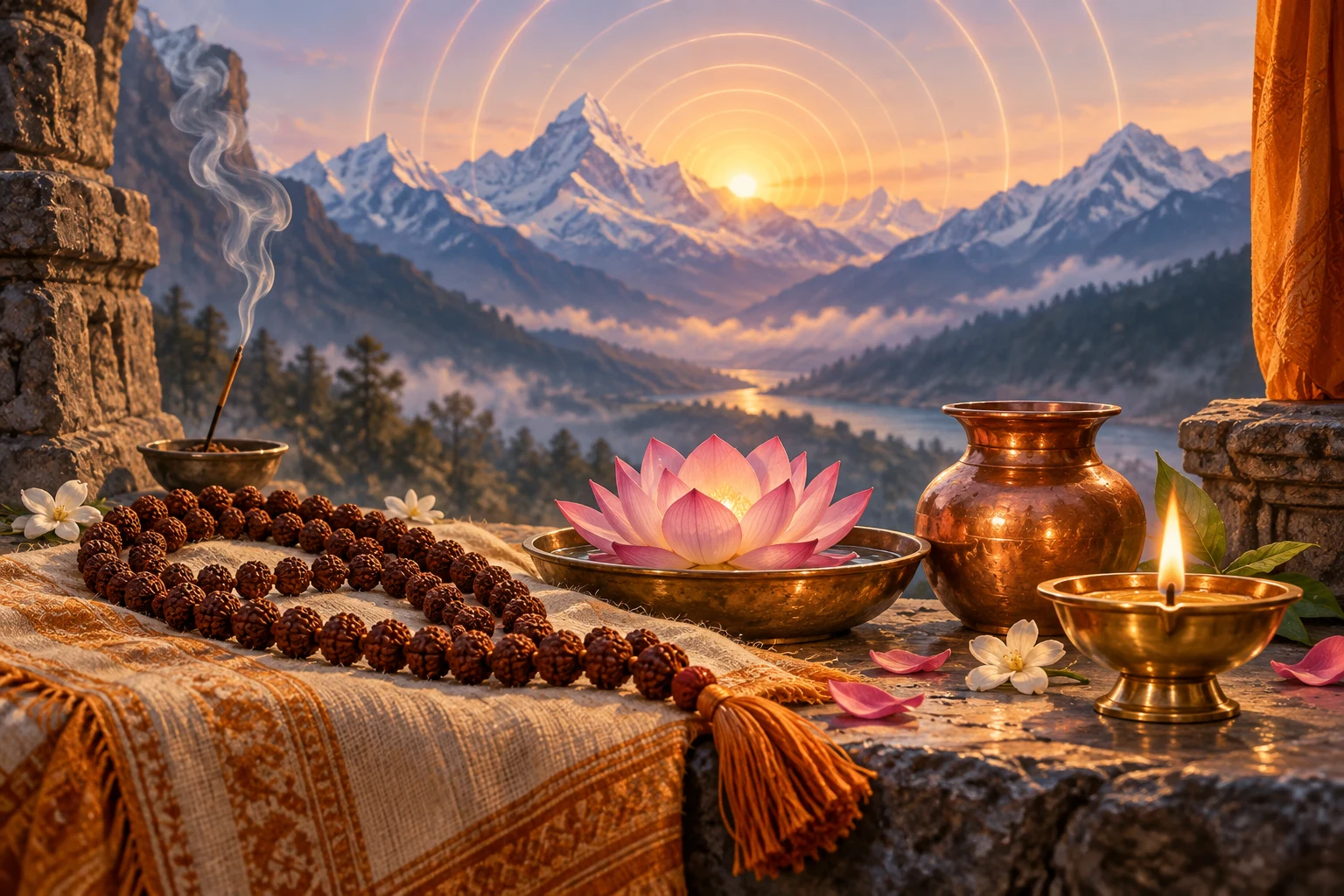
If you’ve spent any time around Hindu worship, you’ve heard all three words — mantra, aarti, chalisa — often used almost interchangeably. They’re related, but they’re not the same thing, and knowing the difference makes it much easier to understand what’s actually happening during a puja.
Mantra: the shortest unit
A mantra is a sacred sound, syllable, or short verse — anywhere from a single beej (seed) syllable like Om to a full Vedic verse like the Gayatri Mantra. Mantras are usually repeated (japa), often counted on a mala of 108 beads. They’re not “sung” in the performance sense — they’re recited, chanted, or silently repeated, and the emphasis is on sound and repetition rather than melody or narrative.
Think of a mantra as the smallest building block: a few words, repeated many times.
Aarti: the closing ritual
An aarti is a short devotional song sung while a lit diya (oil lamp) is circled in front of a deity’s image or idol — almost always at the end of a puja, not the beginning. Om Jai Jagdish Hare and Om Jai Shiv Omkara are two of the most widely sung examples. Aartis are melodic and communal — they’re meant to be sung together, often with a bell and clapping, and they mark the completion of worship, not a meditative practice.
Think of an aarti as a short song performed once, at a specific ritual moment.
Chalisa: the long-form hymn
A chalisa (from chalis, meaning “forty”) is a longer devotional hymn — traditionally forty verses — composed in praise of a single deity’s qualities, deeds, and power. The Hanuman Chalisa, written by the poet-saint Tulsidas, is the most famous example. Unlike an aarti, a chalisa isn’t tied to a specific ritual moment — it’s recited on its own, often daily, or especially on the deity’s designated day of the week (Tuesdays and Saturdays for Hanuman, for example).
Think of a chalisa as a complete devotional biography in verse — much longer than a mantra, and usually recited rather than sung with a lamp.
How they fit together
A typical home puja might actually use all three in sequence:
- Mantra — a short invocation is chanted to begin, such as a beej mantra for the deity being worshipped.
- Chalisa (optional) — a longer hymn like the Hanuman Chalisa may be recited as the main devotional act.
- Aarti — the puja closes with an aarti, lamp circled, marking the end of the ritual.
None of the three is “more important” than the others — they serve different purposes: mantras for repetition and focus, chalisas for extended devotional recitation, and aartis for closing a ceremony with communal song.
Where to start
If you’re new to any of this, the simplest entry point is a short mantra — try Om Namah Shivaya or the Gayatri Mantra. From there, the Hanuman Chalisa is a natural next step, and any of the aartis work well as a closing practice once you’re ready to build a fuller daily routine. See also the aarti and chalisa guide, what is a beej mantra, and the guide to starting a daily mantra practice.
Frequently asked questions
What is the main difference between a mantra, an aarti, and a chalisa?
A mantra is a short sound or verse repeated many times for focus. An aarti is a melodic song sung once while circling a lamp, usually to close a puja. A chalisa is a longer hymn, traditionally forty verses, praising one deity and recited on its own.
Can you use a mantra, chalisa, and aarti in the same puja?
Yes. A common sequence is a short opening mantra, then a chalisa as the main recitation, and an aarti to close the ceremony.
Is a chalisa a type of mantra?
No. A chalisa is a devotional poem of praise, usually recited rather than repeated in counted rounds. A mantra is a shorter unit whose power is understood to lie in repetition of its sound.
Which should a beginner learn first?
A short mantra such as Om Namah Shivaya or the Gayatri Mantra is the easiest starting point, with a chalisa and aarti added later as a routine develops.