
🌐 Deities
Bhuvaneshwari: The Goddess of the Universe, Her Story, Form and Mantra
Bhuvaneshwari, 'queen of the worlds', is the fourth of the ten Mahavidyas: the goddess who is space itself. Here is her story, her form, her seed mantra Hreem and where she is worshipped.
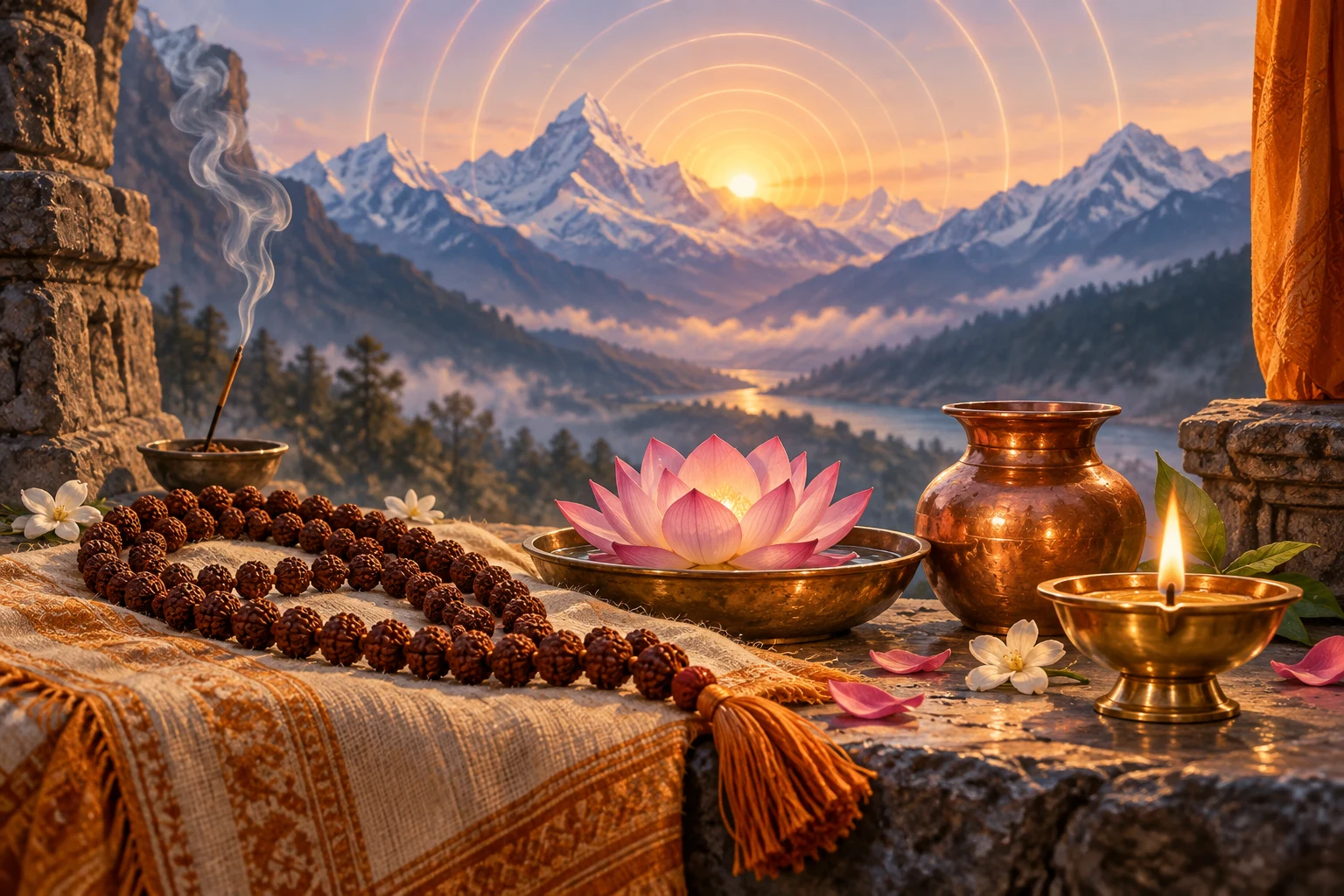
Bhuvaneshwari (भुवनेश्वरी, “queen of the worlds”) is the fourth of the ten Mahavidyas, the wisdom goddesses of Shakta Tantra. She is the Divine Mother as space itself, who holds and rules the universe. Radiant like the rising sun, she carries a noose and goad and shows gestures of blessing and fearlessness. Her seed mantra is Hreem.
Where some Mahavidyas are fierce, Bhuvaneshwari is serene and nurturing: the vast, open mother in whom all things find room.
Bhuvaneshwari at a glance
| Also spelled | Bhuvaneswari, Bhubaneswari |
| Meaning | Bhuvana (worlds) + Ishvari (queen, ruler) |
| Group | Fourth of the ten Mahavidyas |
| Element | Space (akasha) |
| Holds | Noose (pasha) and goad (ankusha); varada and abhaya mudras |
| Complexion | Golden-red, like the rising sun |
| Beej mantra | Hreem (ह्रीं) |
| Abode | Manidvipa, the jewelled island (Devi Bhagavata Purana) |
| Jayanti | Bhadrapada Shukla Dwadashi |
Bhuvaneshwari among the Mahavidyas
The Das Mahavidya are ten forms of the Divine Mother: Kali, Tara, Tripura Sundari, Bhuvaneshwari, Bhairavi, Chinnamasta, Dhumavati, Bagalamukhi, Matangi and Kamala. The order varies by text.
Kali is often said to represent time, and Bhuvaneshwari space — together, the frame within which everything exists. Bhuvaneshwari is also closely linked with Tripura Sundari: in Sri Vidya, she is sometimes described as the form Lalita takes when she manifests the world.
The story of Bhuvaneshwari
Creation of the worlds
One account tells that before creation there was only the Sun. The rishis offered soma to it, and Shakti arose as Bhuvaneshwari, creating the three worlds. In this sense her name is literal: she brings the worlds (bhuvanas) into being and then rules them.
The Devi Bhagavata Purana and Manidvipa
The Devi Bhagavata Purana, a major Shakta scripture, presents Bhuvaneshwari as the supreme goddess. In its third book, Brahma, Vishnu and Shiva are carried in a celestial chariot to a jewelled island, Manidvipa, beyond all worlds. There they see the goddess enthroned. As they approach, the three gods find themselves transformed into women, serving her. Humbled, they understand that their own powers of creation, preservation and destruction come from her, and sing her praise. The Purana describes Manidvipa in rich detail as her eternal abode.
Iconography and symbolism
| Element | Common interpretation |
|---|---|
| Rising-sun complexion | Dawn of creation; warmth, life and light |
| Noose (pasha) | Her power to bind beings in the world through attachment — and to draw them to her |
| Goad (ankusha) | Her power to guide and correct; to free beings from what binds them |
| Varada and abhaya mudras | Granting boons and removing fear |
| Crescent moon on the crown, three eyes | Shared with Shiva; time, insight and transcendence |
| Full, nurturing form | The mother who sustains the world |
Many teachers connect her with space in a meditative sense. Just as space makes room for everything without being changed by it, Bhuvaneshwari invites the practitioner into a spacious, open awareness — beyond the cramped boundaries of ego.
Hreem: the Bhuvaneshwari beej mantra
Bhuvaneshwari’s seed syllable is Hreem (ह्रीं), sometimes called the Maya beej, because it is linked with maya, the power by which the one reality appears as the many. Hreem appears in many Devi mantras, including in the Lalita tradition.
A simple, widely used devotional mantra is:
Om Hrīṁ Bhuvaneśvaryai Namaḥ
Longer Tantric mantras and sadhanas of Bhuvaneshwari are traditionally received through initiation (diksha) from a qualified guru. Lay devotees often simply chant the short mantra with a lamp and red flowers, or recite a stotra. For background, see what is a beej mantra.
Bhuvaneshwari temples
- Kamakhya, Assam — the Bhuvaneshwari temple sits at the very top of Nilachal hill, above the main Kamakhya shrine, among the Mahavidya temples of this great Shakti Peeth.
- Mysore Palace, Karnataka — the palace complex has a Bhuvaneshwari temple, and the goddess is closely linked with the former royal family.
- Gondal, Gujarat — the Bhuvaneshwari Peeth is a well-known Shakta centre.
- Pudukkottai, Tamil Nadu — the Bhuvaneswari temple is associated with the Avadhoota Vidya Peetham.
In Karnataka, the state is personified as Kannada Bhuvaneshwari, whose image is honoured on Kannada Rajyotsava (1 November) — a cultural rather than strictly Tantric form of the goddess.
A simple meditation on Bhuvaneshwari
Many teachers suggest a short contemplation suitable for anyone. Sit quietly, breathe slowly and become aware of the space around you — the room, the sky beyond it, the space between the stars. Then notice the space within: between thoughts, between breaths. Rest in that openness and silently repeat Hreem or Om Hreem Bhuvaneshwaryai Namah for a few minutes. The aim is not to visualise anything elaborate but to feel held within a vast, kind presence. This is a devotional practice, not a Tantric sadhana, and needs no initiation.
Worship and Jayanti
Bhuvaneshwari Jayanti falls on Bhadrapada Shukla Dwadashi, usually in August or September. Devotees offer red flowers, kumkum, sweets and a ghee lamp, and chant her mantra. She is also worshipped during Navratri as one of the forms of the Devi.
Why Bhuvaneshwari matters
Bhuvaneshwari offers a quiet but profound image of the divine: not a distant ruler, but the very space in which we live and breathe. To worship her is to recognise that everything — every person, every experience — is held within the Mother, and to let one’s own heart become as spacious as hers.
Frequently Asked Questions
Who is Bhuvaneshwari?
Bhuvaneshwari is a Hindu goddess and the fourth of the ten Mahavidyas. Her name means 'queen of the worlds'. She is understood as the Divine Mother who is space itself, containing and ruling the whole universe, and is shown radiant like the rising sun, holding a noose and goad.
What is Bhuvaneshwari's mantra?
Her seed (beej) mantra is Hreem (ह्रीं), often called the Maya beej or Bhuvaneshwari beej. A simple devotional form is 'Om Hreem Bhuvaneshwaryai Namah'. Fuller Tantric mantras of the goddess are traditionally received through initiation from a guru.
What is Bhuvaneshwari the goddess of?
She is the goddess of space (akasha) and of the manifest universe. Devotees see her as the mother who gives everything room to exist, and pray to her for expansiveness, abundance, beauty and freedom from a narrow sense of self.
Is Bhuvaneshwari the same as Parvati?
In Shakta theology all the Mahavidyas are forms of the one Devi, so Bhuvaneshwari is ultimately one with Parvati, Durga and Lalita. In the Devi Bhagavata Purana she is the supreme goddess herself, ruling from the jewelled island of Manidvipa.
When is Bhuvaneshwari Jayanti?
Bhuvaneshwari Jayanti is observed on Bhadrapada Shukla Dwadashi, the twelfth day of the bright half of Bhadrapada, which usually falls in August or September.
Where is the Bhuvaneshwari temple?
Well-known shrines include the Bhuvaneshwari temple on Nilachal hill at Kamakhya in Assam, the Bhuvaneshwari temple in the Mysore Palace complex in Karnataka, the Bhuvaneshwari Peeth at Gondal in Gujarat, and the Bhuvaneswari temple at Pudukkottai in Tamil Nadu.