
🔱 Practice Guides
Kalabhairava Ashtakam: Sanskrit Lyrics, Transliteration and Meaning
The Kalabhairava Ashtakam is an eight-verse hymn to Kaal Bhairav, traditionally attributed to Adi Shankaracharya. Here is the Sanskrit, a clear transliteration and the meaning of each verse.
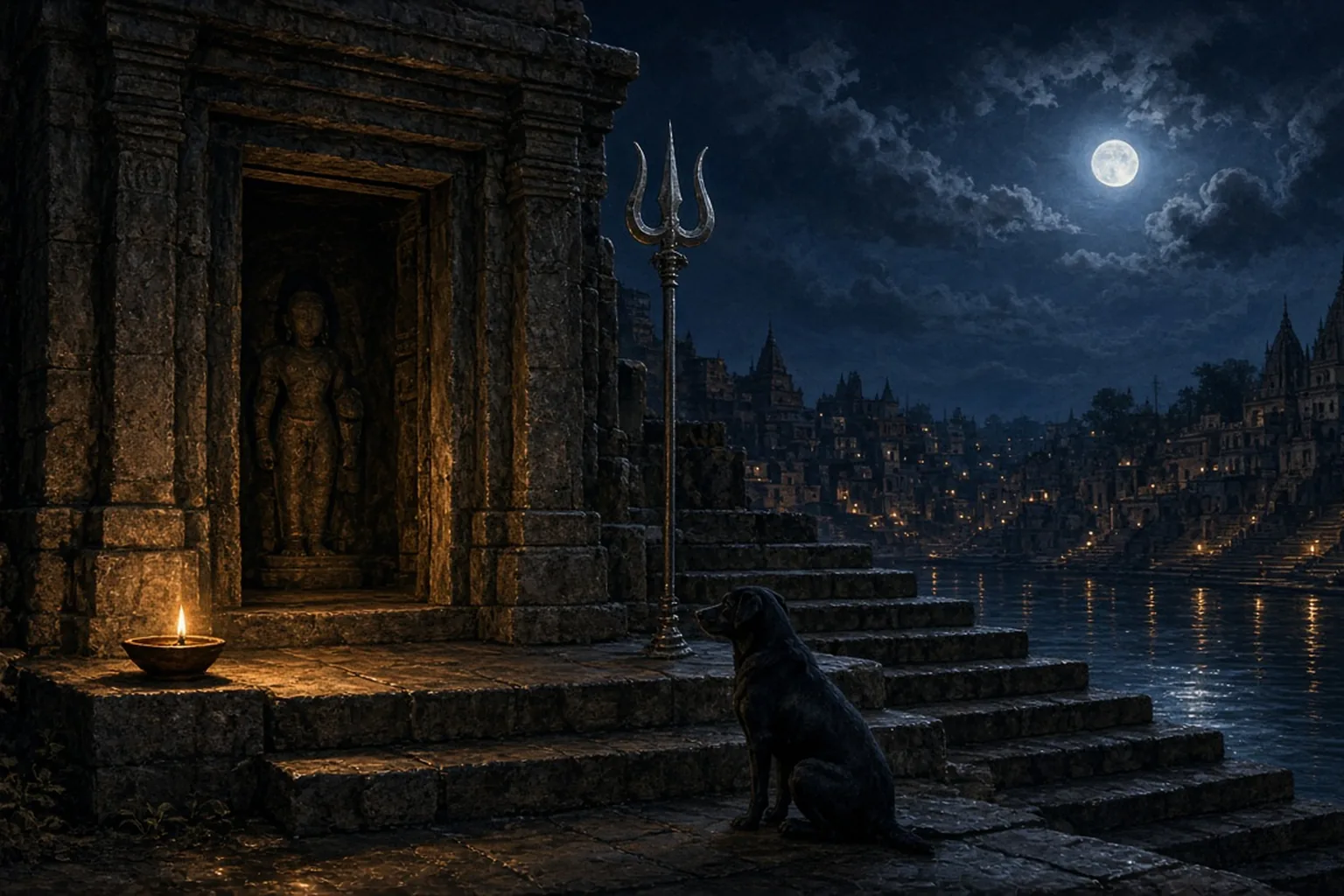
The Kalabhairava Ashtakam is an eight-verse Sanskrit hymn to Kaal Bhairav, the fierce form of Shiva who rules time and guards Kashi (Varanasi). It is traditionally attributed to Adi Shankaracharya. Each verse names a quality of Bhairava — his compassion, his weapons, his dance, his care for devotees — and ends with the same refrain: kāśikāpurādhinātha kālabhairavaṃ bhaje, “I worship Kalabhairava, lord of the city of Kashi.”
Search interest in the hymn rises through November and December, ahead of Kaal Bhairav Jayanti on Tuesday, 1 December 2026. This page gives the widely recited Sanskrit, a letter-by-letter transliteration, and an original English meaning of each verse, written from the Sanskrit rather than copied from another translation.
How the hymn is traditionally recited
Choose a quiet time, often Sunday evening or the Krishna Ashtami of the month. Light a mustard-oil lamp before an image of Bhairava if you have one, sit facing it, and recite the eight verses slowly enough that the refrain can settle. Feeding a dog afterwards is a common act of devotion, since the dog is Bhairava’s companion. The hymn is short enough to learn by heart over a few weeks.
A fuller note on temples, mantra and Jayanti worship is on the Kaal Bhairav page. Dates for the rest of the month are in Hindu festivals in December 2026. Recitation is a spiritual practice, not a substitute for medical, legal or practical help.
The eight verses
Verse 1
देवराजसेव्यमानपावनांघ्रिपङ्कजं व्यालयज्ञसूत्रमिन्दुशेखरं कृपाकरम् । नारदादियोगिवृन्दवन्दितं दिगंबरं काशिकापुराधिनाथकालभैरवं भजे ॥१॥
Transliteration: devarāja-sevyamāna-pāvanāṅghri-paṅkajaṃ vyāla-yajñasūtram indu-śekharaṃ kṛpākaram | nāradādi-yogi-vṛnda-vanditaṃ digambaraṃ kāśikā-purādhinātha-kālabhairavaṃ bhaje ||1||
Meaning: I worship Kalabhairava, lord of Kashi, whose purifying lotus feet are served by Indra, king of the gods; who wears a serpent as his sacred thread and the moon as his crown; who is compassionate; who is praised by Narada and hosts of yogis; and who is sky-clad.
Verse 2
भानुकोटिभास्वरं भवाब्धितारकं परं नीलकण्ठमीप्सितार्थदायकं त्रिलोचनम् । कालकालमंबुजाक्षमक्षशूलमक्षरं काशिकापुराधिनाथकालभैरवं भजे ॥२॥
Transliteration: bhānu-koṭi-bhāsvaraṃ bhavābdhi-tārakaṃ paraṃ nīlakaṇṭham īpsitārtha-dāyakaṃ trilocanam | kāla-kālam ambujākṣam akṣa-śūlam akṣaraṃ kāśikā-purādhinātha-kālabhairavaṃ bhaje ||2||
Meaning: I worship Kalabhairava, lord of Kashi, who shines like a crore of suns, who ferries us across the ocean of worldly life, the Supreme; blue-throated, giver of what is rightly sought, three-eyed; the Death of Time itself, lotus-eyed, who bears the axe and spear and is himself imperishable.
Verse 3
शूलटंकपाशदण्डपाणिमादिकारणं श्यामकायमादिदेवमक्षरं निरामयम् । भीमविक्रमं प्रभुं विचित्रताण्डवप्रियं काशिकापुराधिनाथकालभैरवं भजे ॥३॥
Transliteration: śūla-ṭaṅka-pāśa-daṇḍa-pāṇim ādi-kāraṇaṃ śyāma-kāyam ādi-devam akṣaraṃ nirāmayam | bhīma-vikramaṃ prabhuṃ vicitra-tāṇḍava-priyaṃ kāśikā-purādhinātha-kālabhairavaṃ bhaje ||3||
Meaning: I worship Kalabhairava, lord of Kashi, who holds the trident, axe, noose and staff; the first cause, dark-bodied, the primordial god, deathless and free from affliction; the Lord of formidable valour who delights in his wondrous tandava dance.
Verse 4
भुक्तिमुक्तिदायकं प्रशस्तचारुविग्रहं भक्तवत्सलं स्थितं समस्तलोकविग्रहम् । विनिक्वणन्मनोज्ञहेमकिङ्किणीलसत्कटिं काशिकापुराधिनाथकालभैरवं भजे ॥४॥
Transliteration: bhukti-mukti-dāyakaṃ praśasta-cāru-vigrahaṃ bhakta-vatsalaṃ sthitaṃ samasta-loka-vigraham | vinikvaṇan-manojña-hema-kiṅkiṇī-lasat-kaṭiṃ kāśikā-purādhinātha-kālabhairavaṃ bhaje ||4||
Meaning: I worship Kalabhairava, lord of Kashi, giver of both worldly wellbeing and liberation, whose form is beautiful and widely praised; who is tender toward his devotees and who stands as the very form of all the worlds; whose waist shines with charming golden bells that tinkle as he moves.
Verse 5
धर्मसेतुपालकं त्वधर्ममार्गनाशकं कर्मपाशमोचकं सुशर्मदायकं विभुम् । स्वर्णवर्णशेषपाशशोभितांगमण्डलं काशिकापुराधिनाथकालभैरवं भजे ॥५॥
Transliteration: dharma-setu-pālakaṃ tv adharma-mārga-nāśakaṃ karma-pāśa-mocakaṃ suśarma-dāyakaṃ vibhum | svarṇa-varṇa-śeṣa-pāśa-śobhitāṅga-maṇḍalaṃ kāśikā-purādhinātha-kālabhairavaṃ bhaje ||5||
Meaning: I worship Kalabhairava, lord of Kashi, who guards the bridge of dharma and destroys the path of adharma; who frees a person from the noose of karma and grants true wellbeing; the all-pervading Lord whose body is adorned with a golden serpent-noose. (Another common reading has keśapāśa, a mass of golden hair, in place of śeṣapāśa.)
Verse 6
रत्नपादुकाप्रभाभिरामपादयुग्मकं नित्यमद्वितीयमिष्टदैवतं निरंजनम् । मृत्युदर्पनाशनं करालदंष्ट्रमोक्षदं काशिकापुराधिनाथकालभैरवं भजे ॥६॥
Transliteration: ratna-pādukā-prabhā-bhirāma-pāda-yugmakaṃ nityam advitīyam iṣṭa-daivataṃ nirañjanam | mṛtyu-darpa-nāśanaṃ karāla-daṃṣṭra-mokṣadaṃ kāśikā-purādhinātha-kālabhairavaṃ bhaje ||6||
Meaning: I worship Kalabhairava, lord of Kashi, whose pair of feet is lovely with the radiance of jewelled sandals; the eternal one, without a second, the chosen deity, the stainless one; who destroys the pride of Death and who, even with his fearsome fangs, is the giver of liberation.
Verse 7
अट्टहासभिन्नपद्मजाण्डकोशसंततिं दृष्टिपातनष्टपापजालमुग्रशासनम् । अष्टसिद्धिदायकं कपालमालिकाधरं काशिकापुराधिनाथकालभैरवं भजे ॥७॥
Transliteration: aṭṭahāsa-bhinna-padmajāṇḍa-kośa-saṃtatiṃ dṛṣṭi-pāta-naṣṭa-pāpa-jālam ugra-śāsanam | aṣṭa-siddhi-dāyakaṃ kapāla-mālikā-dharaṃ kāśikā-purādhinātha-kālabhairavaṃ bhaje ||7||
Meaning: I worship Kalabhairava, lord of Kashi, whose roaring laughter splits the shells of Brahma’s cosmic eggs; whose mere glance destroys the net of sins; the stern ruler, giver of the eight siddhis, who wears a garland of skulls.
Verse 8
भूतसंघनायकं विशालकीर्तिदायकं काशिवासलोकपुण्यपापशोधकं विभुम् । नीतिमार्गकोविदं पुरातनं जगत्पतिं काशिकापुराधिनाथकालभैरवं भजे ॥८॥
Transliteration: bhūta-saṃgha-nāyakaṃ viśāla-kīrti-dāyakaṃ kāśi-vāsa-loka-puṇya-pāpa-śodhakaṃ vibhum | nīti-mārga-kovidaṃ purātanaṃ jagat-patiṃ kāśikā-purādhinātha-kālabhairavaṃ bhaje ||8||
Meaning: I worship Kalabhairava, lord of Kashi, leader of the host of beings, giver of wide-ranging glory; who purifies both the merit and the sin of those who dwell in Kashi; knower of the path of right conduct, the ancient Lord of the world.
Phalashruti (the fruit of recitation)
कालभैरवाष्टकं पठंति ये मनोहरं ज्ञानमुक्तिसाधनं विचित्रपुण्यवर्धनम् । शोकमोहदैन्यलोभकोपतापनाशनं प्रयान्ति कालभैरवांघ्रिसन्निधिं नरा ध्रुवम् ॥
Transliteration: kālabhairavāṣṭakaṃ paṭhanti ye manoharaṃ jñāna-mukti-sādhanaṃ vicitra-puṇya-vardhanam | śoka-moha-dainya-lobha-kopa-tāpa-nāśanaṃ prayānti kālabhairavāṅghri-sannidhiṃ narā dhruvam ||
Meaning: Those who recite this beautiful Kalabhairava Ashtakam — a means to knowledge and liberation, which increases many kinds of merit and destroys grief, delusion, misery, greed, anger and suffering — surely reach the presence of Kalabhairava’s feet.
Text notes
The Sanskrit above follows the widely recited recension traditionally attributed to Adi Shankaracharya, as printed in the Complete Works of Shankaracharya, Volume 18, page 89, and checked against the proofread Sanskrit Documents edition (encoded by Narayanaswami Pallasena and proofread with Sunder Hattangadi). Printed copies differ in a few words:
- Verse 4: some editions read sthiram for sthitam, and nikvaṇan for vinikvaṇan.
- Verse 5: some editions read nāśanam for nāśakam, and keśapāśa (a mass of hair) or nirmalam in the last quarter.
- Verse 6: some editions read bhūṣaṇam (“ornament”) in place of mokṣadam.
- Verse 8: some editions read kāśivāsi for kāśivāsa.
- The phalashruti sometimes swaps dainya and lobha, and some copies begin the last line with te prayānti.
A closely related hymn, with the same refrain but different wording in several verses, appears in the Shiva Rahasya (11.34.53–61), where Shiva teaches Parvati the observances of Ashtami. If you are learning the hymn by heart, stay with one printed edition or a teacher so the small differences do not unsettle the recitation.
The English meanings on this page are original to VedicVani. They aim to say plainly what the Sanskrit names, not to replace a word-for-word scholarly commentary.
Related reading
For the story of Bhairava, his mantra and Jayanti worship, see Kaal Bhairav. Other short Shiva hymns on the site include the Rudrashtakam and Om Namah Shivaya; a wider set is gathered in powerful Shiva mantras. A Hindi introduction to the deity is on the काल भैरव page.
Frequently Asked Questions
Who composed the Kalabhairava Ashtakam?
The hymn is traditionally attributed to Adi Shankaracharya, the eighth-century teacher and student of Govinda Bhagavatpada. That attribution appears in the colophon of the recension printed in the Complete Works of Shankaracharya, Volume 18. A closely related hymn is also found in the Shiva Rahasya. As with many stotras, the ascription is traditional rather than a modern historical proof.
How many verses are in the Kalabhairava Ashtakam?
Eight verses, each ending with the refrain kāśikā-purādhinātha kālabhairavaṃ bhaje, 'I worship Kalabhairava, lord of the city of Kashi.' A ninth stanza, the phalashruti, describes the fruit of reciting the hymn.
When should I recite the Kalabhairava Ashtakam?
It is traditionally recited on Sundays, on the Krishna Ashtami of each month (Kalashtami), and especially on Kaal Bhairav Jayanti. In 2026 that Jayanti falls on Tuesday, 1 December. Many devotees also recite it in the evening before a lamp.
What does the refrain of the Kalabhairava Ashtakam mean?
Each verse ends with kāśikā-purādhinātha kālabhairavaṃ bhaje: 'I worship Kalabhairava, the supreme lord of Kashi (Varanasi).' The hymn praises him as the city's guardian as well as the lord of time.
Are there different versions of the Kalabhairava Ashtakam?
Yes. Printed editions of the popular recension differ in a few words, and the Shiva Rahasya preserves a closely related but not identical text. The Sanskrit on this page follows the widely recited recension; common variants are noted in the text notes.