
🏹 Festivals
Ram Navami Story and Significance: The Birth of Lord Rama
Last updated: September 26, 2026
Ram Navami celebrates the birth of Rama, the ideal king and central hero of the Ramayana, whose life is remembered as a model of dharma.
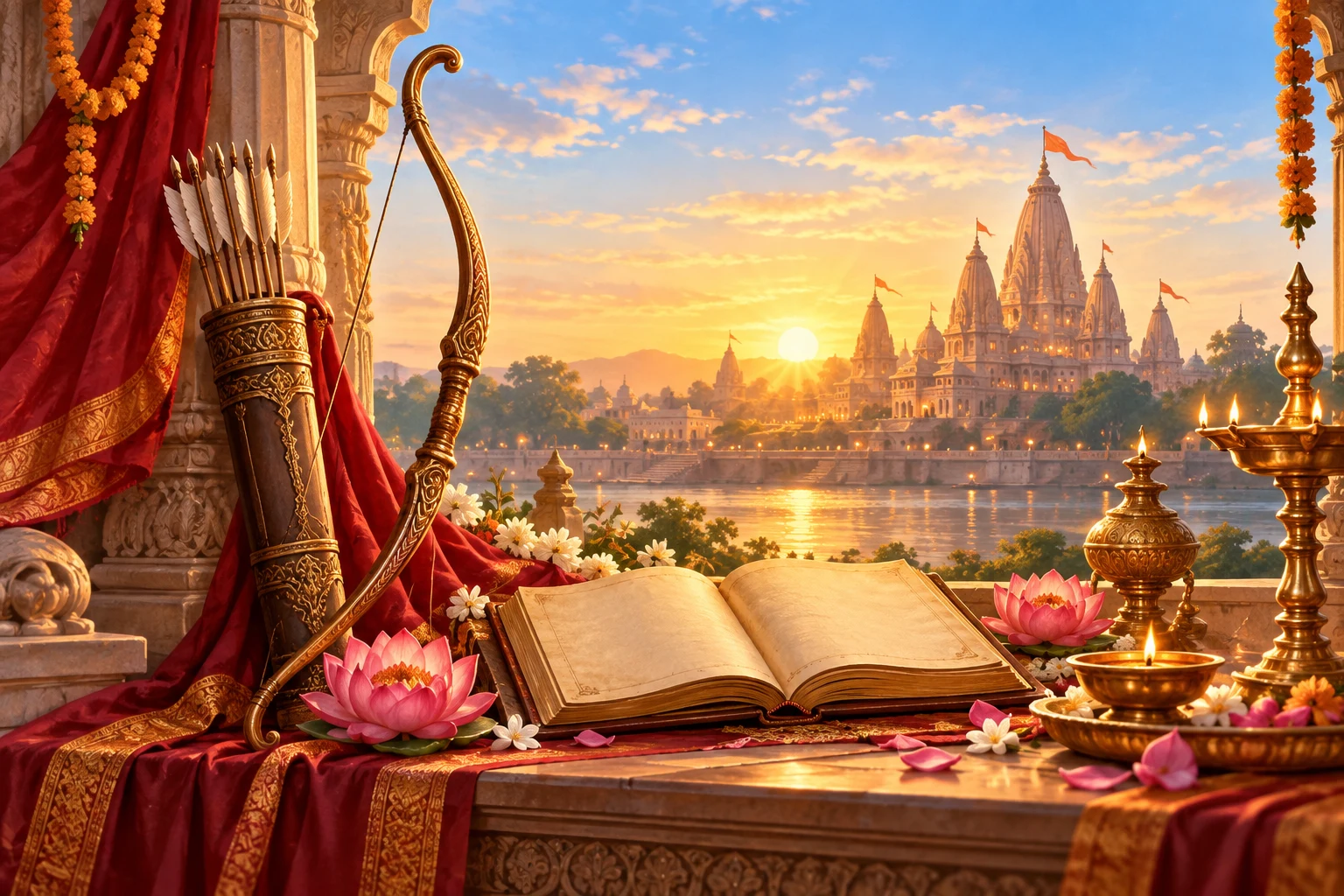
Ram Navami celebrates the birth of Rama, honoured in Vaishnava tradition as the seventh avatar of Vishnu and remembered throughout India and beyond as the central hero of the Ramayana. The festival falls on the ninth day of the bright half of Chaitra and commonly includes temple worship, recitation, devotional music, fasting, charitable giving, and processions.
Rama’s story is treasured in many textual and performance traditions. Valmiki’s Sanskrit epic, Tulsidas’s Ramcharitmanas, Kamban’s Tamil Ramavataram, regional Ramayanas, Ramlila, song, and oral storytelling may emphasize different details. Respecting this diversity gives the festival more depth than treating one version as the only one.
The story of Rama’s birth
King Dasharatha of Ayodhya longed for heirs. After a sacred rite, a consecrated offering was shared among his queens. Rama was born to Kausalya, Bharata to Kaikeyi, and Lakshmana and Shatrughna to Sumitra. Devotional tradition understands Rama’s birth as the Divine entering the world to restore dharma and confront the disorder represented by Ravana.
Many temples mark the birth around midday, but exact timing follows the local calendar. Rama’s birth is often welcomed with bells, singing, aarti, and the ceremonial bathing or adorning of an image of the infant Rama.
Rama’s journey through the Ramayana
Rama’s life moves quickly from royal promise to exile. To uphold Dasharatha’s word, he leaves Ayodhya with Sita and Lakshmana. After Ravana abducts Sita, Rama forms alliances with Sugriva and the vanara community. Hanuman crosses the ocean, finds Sita in Lanka, and becomes an enduring model of courageous service. The story of Hanuman and Rama explores that devotional relationship.
The war in Lanka ends with Ravana’s defeat and the eventual return to Ayodhya. Yet the epic is not only a victory narrative. It asks difficult questions about loyalty, kingship, family duty, justice, suffering, and the cost of public responsibility. Readers and traditions have debated these questions for centuries; respectful devotion does not require pretending they are simple.
What Ram Navami signifies
Rama is associated with maryada: ethical boundaries, restraint, and responsibility. His ideal is often expressed as maryada purushottama, one who exemplifies righteous conduct. For a modern devotee, this can mean keeping a promise, exercising authority without humiliation, telling the truth compassionately, and placing public trust above personal convenience.
The festival also joins devotion with self-examination. Rather than admiring virtue at a distance, choose one concrete practice: finish an obligation, apologise without excuses, intervene safely against unfairness, or serve someone without seeking recognition.
How Ram Navami is observed
Practices vary widely. Ayodhya hosts major celebrations and pilgrim gatherings. Some communities read the Ramayana or Ramcharitmanas continuously, sing bhajans, perform kirtan, or carry images in processions. In parts of South India, the day may also include the ceremonial wedding of Rama and Sita, known as Sita Rama Kalyanam.
Fasting is optional and tradition-specific. It should never endanger health. Children, older adults, pregnant or breastfeeding people, anyone with diabetes or an eating-disorder history, and people taking medication should avoid restrictive fasting unless appropriately advised.
A simple Ram Navami puja at home
- Clean a small prayer space and place an image of Rama, Sita, Lakshmana, and Hanuman if available.
- Offer clean water, flowers, fruit, or a simple vegetarian preparation.
- Recite the Rama mantra or listen to a familiar bhajan.
- Read a short passage from a trusted Ramayana edition and reflect on its context.
- Conclude with gratitude and share the offering as prasad.
Keep any diya on a stable surface and never leave it unattended. If attending a temple, follow its guidance on footwear, photography, queues, and offerings.
Bring Rama’s values into daily life
Ram Navami is most meaningful when remembrance becomes conduct. Truthfulness without cruelty, courage without aggression, devotion without exclusion, and leadership without selfishness are demanding ideals. A modest observance joined to one responsible action can honour Rama more deeply than an elaborate ritual performed without attention.
Frequently Asked Questions
Why is Ram Navami celebrated?
Ram Navami celebrates the birth of Rama, traditionally honoured as Vishnu's seventh avatar and the central hero of the Ramayana. Devotees remember his commitment to dharma, courage, restraint, and service.
When is Ram Navami observed?
It falls on the ninth lunar day of the bright half of Chaitra. Because lunar timings and locations differ, consult the panchang followed by your family or local temple for the civil date and puja time.
Do devotees have to fast on Ram Navami?
No single fasting rule applies to everyone. Practices range from a simple vegetarian meal to a formal vrat, and people who are pregnant, unwell, young, older, or taking medication should choose a safe observance with medical advice where needed.
How can a beginner celebrate Ram Navami at home?
Keep a clean prayer space, offer water, flowers, or fruit, recite a Rama mantra, read a short Ramayana passage, and practise one quality associated with Rama. Elaborate ritual is optional.