
🪔 Festivals
Diwali Story and Significance: Why Hindus Celebrate the Festival of Lights
Last updated: August 31, 2026
Diwali is celebrated through several regional traditions, but its central image is shared: light overcoming darkness, wisdom overcoming ignorance, and homecoming after a difficult journey.
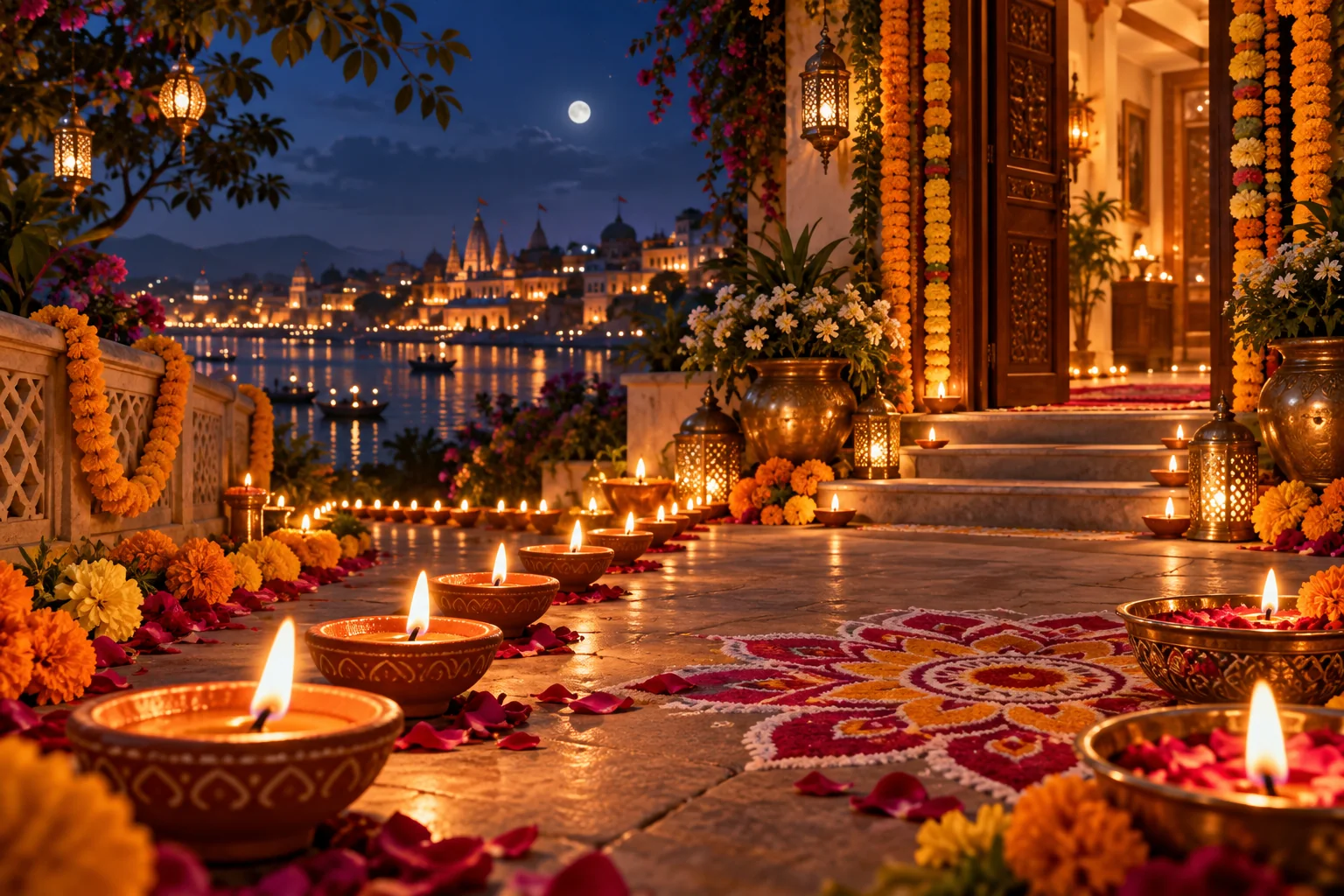
Diwali, or Deepavali, is the Hindu festival of lights and one of the most widely observed festivals in India and the diaspora. Its best-known story is Rama’s return to Ayodhya after exile, while Lakshmi Puja, Krishna’s victory over Narakasura, and other regional traditions give the festival additional meaning. The name comes from the Sanskrit dipavali, “a row of lamps,” and its shared theme is light overcoming darkness.
When is Diwali 2026?
Diwali falls on Amavasya, the new-moon night of the month of Kartik. In 2026, the main Diwali night — Lakshmi Puja — falls on Sunday, 8 November. The wider festival runs across five days, from Dhanteras to Bhai Dooj. Check a current panchang for the Lakshmi Puja window in your city, as tithi-based timings are local.
The story of Rama’s return
In much of North India, Diwali recalls Rama’s return to Ayodhya after fourteen years of exile and his victory over the demon king Ravana. The people of Ayodhya are said to have lit rows of lamps to guide and welcome Rama, Sita, and Lakshmana home. This makes Diwali a celebration of righteous conduct, perseverance, and the return of rightful order after a long period of hardship. Read the full account in Ramayana stories and Dussehra story and significance, which marks the earlier victory over Ravana.
Lakshmi Puja and prosperity
Diwali night is also associated with Lakshmi, the goddess of abundance, beauty, and auspiciousness, who is said to visit clean and well-lit homes. Families decorate their doorways with rangoli, light lamps, and perform Lakshmi Puja to welcome prosperity for the year ahead. In this tradition prosperity is understood broadly — ethical livelihood, generosity, health, learning, and harmony — rather than money alone. A Lakshmi mantra or the aarti Om Jai Lakshmi Mata can accompany the puja.
Other regional stories
Diwali does not have one single story across all communities:
- In many parts of western and southern India, the day before Diwali marks Krishna’s defeat of the demon Narakasura and the freeing of thousands of captives.
- Some communities observe the return of the Pandavas from exile.
- For many businesses, Diwali begins a new financial year, with account books opened afresh (Chopda Pujan).
- Jains commemorate the liberation (nirvana) of Mahavira, and Sikhs observe Bandi Chhor Divas.
These differences are part of the festival’s richness rather than contradictions.
The five days of Diwali
- Dhanteras — worship of Lakshmi and Dhanvantari; buying metal or utensils. See Dhanteras story and significance.
- Naraka Chaturdashi (Chhoti Diwali) — recalling the defeat of Narakasura.
- Lakshmi Puja (Diwali) — the main night of lamps and prayer.
- Govardhan Puja / Annakut — gratitude for nature and food. See Govardhan Puja story and significance.
- Bhai Dooj — celebrating the bond between siblings. See Bhai Dooj story and significance.
The inner meaning of the lamps
The diya is both a household lamp and a spiritual symbol. Its small flame represents awareness that can stay steady even when the surrounding world feels uncertain. Lighting a lamp can become a simple reminder to replace fear, resentment, and confusion with clarity and compassion — the “inner light” that several teachers connect with the festival.
A simple way to observe Diwali
Clean one space thoroughly, light a diya safely, offer a short prayer, and share something with another person or household. Keeping the celebration low-noise and low-smoke, and being mindful of animals and people who find the night difficult, is in keeping with the festival’s spirit. The meaning of Diwali is carried by the quality of attention and generosity, not the scale of decoration.
Frequently asked questions
What is the main story behind Diwali?
In North India, Diwali celebrates Rama’s return to Ayodhya after exile and his victory over Ravana, welcomed home with rows of lamps. Elsewhere it centres on Lakshmi Puja, Krishna’s defeat of Narakasura, or the start of a new business year.
When is Diwali in 2026?
The main Diwali night, Lakshmi Puja, falls on 8 November 2026. The five-day festival runs from Dhanteras (around 6 November) to Bhai Dooj (around 10 November).
Why is Diwali called the Festival of Lights?
The name means “a row of lamps.” Homes and public spaces are lit with diyas and lights to represent knowledge and goodness overcoming ignorance and darkness.
What is Lakshmi Puja on Diwali?
A prayer welcoming Lakshmi, the goddess of prosperity and auspiciousness, into a clean and well-lit home, usually performed on Diwali evening.
How many days is Diwali?
Five: Dhanteras, Naraka Chaturdashi, Lakshmi Puja (Diwali), Govardhan Puja, and Bhai Dooj.
What is the significance of Diwali?
Diwali’s significance is renewal: lamps represent knowledge and hope overcoming darkness, Rama’s homecoming represents the restoration of dharma, and Lakshmi Puja invites prosperity understood as ethical livelihood, generosity, health, and harmony.