
🏹 Practice Guides
Ram Raksha Stotram: Sanskrit, Transliteration and Meaning
Last updated: November 22, 2026
The Ram Raksha Stotram is Budha Kaushika's hymn of Rama's protection, with a distinctive assignment of Rama's names to the body. Here is the full text in Devanagari, IAST and original English, including the opening viniyoga and dhyana.
The Ram Raksha Stotram (Rāmarakṣāstotram, “hymn of Rama’s protection”) is a Sanskrit stotra traditionally attributed to the sage Budha Kaushika. This page gives the popular recension in Devanagari, IAST and original English meanings: the opening viniyoga, the dhyana, and all 38 verses. A shorter guide, without the full text, is already on the site as Ram Raksha Stotra meaning.
The English meanings are original to VedicVani. The Sanskrit was checked against the Sanskrit Documents edition of the popular text (file rraksha, proofread by Jayesh Mistry and others; latest update 7 January 2024). A different Ram Raksha hymn is also printed from the Padma Purana; that is another text, and is not the one given here.
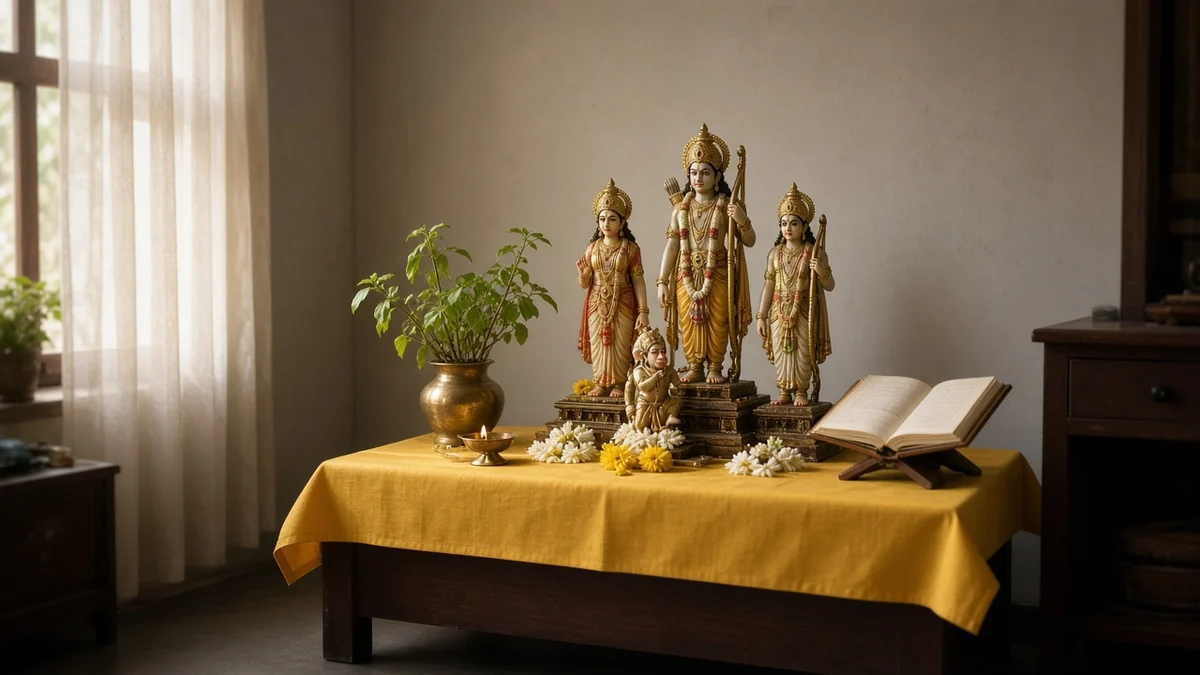
The hymn is especially loved in Marathi and wider North Indian homes, often taught early because of its clear rhythm. After a short meditation, it becomes a protection of the body, name by name, from the head to the feet. The image on this page is a modest home shrine: Rama with Sita and Lakshmana, Hanuman in front, a lamp, tulsi, flowers and an open book.
How the hymn is recited
Many devotees recite the Ram Raksha daily in the morning, and also before a journey or in a time of strain. A common practice is to bathe, sit before a Rama shrine, light a lamp, and read the dhyana and the thirty-eight verses slowly, once. Some traditions recite the viniyoga first. The hymn is a prayer for protection, not a substitute for medical, legal or other care. It sits well beside Rama mantras, the Ram Aarti, and stories of Rama and Hanuman and Rama.
Viniyoga
\nThe traditional assignment of the hymn, as printed in this recension, is recited before the meditation verse. \nअस्य श्रीरामरक्षास्तोत्रमन्त्रस्य । बुधकौशिक ऋषिः । श्रीसीतारामचन्द्रो देवता । अनुष्टुप् छन्दः । सीता शक्तिः । श्रीमद् हनुमान कीलकम् । श्रीरामचन्द्रप्रीत्यर्थे रामरक्षास्तोत्रजपे विनियोगः
asya śrīrāmarakṣāstotramantrasya | budhakauśika ṛṣiḥ | śrīsītārāmacandro devatā | anuṣṭup chandaḥ | sītā śaktiḥ | śrīmad hanumāna kīlakam | śrīrāmacandraprītyarthe rāmarakṣāstotrajape viniyogaḥ \nMeaning. Of this mantra that is the Rama-protection stotra, the seer is Budha Kaushika; the deity is Shri Sita-Ramachandra; the metre is anushtubh; the shakti is Sita; the kilaka (the ‘pin’ of the practice) is Shri Hanuman. It is applied as a recitation of the Rama-protection stotra, for the pleasing of Shri Ramachandra. \n## Dhyana \n### Meditation verse
ध्यायेदाजानुबाहुं धृतशरधनुषं बद्धपद्मासनस्थं पीतं वासो वसानं नवकमलदलस्पर्धिनेत्रं प्रसन्नम् । वामाङ्कारूढ सीतामुखकमलमिलल्लोचनं नीरदाभं नानालङ्कारदीप्तं दधतमुरुजटामण्डनं रामचन्द्रम्
dhyāyedājānubāhuṃ dhṛtaśaradhanuṣaṃ baddhapadmāsanasthaṃ pītaṃ vāso vasānaṃ navakamaladalaspardhinetraṃ prasannam | vāmāṅkārūḍha sītāmukhakamalamilallocanaṃ nīradābhaṃ nānālaṅkāradīptaṃ dadhatamurujaṭāmaṇḍanaṃ rāmacandram
Meaning. One should meditate on Ramachandra: arms reaching to the knees, bow and arrow in hand, seated in a bound lotus, wearing a yellow garment, his eyes rivalling new lotus petals, his face gracious; dark as a rain-cloud, bright with many ornaments, wearing a mass of matted hair, his eyes meeting the lotus face of Sita who is seated on his left side. \n## The hymn \n### Verse 1
चरितं रघुनाथस्य शतकोटि प्रविस्तरम् । एकैकमक्षरं पुंसां महापातकनाशनम्
caritaṃ raghunāthasya śatakoṭi pravistaram | ekaikamakṣaraṃ puṃsāṃ mahāpātakanāśanam
Meaning. The deeds of Raghunatha extend to a hundred crores. Even a single syllable of them destroys a person’s great sins. \n### Verse 2
ध्यात्वा नीलोत्पलश्यामं रामं राजीवलोचनम् । जानकीलक्ष्मणोपेतं जटामुकुटमण्डितम्
dhyātvā nīlotpalaśyāmaṃ rāmaṃ rājīvalocanam | jānakīlakṣmaṇopetaṃ jaṭāmukuṭamaṇḍitam
Meaning. Having meditated on Rama, dark as a blue lotus, with lotus eyes, accompanied by Janaki and Lakshmana, and crowned with matted hair — \n### Verse 3
सासितूणधनुर्बाणपाणिं नक्तञ्चरान्तकम् । स्वलीलया जगत्त्रातुमाविर्भूतमजं विभुम्
sāsitūṇadhanurbāṇapāṇiṃ naktañcarāntakam | svalīlayā jagattrātumāvirbhūtamajaṃ vibhum
Meaning. — a sword, a quiver, a bow and arrows in his hands, the ender of the night-rangers, the unborn, all-pervading Lord who has appeared in his own play to protect the world — \n### Verse 4
रामरक्षां पठेत्प्राज्ञः पापघ्नीं सर्वकामदाम् । शिरो मे राघवः पातु भालं दशरथात्मजः
rāmarakṣāṃ paṭhetprājñaḥ pāpaghnīṃ sarvakāmadām | śiro me rāghavaḥ pātu bhālaṃ daśarathātmajaḥ
Meaning. the wise one should recite this Rama-protection, which destroys sin and grants every wish. May Raghava protect my head; may Dasharatha’s son protect my forehead. \n### Verse 5
कौसल्येयो दृशौ पातु विश्वामित्रप्रियः श्रुती । घ्राणं पातु मखत्राता मुखं सौमित्रिवत्सलः
kausalyeyo dṛśau pātu viśvāmitrapriyaḥ śrutī | ghrāṇaṃ pātu makhatrātā mukhaṃ saumitrivatsalaḥ
Meaning. May Kausalya’s son protect my eyes; may the beloved of Vishvamitra protect my ears; may the protector of the sacrifice protect my nose; may he who loves Sumitra’s son protect my mouth. \n### Verse 6
जिह्वां विद्यानिधिः पातु कण्ठं भरतवन्दितः । स्कन्धौ दिव्यायुधः पातु भुजौ भग्नेशकार्मुकः
jihvāṃ vidyānidhiḥ pātu kaṇṭhaṃ bharatavanditaḥ | skandhau divyāyudhaḥ pātu bhujau bhagneśakārmukaḥ
Meaning. May the treasure-house of knowledge protect my tongue; may he who is honoured by Bharata protect my throat; may he of the divine weapons protect my shoulders; may he who broke Ishvara’s bow protect my arms. \n### Verse 7
करौ सीतापतिः पातु हृदयं जामदग्न्यजित् । मध्यं पातु खरध्वंसी नाभिं जाम्बवदाश्रयः
karau sītāpatiḥ pātu hṛdayaṃ jāmadagnyajit | madhyaṃ pātu kharadhvaṃsī nābhiṃ jāmbavadāśrayaḥ
Meaning. May Sita’s lord protect my hands; may the conqueror of Jamadagni’s son protect my heart; may the destroyer of Khara protect my midriff; may the refuge of Jambavan protect my navel. \n### Verse 8
सुग्रीवेशः कटी पातु सक्थिनी हनुमत्प्रभुः । ऊरू रघूत्तमः पातु रक्षःकुलविनाशकृत्
sugrīveśaḥ kaṭī pātu sakthinī hanumatprabhuḥ | ūrū raghūttamaḥ pātu rakṣaḥkulavināśakṛt
Meaning. May the lord of Sugriva protect my waist; may the lord of Hanuman protect my hips; may the foremost of the Raghus protect my thighs; may the destroyer of the rakshasa race protect them too. \n### Verse 9
जानुनी सेतुकृत्पातु जङ्घे दशमुखान्तकः । पादौ बिभीषणश्रीदः पातु रामोऽखिलं वपुः
jānunī setukṛtpātu jaṅghe daśamukhāntakaḥ | pādau bibhīṣaṇaśrīdaḥ pātu rāmo’khilaṃ vapuḥ
Meaning. May the builder of the bridge protect my knees; may the ender of the ten-headed one protect my shanks; may the giver of fortune to Vibhishana protect my feet; may Rama protect my whole body. \n### Verse 10
एतां रामबलोपेतां रक्षां यः सुकृती पठेत् । स चिरायुः सुखी पुत्री विजयी विनयी भवेत्
etāṃ rāmabalopetāṃ rakṣāṃ yaḥ sukṛtī paṭhet | sa cirāyuḥ sukhī putrī vijayī vinayī bhavet
Meaning. The person of good deeds who recites this protection, which is joined with Rama’s strength, becomes long-lived, happy, blessed with children, victorious and humble. \n### Verse 11
पातालभूतलव्योमचारिणश्छद्मचारिणः । न द्रष्टुमपि शक्तास्ते रक्षितं रामनामभिः
pātālabhūtalavyomacāriṇaśchadmacāriṇaḥ | na draṣṭumapi śaktāste rakṣitaṃ rāmanāmabhiḥ
Meaning. Those who move in the nether world, on the earth or in the sky, and those who move in disguise, cannot even look upon one who is guarded by Rama’s names. \n### Verse 12
रामेति रामभद्रेति रामचन्द्रेति वा स्मरन् । नरो न लिप्यते पापैः भुक्तिं मुक्तिं च विन्दति
rāmeti rāmabhadreti rāmacandreti vā smaran | naro na lipyate pāpaiḥ bhuktiṃ muktiṃ ca vindati
Meaning. Remembering ‘Rama,’ or ‘Ramabhadra,’ or ‘Ramachandra,’ a person is not stained by sins, and finds both enjoyment and liberation. \n### Verse 13
जगज्जैत्रैकमन्त्रेण रामनाम्नाभिरक्षितम् । यः कण्ठे धारयेत्तस्य करस्थाः सर्वसिद्धयः
jagajjaitraikamantreṇa rāmanāmnābhirakṣitam | yaḥ kaṇṭhe dhārayettasya karasthāḥ sarvasiddhayaḥ
Meaning. Whoever wears at the throat this protection made by the one world-conquering mantra, the name of Rama, has every accomplishment in the hollow of the hand. \n### Verse 14
वज्रपञ्जरनामेदं यो रामकवचं स्मरेत् । अव्याहताज्ञः सर्वत्र लभते जयमङ्गलम्
vajrapañjaranāmedaṃ yo rāmakavacaṃ smaret | avyāhatājñaḥ sarvatra labhate jayamaṅgalam
Meaning. Whoever remembers this Rama-armour called the adamantine cage obtains, unobstructed in command, victory and welfare everywhere. \n### Verse 15
आदिष्टवान् यथा स्वप्ने रामरक्षामिमां हरः । तथा लिखितवान् प्रातः प्रबुद्धो बुधकौशिकः
ādiṣṭavān yathā svapne rāmarakṣāmimāṃ haraḥ | tathā likhitavān prātaḥ prabuddho budhakauśikaḥ
Meaning. Just as Hara taught this Rama-protection in a dream, so Budha Kaushika, waking in the morning, wrote it down. This is the hymn’s own account of its origin. \n### Verse 16
आरामः कल्पवृक्षाणां विरामः सकलापदाम् । अभिरामस्त्रिलोकानां रामः श्रीमान् स नः प्रभुः
ārāmaḥ kalpavṛkṣāṇāṃ virāmaḥ sakalāpadām | abhirāmastrilokānāṃ rāmaḥ śrīmān sa naḥ prabhuḥ
Meaning. A garden of wish-trees, a close of all misfortunes, the delight of the three worlds: that blessed Rama is our Lord. \n### Verse 17
तरुणौ रूपसम्पन्नौ सुकुमारौ महाबलौ । पुण्डरीकविशालाक्षौ चीरकृष्णाजिनाम्बरौ
taruṇau rūpasampannau sukumārau mahābalau | puṇḍarīkaviśālākṣau cīrakṛṣṇājināmbarau
Meaning. Young, endowed with beauty, tender yet of great strength, with eyes wide as lotuses, wearing bark and a black antelope-skin — \n### Verse 18
फलमूलाशिनौ दान्तौ तापसौ ब्रह्मचारिणौ । पुत्रौ दशरथस्यैतौ भ्रातरौ रामलक्ष्मणौ
phalamūlāśinau dāntau tāpasau brahmacāriṇau | putrau daśarathasyaitau bhrātarau rāmalakṣmaṇau
Meaning. — eating fruit and roots, restrained, living as ascetics and brahmacharins: these two sons of Dasharatha, the brothers Rama and Lakshmana — \n### Verse 19
शरण्यौ सर्वसत्त्वानां श्रेष्ठौ सर्वधनुष्मताम् । रक्षः कुलनिहन्तारौ त्रायेतां नो रघूत्तमौ
śaraṇyau sarvasattvānāṃ śreṣṭhau sarvadhanuṣmatām | rakṣaḥ kulanihantārau trāyetāṃ no raghūttamau
Meaning. — worthy of the refuge of all beings, foremost among all who bear the bow, destroyers of the rakshasa race: may those two foremost Raghus protect us. \n### Verse 20
आत्तसज्जधनुषाविषुस्पृशावक्षयाशुगनिषङ्गसङ्गिनौ । रक्षणाय मम रामलक्ष्मणावग्रतः पथि सदैव गच्छताम्
āttasajjadhanuṣāviṣuspṛśāvakṣayāśuganiṣaṅgasaṅginau | rakṣaṇāya mama rāmalakṣmaṇāvagrataḥ pathi sadaiva gacchatām
Meaning. With bows taken up and made ready, fingers on the arrows, joined to inexhaustible quivers of swift shafts, may Rama and Lakshmana go always in front of me on the path, for my protection. \n### Verse 21
सन्नद्धः कवची खड्गी चापबाणधरो युवा । गच्छन्मनोरथोऽस्माकं रामः पातु सलक्ष्मणः
sannaddhaḥ kavacī khaḍgī cāpabāṇadharo yuvā | gacchanmanoratho’smākaṃ rāmaḥ pātu salakṣmaṇaḥ
Meaning. Armed, armoured, wearing a sword, bearing bow and arrows, the young one: may Rama, with Lakshmana, going as our heart’s desire, protect us. \n### Verse 22
रामो दाशरथिः शूरो लक्ष्मणानुचरो बली । काकुत्स्थः पुरुषः पूर्णः कौसल्येयो रघूत्तमः
rāmo dāśarathiḥ śūro lakṣmaṇānucaro balī | kākutsthaḥ puruṣaḥ pūrṇaḥ kausalyeyo raghūttamaḥ
Meaning. Rama, Dasharatha’s son, the hero, followed by Lakshmana, the strong one; a Kakutstha, the complete person, Kausalya’s son, foremost of the Raghus. \n### Verse 23
वेदान्तवेद्यो यज्ञेशः पुराणपुरुषोत्तमः । जानकीवल्लभः श्रीमान् अप्रमेय पराक्रमः
vedāntavedyo yajñeśaḥ purāṇapuruṣottamaḥ | jānakīvallabhaḥ śrīmān aprameya parākramaḥ
Meaning. To be known through Vedanta, lord of the sacrifice, the ancient Purushottama, Janaki’s beloved, the blessed one, of immeasurable valour. \n### Verse 24
इत्येतानि जपन्नित्यं मद्भक्तः श्रद्धयान्वितः । अश्वमेधाधिकं पुण्यं सम्प्राप्नोति न संशयः
ityetāni japannityaṃ madbhaktaḥ śraddhayānvitaḥ | aśvamedhādhikaṃ puṇyaṃ samprāpnoti na saṃśayaḥ
Meaning. The devotee who, with faith, recites these daily obtains, without doubt, merit greater than that of an ashvamedha. These names and epithets are the ‘these’ of the verse. \n### Verse 25
रामं दूर्वादलश्यामं पद्माक्षं पीतवाससम् । स्तुवन्ति नामभिर्दिव्यैः न ते संसारिणो नराः
rāmaṃ dūrvādalaśyāmaṃ padmākṣaṃ pītavāsasam | stuvanti nāmabhirdivyaiḥ na te saṃsāriṇo narāḥ
Meaning. Those who praise, with divine names, Rama who is dark as a blade of durva, lotus-eyed, wearing yellow, are not people bound in samsara. \n### Verse 26
रामं लक्ष्मणपूर्वजं रघुवरं सीतापतिं सुन्दरम् । काकुत्स्थं करुणार्णवं गुणनिधिं विप्रप्रियं धार्मिकम् । राजेन्द्रं सत्यसन्धं दशरथतनयं श्यामलं शान्तमूर्तिम् । वन्दे लोकाभिरामं रघुकुलतिलकं राघवं रावणारिम्
rāmaṃ lakṣmaṇapūrvajaṃ raghuvaraṃ sītāpatiṃ sundaram | kākutsthaṃ karuṇārṇavaṃ guṇanidhiṃ viprapriyaṃ dhārmikam | rājendraṃ satyasandhaṃ daśarathatanayaṃ śyāmalaṃ śāntamūrtim | vande lokābhirāmaṃ raghukulatilakaṃ rāghavaṃ rāvaṇārim
Meaning. I bow to Rama, the elder of Lakshmana, the foremost of the Raghus, Sita’s lord, beautiful; a Kakutstha, an ocean of compassion, a treasure of virtues, dear to brahmins, righteous; a king of kings, true to his word, Dasharatha’s son, dark, a form of peace; the delight of the worlds, the mark of the Raghu line, Raghava, the foe of Ravana. \n### Verse 27
रामाय रामभद्राय रामचन्द्राय वेधसे । रघुनाथाय नाथाय सीतायाः पतये नमः
rāmāya rāmabhadrāya rāmacandrāya vedhase | raghunāthāya nāthāya sītāyāḥ pataye namaḥ
Meaning. Obeisance to Rama, to Ramabhadra, to Ramachandra, to the creator; to Raghunatha, to the Lord, to the husband of Sita. \n### Verse 28
श्रीराम राम रघुनन्दन राम राम श्रीराम राम भरताग्रज राम राम । श्रीराम राम रणकर्कश राम राम श्रीराम राम शरणं भव राम राम
śrīrāma rāma raghunandana rāma rāma śrīrāma rāma bharatāgraja rāma rāma | śrīrāma rāma raṇakarkaśa rāma rāma śrīrāma rāma śaraṇaṃ bhava rāma rāma
Meaning. Shri Rama, Rama, delight of the Raghus, Rama, Rama; Shri Rama, Rama, elder of Bharata, Rama, Rama; Shri Rama, Rama, fierce in battle, Rama, Rama; Shri Rama, Rama, be my refuge, Rama, Rama. \n### Verse 29
श्रीरामचन्द्रचरणौ मनसा स्मरामि श्रीरामचन्द्रचरणौ वचसा गृणामि । श्रीरामचन्द्रचरणौ शिरसा नमामि श्रीरामचन्द्रचरणौ शरणं प्रपद्ये
śrīrāmacandracaraṇau manasā smarāmi śrīrāmacandracaraṇau vacasā gṛṇāmi | śrīrāmacandracaraṇau śirasā namāmi śrīrāmacandracaraṇau śaraṇaṃ prapadye
Meaning. I remember the feet of Shri Ramachandra with the mind; I praise the feet of Shri Ramachandra with speech; I bow to the feet of Shri Ramachandra with the head; I take refuge at the feet of Shri Ramachandra. \n### Verse 30
माता रामो मत्पिता रामचन्द्रः स्वामी रामो मत्सखा रामचन्द्रः । सर्वस्वं मे रामचन्द्रो दयालुर्नान्यं जाने नैव जाने न जाने
mātā rāmo matpitā rāmacandraḥ svāmī rāmo matsakhā rāmacandraḥ | sarvasvaṃ me rāmacandro dayālurnānyaṃ jāne naiva jāne na jāne
Meaning. Rama is my mother; Ramachandra is my father; Rama is my lord; Ramachandra is my friend. Kind Ramachandra is all I have. I know no other — I know none, I know none. \n### Verse 31
दक्षिणे लक्ष्मणो यस्य वामे तु जनकात्मजा । पुरतो मारुतिर्यस्य तं वन्दे रघुनन्दनम्
dakṣiṇe lakṣmaṇo yasya vāme tu janakātmajā | purato mārutiryasya taṃ vande raghunandanam
Meaning. I bow to that delight of the Raghus, who has Lakshmana on his right, the daughter of Janaka on his left, and Maruti in front. \n### Verse 32
लोकाभिरामं रणरङ्गधीरं राजीवनेत्रं रघुवंशनाथम् । कारुण्यरूपं करुणाकरं तं श्रीरामचन्द्रम् शरणं प्रपद्ये
lokābhirāmaṃ raṇaraṅgadhīraṃ rājīvanetraṃ raghuvaṃśanātham | kāruṇyarūpaṃ karuṇākaraṃ taṃ śrīrāmacandram śaraṇaṃ prapadye
Meaning. The delight of the worlds, steadfast in the arena of battle, lotus-eyed, lord of the Raghu line, a form of compassion, a mine of compassion: I take refuge in that Shri Ramachandra. \n### Verse 33
मनोजवं मारुततुल्यवेगं जितेन्द्रियं बुद्धिमतां वरिष्ठम् । वातात्मजं वानरयूथमुख्यं श्रीरामदूतं शरणं प्रपद्ये
manojavaṃ mārutatulyavegaṃ jitendriyaṃ buddhimatāṃ variṣṭham | vātātmajaṃ vānarayūthamukhyaṃ śrīrāmadūtaṃ śaraṇaṃ prapadye
Meaning. Swift as thought, with a speed like the wind, his senses conquered, foremost among the intelligent, son of the Wind, chief of the vanara hosts: I take refuge in that messenger of Shri Rama. \n### Verse 34
कूजन्तं रामरामेति मधुरं मधुराक्षरम् । आरुह्य कविताशाखां वन्दे वाल्मीकिकोकिलम्
kūjantaṃ rāmarāmeti madhuraṃ madhurākṣaram | āruhya kavitāśākhāṃ vande vālmīkikokilam
Meaning. I bow to the cuckoo Valmiki, who, having climbed the branch of poetry, sings ‘Rama, Rama,’ sweet, in sweet syllables. \n### Verse 35
आपदामपहर्तारं दातारं सर्वसम्पदाम् । लोकाभिरामं श्रीरामं भूयो भूयो नमाम्यहम्
āpadāmapahartāraṃ dātāraṃ sarvasampadām | lokābhirāmaṃ śrīrāmaṃ bhūyo bhūyo namāmyaham
Meaning. The remover of misfortunes, the giver of every fortune, the delight of the worlds, Shri Rama: I bow to him again and again. \n### Verse 36
भर्जनं भवबीजानामर्जनं सुखसम्पदाम् । तर्जनं यमदूतानां रामरामेति गर्जनम्
bharjanaṃ bhavabījānāmarjanaṃ sukhasampadām | tarjanaṃ yamadūtānāṃ rāmarāmeti garjanam
Meaning. The roaring of ‘Rama, Rama’ burns the seeds of becoming, gathers happiness and fortune, and threatens the messengers of Yama. \n### Verse 37
रामो राजमणिः सदा विजयते रामं रमेशं भजे रामेणाभिहता निशाचरचमू रामाय तस्मै नमः । रामान्नास्ति परायणं परतरं रामस्य दासोऽस्म्यहं रामे चित्तलयः सदा भवतु मे भो राम मामुद्धर
rāmo rājamaṇiḥ sadā vijayate rāmaṃ rameśaṃ bhaje rāmeṇābhihatā niśācaracamū rāmāya tasmai namaḥ | rāmānnāsti parāyaṇaṃ parataraṃ rāmasya dāso’smyahaṃ rāme cittalayaḥ sadā bhavatu me bho rāma māmuddhara
Meaning. Rama, jewel of kings, is ever victorious; I worship Rama, lord of Rama (Lakshmi). The army of the night-rangers was struck down by Rama; obeisance to that Rama. There is no higher refuge than Rama; I am Rama’s servant. May my mind always dissolve in Rama. O Rama, lift me up. \n### Verse 38
रामरामेति रामेति रमे रामे मनोरमे । सहस्रनामतत्तुल्यं रामनाम वरानने
rāmarāmeti rāmeti rame rāme manorame | sahasranāmatattulyaṃ rāmanāma varānane
Meaning. O you of the lovely face: I delight in Rama, in Rama who delights the mind, saying ‘Rama, Rama,’ and again ‘Rama.’ The name of Rama is equal to a thousand names. Some prints begin the first half with the variant śrīrāmarāmarāmeti.
Text notes
- This page follows the popular recension on Sanskrit Documents (
rraksha). The hymn’s own colophon ascribes it to Budha Kaushika. Verse 15 is the origin story told by the text itself: Shiva taught it in a dream, and the sage wrote it at dawn. - A separate Ram Raksha stotra appears in the Padma Purana, with a different viniyoga and a much shorter body. It is not mixed into this page.
- Verse 38: some prints begin the first half śrīrāmarāmarāmeti in place of rāmarāmeti rāmeti. The sense — repeating the name of Rama — is the same. The second half addresses a “lovely-faced” listener (varānane), in the language of a teaching spoken to Parvati in some frame-stories; the popular text as printed does not spell out that frame.
- Verses 2–4 form one long sentence in the Sanskrit: meditate on Rama in this form, then the wise one should recite the protection, and the limb-by-limb prayer begins in the second half of verse 4.
- The English meanings are original. They do not reproduce the English renderings published with the Sanskrit Documents file.
Related reading
A shorter introduction is at Ram Raksha Stotra meaning. For Rama on this site, see Rama mantras, Ram Aarti, stories of Rama, Hanuman and Rama and Ram Navami. A wider starting point is the beginner’s guide to Hindu mantras.
Frequently Asked Questions
Who composed the Ram Raksha Stotram?
The hymn names Budha Kaushika as its seer. Verse 15 gives the hymn's own origin story: Hara (Shiva) taught this protection in a dream, and Budha Kaushika wrote it down on waking in the morning.
How many verses are in the Ram Raksha Stotram?
The popular recension followed here has 38 verses, preceded by a viniyoga and a dhyana. Some books group the opening lines differently, but the body of the hymn in this edition ends at verse 38.
What is distinctive about the Ram Raksha Stotram?
After the opening meditation, verses 4–9 assign Rama's names as protection over the body from the head down to the feet, and then over the whole body. That limb-by-limb assignment is why the hymn is so closely tied to raksha, protection.
When is the Ram Raksha Stotram recited?
Many families, especially in Maharashtra and across North India, recite it daily in the morning, and also in times of difficulty or before a journey. It is a protection hymn, not a substitute for medical or other care.
Where can I read a shorter guide?
A shorter introduction, without the full text, is on our [Ram Raksha Stotra meaning](/blog/ram-raksha-stotra-meaning/) page. The two pages are meant to be read together.