
☀️ Practice Guides
Surya Namaskar Steps: The 12-Posture Sun Salutation Sequence
Last updated: October 4, 2026
Surya Namaskar is often taught as a warm-up sequence, but it's traditionally a complete practice in itself — part exercise, part moving prayer. Here are the 12 steps.
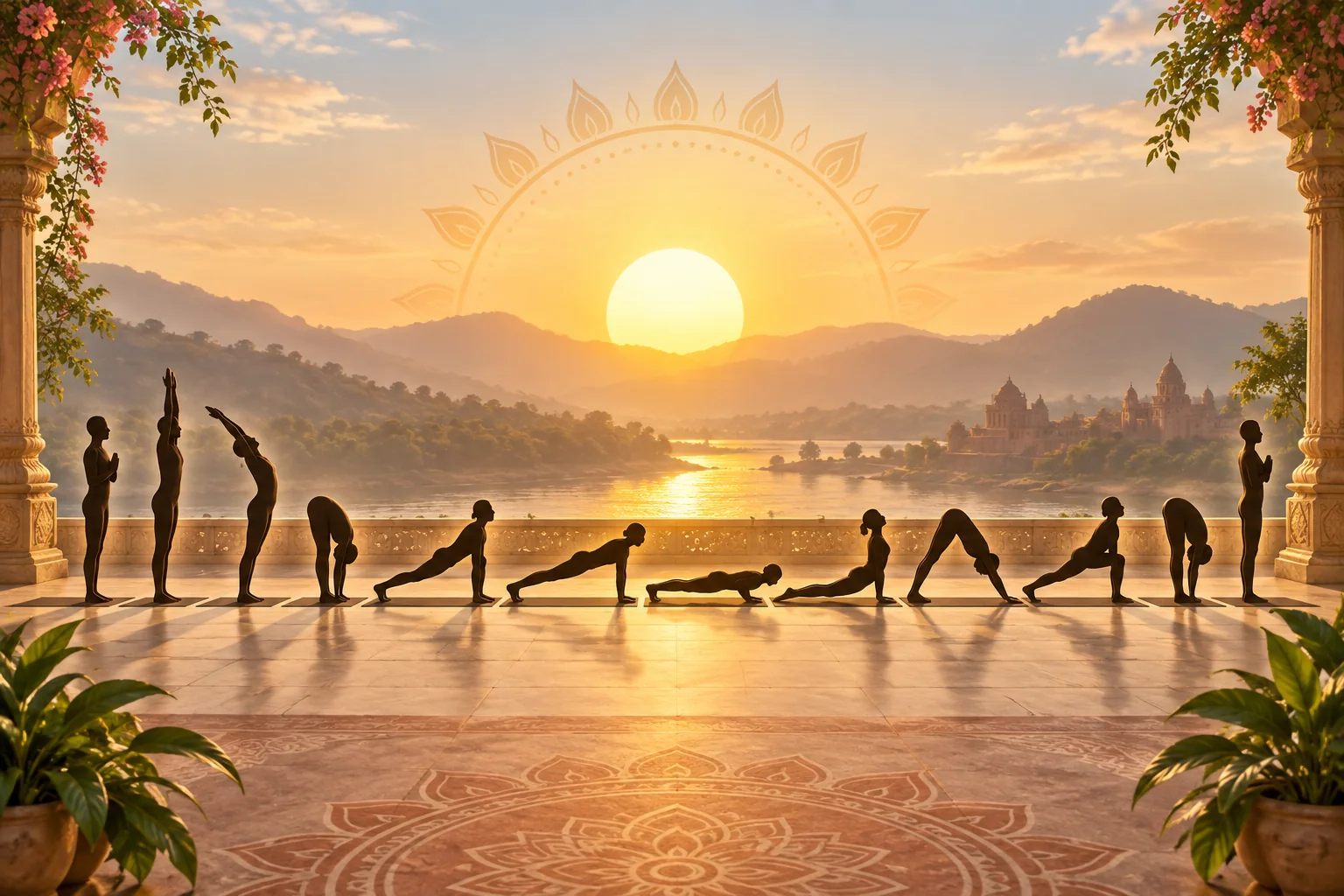
Surya Namaskar, or Sun Salutation, is a sequence of twelve linked postures traditionally practiced as a complete devotional and physical practice honoring the sun. While it’s often taught today as a warm-up before a longer yoga class, its traditional form is a full practice in its own right, combining movement, breath, and, for many practitioners, the recitation of mantras dedicated to Surya — see the Surya Mantra for one commonly paired with the sequence.
The 12 steps
- Pranamasana (Prayer Pose) — Stand with palms together at the chest, feet together, weight balanced evenly.
- Hasta Uttanasana (Raised Arms Pose) — Inhale, raise the arms overhead, and gently arch back.
- Hastapadasana (Standing Forward Bend) — Exhale, bend forward from the hips, bringing hands toward the floor beside the feet.
- Ashwa Sanchalanasana (Equestrian Pose) — Inhale, step the right leg back into a low lunge, looking forward.
- Dandasana (Plank Pose) — Exhale, step the left leg back to meet the right, forming a straight line from head to heels.
- Ashtanga Namaskara (Eight-Limbed Salutation) — Exhale and lower the knees, chest, and chin to the floor, hips slightly raised.
- Bhujangasana (Cobra Pose) — Inhale, slide forward and lift the chest, straightening the arms as comfortable.
- Adho Mukha Svanasana (Downward-Facing Dog) — Exhale, lift the hips up and back, forming an inverted V shape.
- Ashwa Sanchalanasana (Equestrian Pose) — Inhale, step the right foot forward between the hands, repeating step 4 on the other side.
- Hastapadasana (Standing Forward Bend) — Exhale, step the left foot forward to meet the right, folding forward as in step 3.
- Hasta Uttanasana (Raised Arms Pose) — Inhale, roll up to standing and raise the arms overhead, as in step 2.
- Pranamasana (Prayer Pose) — Exhale, return to standing with palms together at the chest, completing one round.
These twelve steps lead with the right leg. Repeating them leading with the left leg completes one full round of 24 movements, so both sides of the body are worked evenly. A complete practice typically includes several rounds.
The 12 Surya Namaskar steps with names at a glance
| Step | Sanskrit name | English name | Breath |
|---|---|---|---|
| 1 | Pranamasana | Prayer Pose | Exhale |
| 2 | Hasta Uttanasana | Raised Arms Pose | Inhale |
| 3 | Hastapadasana | Standing Forward Bend | Exhale |
| 4 | Ashwa Sanchalanasana | Equestrian Pose | Inhale |
| 5 | Dandasana | Plank Pose | Exhale |
| 6 | Ashtanga Namaskara | Eight-Limbed Salutation | Hold out |
| 7 | Bhujangasana | Cobra Pose | Inhale |
| 8 | Adho Mukha Svanasana | Downward-Facing Dog | Exhale |
| 9 | Ashwa Sanchalanasana | Equestrian Pose | Inhale |
| 10 | Hastapadasana | Standing Forward Bend | Exhale |
| 11 | Hasta Uttanasana | Raised Arms Pose | Inhale |
| 12 | Pranamasana | Prayer Pose | Exhale |
Schools differ slightly. Some teach Parvatasana (Mountain Pose, similar to Downward-Facing Dog) as the fifth step and omit the plank, and the breath in Ashtanga Namaskara is held out in some traditions and exhaled in others. The overall shape of the sequence is the same.
Breath and the sequence
Each posture is traditionally linked to a specific inhale or exhale, making Surya Namaskar as much a breathing practice as a physical one — the movement follows the breath rather than the breath being fitted around the movement. This coordination is part of why the sequence is considered meditative in its full traditional form, not just physical exercise.
The 12 Surya mantras
In many traditions each step is paired with one of twelve names of the sun, chanted silently or aloud before the movement:
- Om Mitraya Namah — the friend of all
- Om Ravaye Namah — the shining one
- Om Suryaya Namah — the one who brings activity
- Om Bhanave Namah — the one who illuminates
- Om Khagaya Namah — the one who moves through the sky
- Om Pushne Namah — the giver of nourishment
- Om Hiranyagarbhaya Namah — the golden cosmic self
- Om Marichaye Namah — the rays of light
- Om Adityaya Namah — the son of Aditi
- Om Savitre Namah — the source of life
- Om Arkaya Namah — the one worthy of praise
- Om Bhaskaraya Namah — the one who leads to illumination
Practising safely
Move slowly for the first rounds and let the breath set the pace. Bend the knees in the forward bends if the hamstrings are tight, and lower the knees in plank if the wrists or shoulders tire. People with back, wrist, or blood pressure problems, or who are pregnant, should learn the sequence from a qualified teacher and adapt it as needed.
Common questions
Which asana is 5th in the sequence of Surya Namaskar?
In the sequence on this page the fifth step is Dandasana (Plank Pose), stepping the second leg back to form a straight line from head to heels. In some schools the fifth step is Parvatasana (Mountain Pose) instead, so it is worth checking which version your teacher follows.
How many steps are in Surya Namaskar?
Twelve postures make up one half-round; a full round repeats the sequence leading with the opposite leg in steps 4 and 9.
Is Surya Namaskar only for flexible or experienced practitioners?
No — the sequence can be modified (bent knees in the forward bend, dropping to the knees in plank) and is commonly taught to beginners, though learning proper alignment from a teacher helps avoid strain.
When is Surya Namaskar traditionally practiced?
At sunrise, facing east, often accompanied by the Surya Mantra or one of twelve traditional mantras associated with different names of the sun, one recited per posture in some traditions.
Is Surya Namaskar a form of pranayama?
Not exactly — it’s a linked breath-and-movement sequence rather than a seated breathing practice, but see What Is Pranayama? for how breath-focused practices fit into yoga more broadly.