
🌬️ Practice Guides
Pranayama Definition: What Is Pranayama in Yoga? Meaning, Types, and Benefits
Last updated: October 10, 2026
Pranayama is often reduced to 'breathing exercises,' but it's a specific, structured practice with its own place in the yogic tradition. Here's what it actually is.
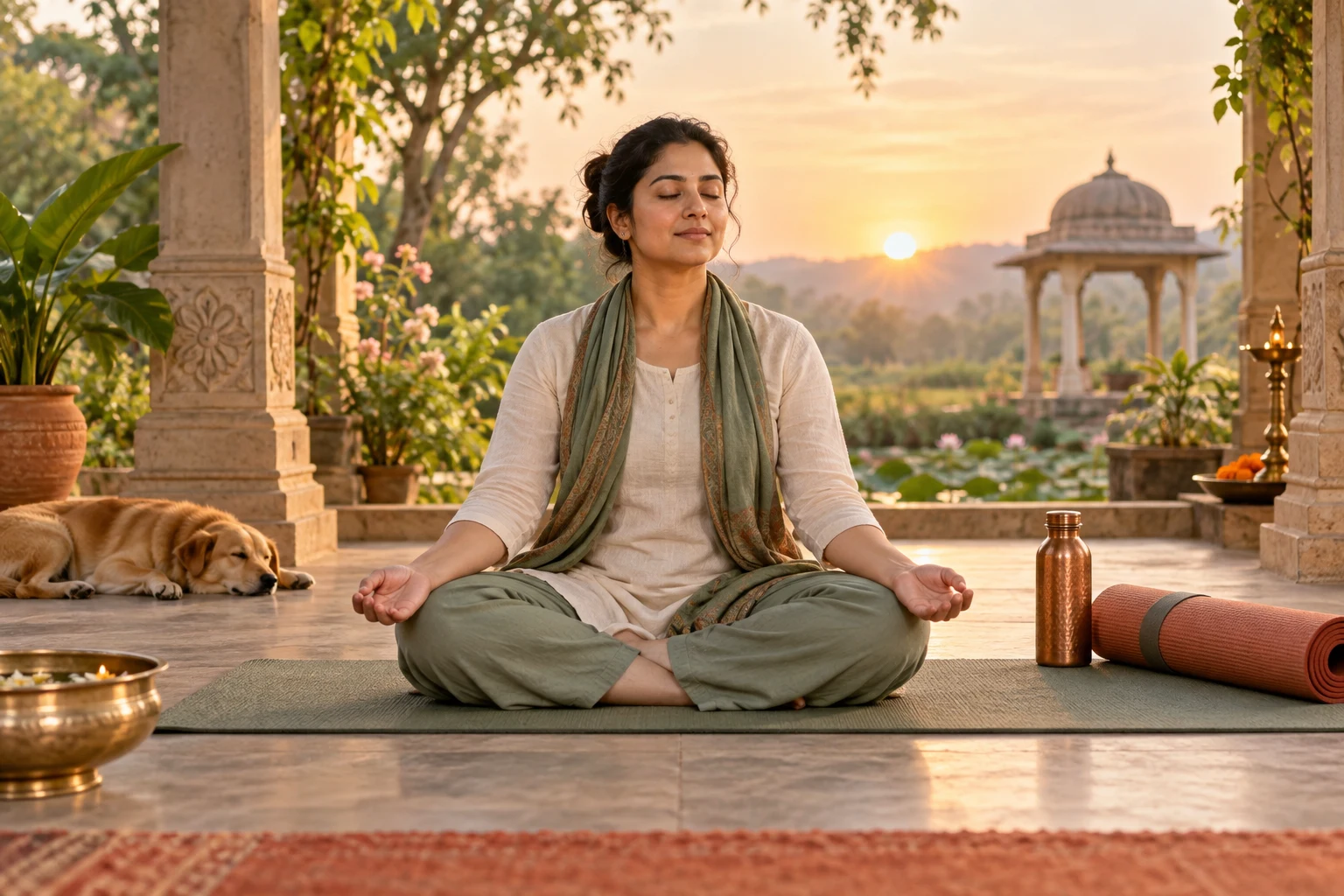
Pranayama definition: Pranayama (प्राणायाम) is the yogic practice of consciously regulating the breath — its inhalation, exhalation, and pauses — in order to steady prana, the vital life force, and calm the mind. The word joins prana (life force, breath) and ayama (extension or control). It is the fourth of the eight limbs of yoga.
Pranayama is often translated simply as “breath control,” but that undersells it: pranayama is a structured practice with its own techniques, sequencing, and place within the broader yogic tradition, not just deep breathing done mindfully.
Pranayama meaning, word by word
| Part | Sanskrit | Meaning |
|---|---|---|
| Prana | प्राण | Life force, vital energy; most directly experienced as breath |
| Ayama | आयाम | Extension, expansion, regulation |
| Yama (alternative reading) | यम | Restraint, control |
Many teachers read the word as prana + ayama, “extending the life force,” while others read it as prana + yama, “restraining the breath.” Both readings point to the same practice: taking the breath out of its automatic rhythm and guiding it with awareness.
In yogic physiology, prana is described as working through five main currents (vayus) — prana, apana, samana, udana, and vyana — each governing a different function in the body. Pranayama is understood to balance these currents.
How Patanjali defines pranayama
The classical definition comes from Patanjali’s Yoga Sutras (2.49): once a steady posture (asana) is established, pranayama is the regulation — literally the “cutting” or pausing — of the movement of inhalation and exhalation.
The next sutra (2.50) describes three aspects of the breath that pranayama works with: the outward movement (exhalation), the inward movement (inhalation), and the suspended pause, each regulated by place, time, and number until the breath becomes long and subtle. Patanjali then says pranayama thins the veil over the inner light (2.52) and makes the mind fit for concentration (dharana, 2.53).
The Bhagavad Gita also uses the word: in Bhagavad Gita 4.29, Krishna describes those devoted to pranayama who offer the outgoing breath into the incoming and the incoming into the outgoing, as a form of inner sacrifice.
What is pranayama in yoga? Where it fits
Classical yoga, as outlined in Patanjali’s Yoga Sutras, describes eight interconnected limbs (ashtanga), and pranayama is the fourth — positioned after asana (physical posture) and before pratyahara (withdrawal of the senses) on the path toward meditation. This placement is intentional: pranayama is traditionally understood as a bridge between the physical practice of yoga and its more inward, meditative stages, using the breath as the link between body and mind.
The three phases of a breath in pranayama
- Puraka — inhalation.
- Rechaka — exhalation.
- Kumbhaka — retention: antara kumbhaka after inhaling, bahya kumbhaka after exhaling.
Beginners work only with puraka and rechaka — smooth, even inhalations and exhalations. Breath retention is introduced gradually and, traditionally, under a teacher’s guidance.
Why the breath is treated as central
In yogic philosophy, breath and mental state are considered directly connected — an agitated mind produces irregular breath, and a calm mind produces steady breath. Pranayama works this relationship in the other direction: by deliberately steadying and regulating the breath, the practice is understood to calm and steady the mind as well. This is part of why pranayama is treated as foundational preparation for meditation rather than a separate wellness technique. In the language of the three gunas, steady breathing is said to settle rajas and lift tamas, making the mind more sattvic.
Types of pranayama
| Technique | What it involves | Traditional quality |
|---|---|---|
| Anulom Vilom / Nadi Shodhana | Alternate-nostril breathing | Balancing, calming |
| Bhramari | Humming “bee” exhalation | Soothing, quieting the mind |
| Ujjayi | Gentle throat-constricted “ocean” breath | Steadying, focusing |
| Bhastrika | Forceful “bellows” breathing | Energising, heating |
| Kapalbhati | Sharp, active exhalations with passive inhalation | Cleansing, energising |
| Sheetali and Sheetkari | Inhaling through the rolled tongue or teeth | Cooling |
Different techniques emphasize different qualities — some cool and calm, some generate heat and energy, and some balance and clear the breath. The linked guides explain how each is practised.
A simple pranayama practice for beginners
- Sit comfortably with the spine upright — on a cushion, in Vajrasana, or on a chair.
- Rest the hands in Gyan Mudra or Prana Mudra on the knees.
- Observe the natural breath for one minute without changing it.
- Lengthen the breath — inhale slowly through the nose for a count of four, exhale for a count of four to six.
- Practise Anulom Vilom for five minutes, alternating nostrils without holding the breath.
- Finish with three rounds of Bhramari, humming gently on each exhalation.
- Sit quietly for a minute, or move into meditation or mantra chanting.
Benefits of pranayama
Traditionally, pranayama is described as purifying the energy channels (nadis), steadying the mind, and preparing it for meditation. In modern terms, slow, regulated breathing is widely used to support relaxation, attention, and a sense of calm, and to improve breath awareness. Specific techniques have specific emphases — cooling, energising, or calming — so the choice of practice matters.
Pranayama supports, but does not replace, medical care. Anyone using it for a health concern should do so alongside qualified advice.
Getting started safely
Pranayama is traditionally learned gradually and, ideally, under the guidance of an experienced teacher, especially for the more forceful techniques like Bhastrika and Kapalbhati. Practice on an empty stomach, in a comfortable seated position, and never force the breath — dizziness or discomfort is a sign to stop and return to normal breathing. Pregnant women and those with high or low blood pressure, heart conditions, epilepsy, or recent abdominal surgery should consult a doctor and a qualified teacher before starting, since some techniques are not appropriate for these conditions.
Frequently asked questions
What is the definition of pranayama?
Pranayama is the yogic practice of regulating the breath — inhalation, exhalation, and retention — to steady prana (life force) and calm the mind. It is the fourth limb of Patanjali’s eight-limbed yoga.
What does “pranayama” mean?
“Extension or control of prana (life force/breath)” — from the Sanskrit prana and ayama.
What is pranayama in yoga?
In yoga, pranayama is the bridge between the physical postures (asana) and the inward stages of meditation. It uses the breath to settle the body and mind before sense-withdrawal and concentration.
Is pranayama just breathing exercises?
It overlaps with breathing exercises but is a more structured practice with a specific place within the eight limbs of yoga, traditionally aimed at preparing the mind for meditation.
Do I need to be flexible or experienced in yoga to practice pranayama?
No — pranayama can be practiced seated in a simple comfortable position and doesn’t require advanced physical flexibility, though learning proper technique from a teacher is recommended, especially for more advanced practices.
Is pranayama safe for everyone?
Most gentle techniques are safe for most people, but some — particularly forceful or breath-retention techniques — aren’t appropriate during pregnancy or for those with certain heart, blood pressure, or respiratory conditions. Check with a doctor if you have a relevant health condition.