
Mantra · Budh
Budh Mantra (Mercury Beej Mantra: Om Braam Breem Braum Sah Budhaya Namah)
Last updated: November 24, 2026
Edited by Anurag Goel
Budh mantra, the Mercury beej mantra Om Braam Breem Braum Sah Budhaya Namah: Sanskrit, Hindi and English meaning, 108-count jaap, benefits for intellect and speech, and how it differs from Buddhist Buddha mantras.
ॐ ब्रां ब्रीं ब्रौं सः बुधाय नमः
Om Braam Breem Braum Sah Budhaya Namah
Meaning
"I bow to Budh (Mercury)." Built around the beej syllables "Braam Breem Braum," this mantra invokes Budh's association with intellect, communication and learning. In Vedic astrology, Budh is the karaka of intelligence, speech, memory, mathematics, writing and trade, and this mantra is chanted by students, writers, business people and communicators, as well as those seeking to ease a difficult Budh period.
बुध मंत्र "ॐ ब्रां ब्रीं ब्रौं सः बुधाय नमः" का अर्थ है: मैं बुध देव को नमन करता हूँ। यह बुध ग्रह का बीज मंत्र है, जिसे बुधवार को 108 बार जपा जाता है। "ब्रां ब्रीं ब्रौं" बीज अक्षर बुध ग्रह की बुद्धि और वाणी से जुड़ी ऊर्जा का प्रतीक हैं। ज्योतिष में बुध बुद्धि, वाणी, स्मरण शक्ति, गणित, लेखन और व्यापार का कारक है। इसलिए यह मंत्र विद्यार्थियों, लेखकों, व्यापारियों और वाणी से जुड़े काम करने वालों द्वारा विशेष रूप से जपा जाता है। बुध का दिन बुधवार, रंग हरा और रत्न पन्ना माना जाता है।
Benefits
- Chanted for clarity of thought, sharp intellect and good memory.
- Traditionally recited for clear, confident speech and communication.
- Popular with students, especially for mathematics, languages and exams.
- Associated with success in business, trade, writing and analytical work.
- Used as a remedy for a weak Mercury or a difficult Budh dasha in Vedic astrology.
- Said to bring adaptability, wit and a calm, balanced nervous temperament.
How to Chant
Chant on Wednesday, Budh's traditional day, in the morning after bathing. Wear green if possible and sit facing north in a quiet space. Repeat the mantra with clear, attentive pronunciation, since Budh is closely associated with the clarity of speech itself.
Recommended count: 108 times, traditionally using an emerald or green-hued mala if available, though any mala is acceptable
Budh mantra at a glance
| Main mantra | ॐ ब्रां ब्रीं ब्रौं सः बुधाय नमः (Om Braam Breem Braum Sah Budhaya Namah) |
| Short mantra | ॐ बुं बुधाय नमः (Om Bum Budhaya Namah) |
| Planet | Mercury (Budh) |
| Rules over | Intellect, speech, memory, writing, mathematics, trade |
| Day | Wednesday (Budhvar) |
| Colour | Green |
| Gemstone | Emerald (panna) |
| Metal | Bronze |
| Direction | North |
| Daily count | 108 (one mala) |
| Traditional full count | 9,000 for Navagraha shanti (varies by tradition) |
Budh among the Navagraha
Budh is one of the nine grahas (Navagraha) in Vedic astrology, alongside Surya, Chandra, Mangal, Guru, Shukra, Shani, Rahu and Ketu. He is the prince among the planets, traditionally associated with intellect, communication and adaptability: qualities this mantra is chanted to support, particularly around study, writing, business and situations requiring clear thinking.
The English word Budh is easy to confuse with Buddha. This page treats the Vedic graha Mercury. It is not a guide to Buddhist Buddha mantras.
Who is Budh?
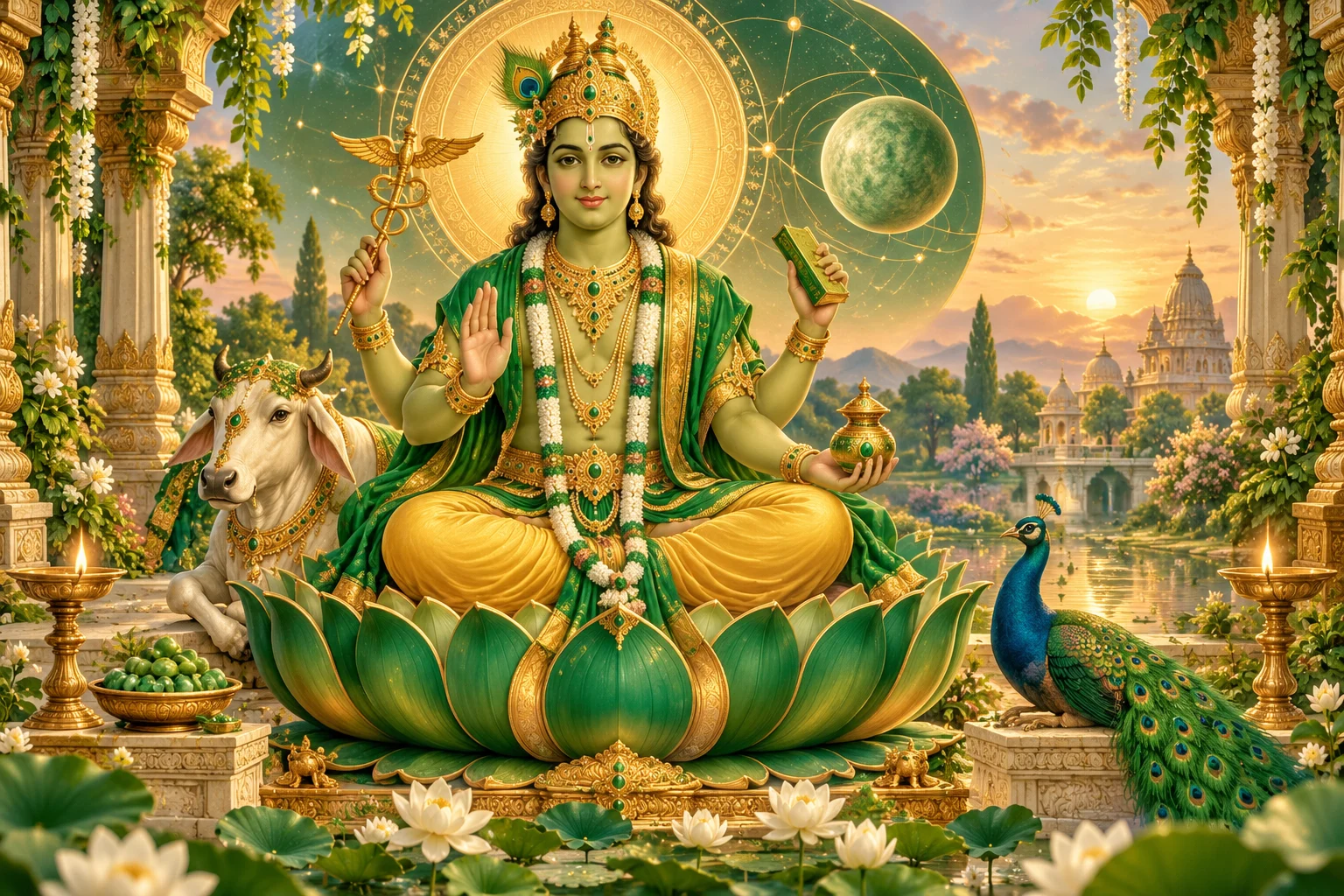
In the Puranas, Budh is the son of Chandra (the Moon) and Tara. He is described as green in complexion, gentle (saumya) in nature, and riding a lion. Budh married Ila, and their son Pururavas founded the Lunar dynasty (Chandravamsha), the line into which Krishna and the Pandavas were later born. His gentle, clever nature is why he rules speech, wit and learning.
All Budh mantras
| Mantra | Text | When it is used |
|---|---|---|
| Budh beej mantra | ॐ ब्रां ब्रीं ब्रौं सः बुधाय नमः Om Braam Breem Braum Sah Budhaya Namah |
Main remedy mantra; 108 times on Wednesday |
| Short Budh mantra | ॐ बुं बुधाय नमः Om Bum Budhaya Namah |
Simple daily chanting |
| Navagraha Stotra verse | प्रियंगुकलिकाश्यामं रूपेणाप्रतिमं बुधम्। सौम्यं सौम्यगुणोपेतं तं बुधं प्रणमाम्यहम्॥ Priyangu-kalika-shyamam rupena-pratimam budham, saumyam saumya-gunopetam tam budham pranamamyaham |
Navagraha puja |
| Budh Gayatri mantra | ॐ सौम्यरूपाय विद्महे बाणेशाय धीमहि तन्नो बुधः प्रचोदयात्॥ Om Saumya-rupaya Vidmahe Baneshaya Dhimahi Tanno Budhah Prachodayat |
Meditation for intellect and clear speech |
The Navagraha Stotra verse means: “I bow to Budh, dark like the bud of the priyangu flower, incomparable in form, gentle and full of gentle qualities.”
How to chant the Budh mantra
- Choose the day: begin on a Wednesday morning after bathing.
- Prepare: wear green if possible, and sit facing north.
- Offer: many devotees first worship Ganesha, the lord of intellect, offering durva grass.
- Chant: repeat Om Braam Breem Braum Sah Budhaya Namah 108 times on a mala, pronouncing each syllable clearly.
- Close: sit quietly for a moment before starting your study or work.
A green or emerald-hued mala is traditional but any mala works. If you are new to japa, read why mantras are chanted 108 times and the guide to starting a daily mantra practice. For learning and clear speech, some students also chant the Saraswati Mantra.
Signs of a weak Mercury and traditional remedies
In Vedic astrology, a weak or afflicted Budh is associated with poor concentration, difficulty expressing oneself, nervousness, forgetfulness and setbacks in study or business. Traditional remedies include:
- Chanting the Budh mantra 108 times every Wednesday
- Worshipping Ganesha on Wednesdays and offering durva grass
- Donating green moong dal or green cloth on Wednesday
- Feeding green fodder to cows
Navagraha mantras are traditional remedies, not guarantees. A difficult period still calls for practical effort and, where needed, qualified advice.
Frequently asked questions
What is the Budh mantra?
The main Budh mantra is the beej mantra Om Braam Breem Braum Sah Budhaya Namah. A shorter version is Om Bum Budhaya Namah.
What is the Budh mantra used for?
It is chanted for clarity of thought, memory, communication and learning, for success in business and writing, and to ease a difficult Mercury period in Vedic astrology.
Which day is best for the Budh mantra?
Wednesday is Budh’s traditional day. Morning, after bathing, is the most common time.
How many times should the Budh mantra be chanted?
108 times (one mala) for daily or weekly practice. The traditional full count for Navagraha shanti is often given as 9,000, though traditions vary.
Is the Budh mantra good for students?
Yes. Because Budh rules intellect, memory and speech, it is one of the most popular planetary mantras for students, often chanted alongside a Saraswati or Ganesha mantra.
Who is the father of Budh?
According to the Puranas, Budh is the son of Chandra, the Moon god, and Tara.
Is the Budh mantra the same as a Buddha mantra?
No. This page is about Budh, Mercury in Vedic astrology — not the Buddha of Buddhist tradition. English spelling makes the names look alike, and search results often mix the two. A Buddha mantra (such as Buddham saranam gacchami or a Medicine Buddha dharani) belongs to a different path, with different texts and aims. If you came here looking for a Buddhist chant, this is not that page.
Can I chant the Budh mantra every day or at night?
Wednesday morning is the usual time, but a short daily practice on other days is also common. Night chanting is not prohibited; morning is simply preferred, because the mantra is used for a clear, attentive mind. If chanting late leaves you restless, keep it for the morning.
Do I need an emerald (panna) to chant it?
No. Emerald is the gem traditionally associated with Budh, and some people wear one when taking a gem as a remedy, but the mantra does not depend on a stone. Any mala is acceptable, and the beej mantra can be recited without one. Choosing a gem is a personal decision and, if you want chart-specific advice, a matter for a qualified jeweller or astrologer.
Sources and editorial note
The portrait of Budh as the son of Chandra and Tara, and as an ancestor of the Lunar dynasty, follows standard Puranic genealogy already summarised on this page. The Navagraha Stotra verse quoted above is the widely printed priyangu-kalika-shyamam verse attributed to Vedavyasa. Day, colour, direction and gem associations are those of the received Navagraha tradition; they are customary correspondences, not laboratory findings. English explanations are original to this site.
This page was reviewed on 24 November 2026 by Anurag Goel, who publishes VedicVani. The mantra is a prayer and a traditional astrological remedy, not a medical treatment or a guarantee of exam or business results. Corrections are welcome through the About page.
Frequently Asked Questions
What does Budh Mantra (Mercury Beej Mantra: Om Braam Breem Braum Sah Budhaya Namah) mean?
"I bow to Budh (Mercury)." Built around the beej syllables "Braam Breem Braum," this mantra invokes Budh's association with intellect, communication and learning. In Vedic astrology, Budh is the karaka of intelligence, speech, memory, mathematics, writing and trade, and this mantra is chanted by students, writers, business people and communicators, as well as those seeking to ease a difficult Budh period.
How many times should Budh Mantra (Mercury Beej Mantra: Om Braam Breem Braum Sah Budhaya Namah) be chanted?
The traditional recommendation is 108 times, traditionally using an emerald or green-hued mala if available, though any mala is acceptable.
What are the benefits of chanting Budh Mantra (Mercury Beej Mantra: Om Braam Breem Braum Sah Budhaya Namah)?
Chanted for clarity of thought, sharp intellect and good memory. Traditionally recited for clear, confident speech and communication.
Is the Budh mantra the same as a Buddha mantra?
No. Budh in this context is Mercury, the Vedic graha of intellect and speech. Buddha mantras belong to Buddhist practice (for example, homage to the Buddha or the Medicine Buddha). The sounds can look similar in English spelling, but the deities, texts and purposes are different.
Can I chant the Budh mantra every day or at night?
Wednesday morning, after bathing, is the traditional time. Many people also keep a shorter daily practice on other days. Night chanting is not forbidden, but morning is preferred because Budh is associated with a clear, alert mind. If late repetition leaves you restless, keep the practice for the morning.
Do I need an emerald (panna) to chant the Budh mantra?
No. Emerald is the gem traditionally linked with Budh, and some people wear one after personal astrological advice, but the mantra can be chanted with any mala, or with none. A gem is a separate choice, not a requirement for japa.
What should I do when Budh (Mercury) is weak?
Traditional remedies include chanting the Budh beej mantra 108 times on Wednesday, worshipping Ganesha, and donating green moong or green cloth. These are customary practices, not guarantees. Study, speech and work still need ordinary effort, and a difficult chart is a matter for a qualified astrologer if you want personal advice.