
Mantra · Mangal
Mangal Mantra (Om Kraam Kreem Kraum Sah Bhaumaya Namah)
Last updated: November 8, 2026
Edited by Anurag Goel
Mangal mantra: Om Kraam Kreem Kraum Sah Bhaumaya Namah. Sanskrit, meaning, benefits for courage, 5 Mangal mantras, Mangal dosha remedies and how to chant.
ॐ क्रां क्रीं क्रौं सः भौमाय नमः
Om Kraam Kreem Kraum Sah Bhaumaya Namah
Meaning
"I bow to Mangal (Mars), also called Bhauma, the son of the Earth." Built around the beej syllables "Kraam Kreem Kraum," this mantra invokes Mangal's energy of courage, action and decisiveness. In Vedic astrology, Mangal is the karaka of strength, courage, siblings, land and property, and this mantra is chanted for strength of will, to calm anger, and to ease a difficult Mangal period or Mangal dosha.
मंगल मंत्र "ॐ क्रां क्रीं क्रौं सः भौमाय नमः" का अर्थ है: मैं मंगल देव (भौम) को नमन करता हूँ। यह मंगल का बीज मंत्र है, जिसे मंगलवार को 108 बार जपा जाता है। "क्रां क्रीं क्रौं" बीज अक्षर मंगल ग्रह की साहस और शक्ति से जुड़ी ऊर्जा का प्रतीक हैं। यह मंत्र साहस, आत्मविश्वास, निर्णय लेने की क्षमता और मंगल दोष की शांति के लिए परंपरागत रूप से जपा जाता है।
Benefits
- Chanted for courage, confidence and decisiveness.
- Traditionally recited to channel energy and calm anger or impatience.
- Used as a remedy for Mangal dosha (Manglik dosha) and a difficult Mars period in Vedic astrology.
- Associated with physical energy, stamina and the strength to take action.
- Believed to support matters of land, property and good relations with siblings.
- Chanted before competitions, exams, interviews or difficult undertakings for steady confidence.
How to Chant
Chant on Tuesday, Mangal's traditional day, in the morning after bathing. Wear red if possible and sit facing east or south. Because Mangal's energy is associated with intensity, a calm, unhurried tone is traditionally preferred over a rushed or agitated one.
Recommended count: 108 times, traditionally using a red coral or rudraksha mala
Mangal mantra at a glance
| Main mantra | ॐ क्रां क्रीं क्रौं सः भौमाय नमः (Om Kraam Kreem Kraum Sah Bhaumaya Namah) |
| Short mantra | ॐ अं अंगारकाय नमः (Om Am Angarakaya Namah) |
| Planet | Mars (Mangal, also called Bhauma, Angaraka, Kuja) |
| Rules over | Courage, energy, siblings, land and property |
| Day | Tuesday (Mangalvar) |
| Colour | Red |
| Gemstone | Red coral (moonga) |
| Metal | Copper |
| Direction | South |
| Daily count | 108 (one mala) |
| Traditional full count | 10,000 for Navagraha shanti |
Mangal among the Navagraha
Mangal is one of the nine grahas (Navagraha) in Vedic astrology, alongside Surya, Chandra, Budh, Guru, Shukra, Shani, Rahu and Ketu. He is the commander (senapati) among the planets, traditionally associated with energy, courage and the will to act. The mantra is chanted to invoke those qualities, particularly by those seeking confidence before a difficult decision or undertaking, and to cool Mars’s fiery side: anger, impatience and conflict.
Who is Mangal?
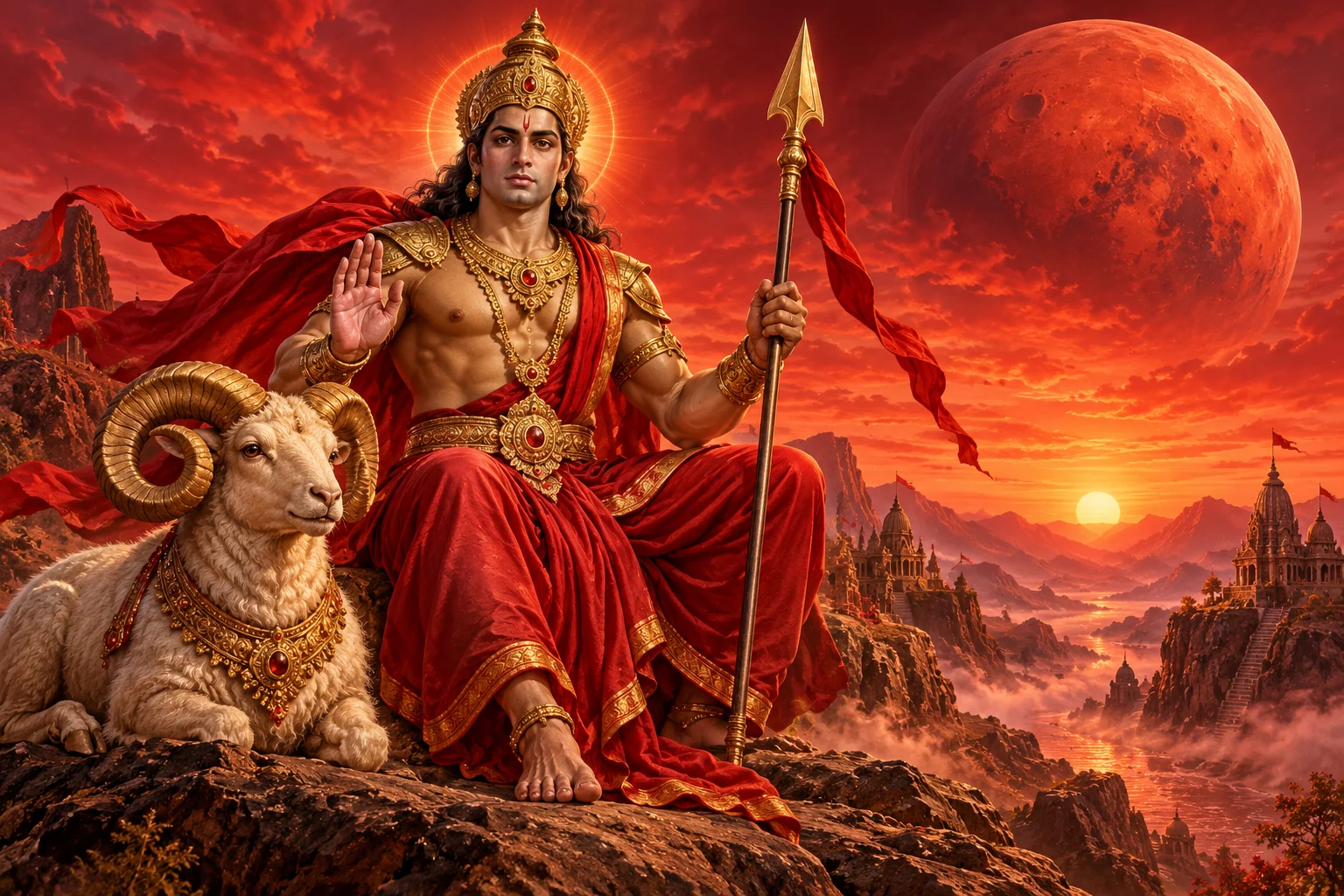
The name Bhauma means “son of Bhumi,” the Earth goddess, and the Navagraha Stotra calls Mangal dharaṇī-garbha-sambhūtam, “born from the womb of the Earth.” Other Puranic accounts say he was born from a drop of Shiva’s sweat that fell to the earth. He is pictured as a red, youthful warrior (kumara) holding a spear (shakti), riding a ram. His other names, Angaraka (“the glowing ember”) and Lohitanga (“red-bodied”), reflect the planet’s red colour.
All Mangal mantras
| Mantra | Text | When it is used |
|---|---|---|
| Mangal beej mantra | ॐ क्रां क्रीं क्रौं सः भौमाय नमः Om Kraam Kreem Kraum Sah Bhaumaya Namah |
Main remedy mantra; 108 times on Tuesday |
| Short Mangal mantra | ॐ अं अंगारकाय नमः Om Am Angarakaya Namah |
Simple daily chanting |
| Navagraha Stotra verse | धरणीगर्भसम्भूतं विद्युत्कान्तिसमप्रभम्। कुमारं शक्तिहस्तं तं मङ्गलं प्रणमाम्यहम्॥ Dharani-garbha-sambhutam vidyut-kanti-samaprabham, kumaram shakti-hastam tam mangalam pranamamyaham |
Navagraha puja |
| Mangal Gayatri mantra | ॐ अङ्गारकाय विद्महे शक्तिहस्ताय धीमहि तन्नो भौमः प्रचोदयात्॥ Om Angarakaya Vidmahe Shakti-hastaya Dhimahi Tanno Bhaumah Prachodayat |
Meditation for courage and inner strength |
| Mangalam Bhagavan Vishnu | मङ्गलं भगवान विष्णुः मङ्गलं गरुडध्वजः। मङ्गलं पुण्डरीकाक्षः मङ्गलाय तनो हरिः॥ | An auspicious blessing, not a Mars mantra (see below) |
The Navagraha Stotra verse means: “I bow to Mangal, born from the womb of the Earth, shining like lightning, the youthful one who holds a spear in his hand.”
A common mix-up: Mangalam Bhagavan Vishnu is a well-known blessing recited at weddings, housewarmings and the start of pujas. Mangalam here means “auspicious,” so it is a prayer to Vishnu for good fortune, not a mantra of the planet Mangal.
How to chant the Mangal mantra
- Choose the day: start on a Tuesday, preferably in the morning after bathing.
- Prepare: wear red or orange if possible, and sit facing east or south.
- Offer: light a lamp, and offer red flowers if you have them.
- Chant: repeat Om Kraam Kreem Kraum Sah Bhaumaya Namah 108 times on a mala, with a calm, steady tone.
- Close: sit quietly and offer a short prayer for courage and patience.
A red coral or rudraksha mala is traditional but any mala works. New chanters can read why mantras are chanted 108 times and the guide to starting a daily mantra practice.
Mangal dosha and traditional remedies
In Vedic astrology, Mangal dosha (also called Manglik or Kuja dosha) is said to occur when Mars sits in certain houses of the birth chart. It is most often discussed in connection with marriage matching. Traditional remedies include:
- Chanting the Mangal mantra 108 times every Tuesday
- Reciting the Hanuman Chalisa on Tuesdays, since Tuesday is also Hanuman’s day; some pair it with the Hanuman Beej Mantra
- Offering sindoor and red flowers to Hanuman
- Donating red lentils (masoor dal), red cloth or jaggery on Tuesday
Astrologers differ widely on how Mangal dosha is calculated and when it is cancelled. Navagraha mantras are traditional remedies, not guarantees, and decisions about marriage should never rest on astrology alone.
Frequently asked questions
What is the Mangal mantra?
The main Mangal mantra is the beej mantra Om Kraam Kreem Kraum Sah Bhaumaya Namah. A shorter version is Om Am Angarakaya Namah.
What is the Mangal mantra used for?
It is chanted for courage, confidence and decisiveness, to calm anger, and to ease a difficult Mars period or Mangal dosha in Vedic astrology.
Which day is best for the Mangal mantra?
Tuesday is Mangal’s traditional day. Morning, after bathing, is the preferred time.
How many times should the Mangal mantra be chanted?
108 times (one mala) for daily or weekly practice. The traditional full count for Navagraha shanti is 10,000.
Which mantra is best for Mangal dosha?
The Mangal beej mantra, chanted 108 times on Tuesdays, is the main one. Many families also recite the Hanuman Chalisa on Tuesdays.
Is “Mangalam Bhagavan Vishnu” a Mangal mantra?
No. It is an auspicious blessing to Vishnu, recited at weddings and the start of rituals. The word mangalam there means “auspicious,” not the planet Mars.
Frequently Asked Questions
What does Mangal Mantra (Om Kraam Kreem Kraum Sah Bhaumaya Namah) mean?
"I bow to Mangal (Mars), also called Bhauma, the son of the Earth." Built around the beej syllables "Kraam Kreem Kraum," this mantra invokes Mangal's energy of courage, action and decisiveness. In Vedic astrology, Mangal is the karaka of strength, courage, siblings, land and property, and this mantra is chanted for strength of will, to calm anger, and to ease a difficult Mangal period or Mangal dosha.
How many times should Mangal Mantra (Om Kraam Kreem Kraum Sah Bhaumaya Namah) be chanted?
The traditional recommendation is 108 times, traditionally using a red coral or rudraksha mala.
What are the benefits of chanting Mangal Mantra (Om Kraam Kreem Kraum Sah Bhaumaya Namah)?
Chanted for courage, confidence and decisiveness. Traditionally recited to channel energy and calm anger or impatience.