
Tulsi · Aarti
Tulsi Mata Aarti
Tulsi Mata Aarti (Jai Jai Tulsi Mata) full lyrics in Hindi with English transliteration and meaning — how to sing this hymn at daily tulsi puja and at Tulsi Vivah.
Significance
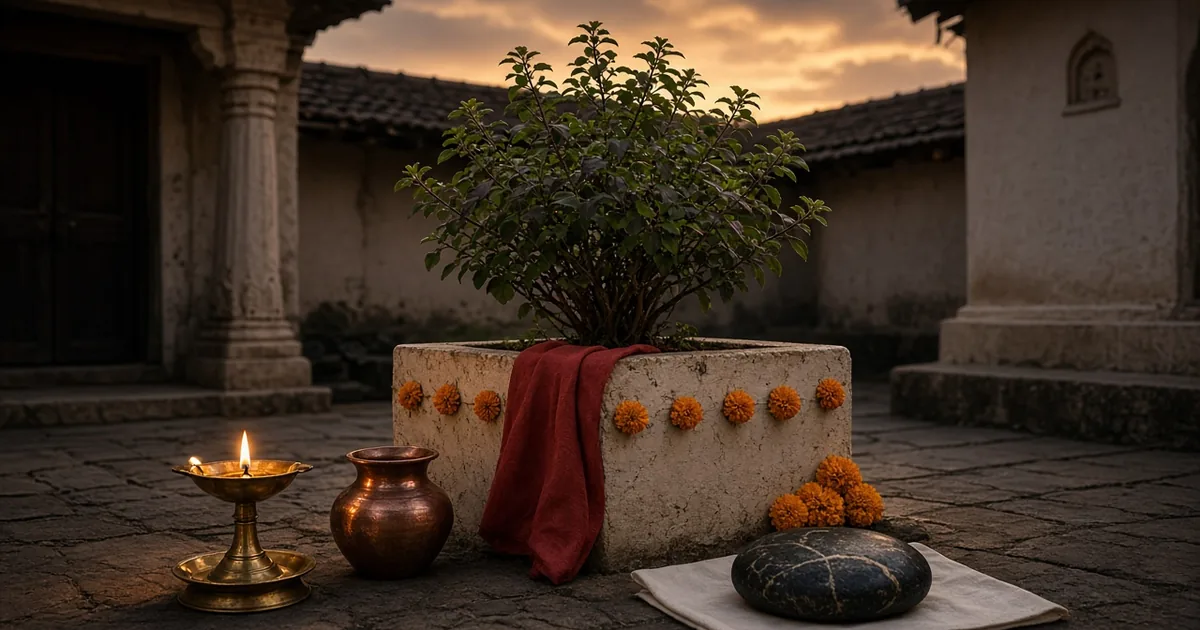
This is the aarti most often sung at the household tulsi plant, especially in the evening, through the month of Kartik, and at Tulsi Vivah, which falls on Saturday, 21 November 2026, the day after Dev Uthani Ekadashi. Families also sing it after watering the plant or offering a lamp at the tulsi chaura. Its central mood is gratitude for a living presence in the courtyard, not only a festival hymn.
How to Perform
Stand or sit facing the household tulsi, or a simple image of Vishnu or a Shaligram if you have one. Light a diya safely, offer water, flowers or a few grains of rice, and circle the lamp while singing. The refrain "Jai Jai Tulsi Mata" is repeated after each verse. Many households close with Om Jai Jagdish Hare. Kartik evenings, Dev Uthani Ekadashi and Tulsi Vivah are the most common special occasions; the aarti may also be part of daily sandhya. Recitation is a spiritual practice, not a substitute for medical, legal or practical help.
The Tulsi Mata Aarti, opening with the line Jai Jai Tulsi Mata, is the short Hindi hymn most families sing before the household tulsi plant. This page gives the widely recited text in Devanagari, a readable transliteration, and an original English meaning of each verse, written from the Hindi rather than copied from another translation. It is the aarti of Tulsi Vivah, which in 2026 falls on Saturday, 21 November.
Lyrics
जय जय तुलसी माता। सब जग की सुखदाता, वरदाता॥ जय जय तुलसी माता॥
सब योगों के ऊपर, सब रोगों के ऊपर। रुज से रक्षा करके, भव त्राता॥ जय जय तुलसी माता॥
बहु पुत्री है श्यामा, सुर बल्ली है ग्राम्या। विष्णुप्रिये जो तुमको सेवे, सो नर तर जाता॥ जय जय तुलसी माता॥
हरि के शीश विराजत, त्रिभुवन से हो वंदित। पतित जनों की तारिणि, तुम हो विख्याता॥ जय जय तुलसी माता॥
लेकर जन्म विपिन में, आई दिव्य भवन में। मानव लोक तुम्हीं से सुख सम्पति पाता॥ जय जय तुलसी माता॥
हरि को तुम अति प्यारी, श्याम वरण सुकुमारी। प्रेम अजब है उनका, तुमसे कैसा नाता॥ जय जय तुलसी माता॥
Transliteration
Jai Jai Tulsi Mata. Sab Jag Ki Sukhdata, Vardata. Jai Jai Tulsi Mata.
Sab Yogon Ke Upar, Sab Rogon Ke Upar. Ruj Se Raksha Karke, Bhav Trata. Jai Jai Tulsi Mata.
Bahu Putri Hai Shyama, Sur Balli Hai Gramya. Vishnupriye Jo Tumko Seve, So Nar Tar Jata. Jai Jai Tulsi Mata.
Hari Ke Shish Virajat, Tribhuvan Se Ho Vandit. Patit Janon Ki Tarini, Tum Ho Vikhyata. Jai Jai Tulsi Mata.
Lekar Janma Vipin Mein, Aai Divya Bhavan Mein. Manav Lok Tumhin Se Sukh Sampati Pata. Jai Jai Tulsi Mata.
Hari Ko Tum Ati Pyari, Shyam Varan Sukumari. Prem Ajab Hai Unka, Tumse Kaisa Nata. Jai Jai Tulsi Mata.
Use the transliteration only until you can follow the Devanagari and a recording; Roman spellings vary and cannot capture every sound.
English meaning, verse by verse
- Victory, victory to Mother Tulsi, who gives joy to the whole world and grants blessings.
- You stand above every yoga and above every illness. Protecting from disease (ruj), you are the one who carries beings across worldly existence (bhava).
- You are Shyama, the dark-hued one, called bahu putri; you are the gods’ own creeper (sur balli), and gramya, she who grows by village homes. O beloved of Vishnu, whoever serves you crosses over.
- You rest on Hari’s head — tulsi leaves are offered to Vishnu in worship — and the three worlds bow to you. You are renowned as the one who carries the fallen across.
- Taking birth in the forest (vipin), you came into the divine household. The world of humans receives joy and prosperity from you alone.
- You are most dear to Hari, O tender one of dark hue. Wondrous is his love; how deep is this bond with you?
The hymn’s mention of protection from illness belongs to its devotional language. It is not a medical claim, and singing the aarti is not a substitute for care or treatment.
A few phrases in verse 3 are traditional epithets whose exact sense is discussed rather than settled: bahu putri is the reading of the printed booklets used here; some modern copies read batu putri, which is still less clear. Sur balli (also printed sur valli or shar balli) names Tulsi as a sacred creeper; gramya points to the plant that grows beside ordinary homes.
Text and sources
The Hindi here follows the widely sung recension of the Tulsi Mata Aarti as printed on page 22 of Ganga Lahari, an undated hymn booklet from Bharat Prakashan Mandir, Mathura (eGangotri scan on the Internet Archive, CC-0 declaration on the digitisation). The opening “जय जय तुलसी माता”, the six-verse sequence, and the closing line on Hari’s bond with Tulsi are taken from that page. A few letters on the scan are worn or poorly set — notably in the third verse — so those words were checked against page 4 of the undated Arti Sangraha published by Anand Prakashan (also on the Internet Archive), which carries the same verses in a clearer type. The Anand booklet opens the refrain as “जय तुलसी माता जय तुलसी माता” and reads “सब जग सुख की दाता वर दाता”; the Mathura opening is kept as the controlling text because it matches the form in which the aarti is most often sung. Neither print names an author; the hymn is presented as traditional and anonymous.
A few common printed and sung variants are worth knowing. Anand reads विजन (a lonely place) where the Mathura page has विपिन (forest); both describe the same wilderness birth. Some copies read विराजित for विराजत, तारणी for तारिणि, and श्री हरि का तुम से नाता for उनका, तुमसे कैसा नाता. A later spoken line, “हमारी विपद हरो तुम, कृपा करो माता”, appears in some modern booklets and recordings but is not in either of these two prints, so it is not added here. None of these changes the hymn’s overall meaning.
The English meanings on this page are original to VedicVani, written from the Hindi, and are not taken from any published translation of the aarti.
Another popular hymn, Namo Namo Tulsi Maharani, is a separate composition and is not printed on this page. After the aarti, many households also sing Om Jai Jagdish Hare.
How to sing the Tulsi Mata Aarti
Choose a quiet moment, most often at evening sandhya, when you can stand before the tulsi without rushing. Light a diya safely, offer a little water at the root if the plant is in the courtyard, and sing the six verses slowly enough that the refrain can settle. Beginners often keep the Hindi, the transliteration and the English meaning side by side for a few days, then return to the Devanagari. Through Kartik, and especially at Tulsi Vivah on Saturday, 21 November 2026, the aarti is sung as part of the wedding of tulsi to Vishnu (usually a Shaligram). Dev Uthani Ekadashi on 20 November, the day before, closes Chaturmas and is another natural time to begin. A Vishnu mantra and the household care of the plant itself — watering, a clean chaura, and not plucking leaves at night, according to common custom — are natural companions. For how an aarti sits beside a chalisa or a mantra, see aarti, chalisa and mantra explained.
Meaning and traditional benefits
Devotees turn to the Tulsi Mata Aarti for a short, memorable praise of the plant they live with every day, and for the hymn’s own language of protection, crossing over, and the love between Tulsi and Hari. Those statements belong to the devotional tradition of the poem; they are not a substitute for care, medicine or practical judgement.
Overall Meaning
Jai Jai Tulsi Mata is a short Hindi aarti in praise of Tulsi, the sacred basil revered as Vishnu's beloved. It greets her as the mother who gives joy and blessings to the world, who stands above illness, and who is dear to Hari — resting, as a tulsi leaf, on his head. The later verses remember her birth in the forest, her place in the divine household, and the wondrous bond between Tulsi and Vishnu. The hymn names no author and is sung as a traditional, anonymous aarti.
Frequently Asked Questions
What is the meaning of Tulsi Mata Aarti?
Jai Jai Tulsi Mata is a short Hindi aarti in praise of Tulsi, the sacred basil revered as Vishnu's beloved. It greets her as the mother who gives joy and blessings to the world, who stands above illness, and who is dear to Hari — resting, as a tulsi leaf, on his head. The later verses remember her birth in the forest, her place in the divine household, and the wondrous bond between Tulsi and Vishnu. The hymn names no author and is sung as a traditional, anonymous aarti.
Why is Tulsi Mata Aarti significant?
This is the aarti most often sung at the household tulsi plant, especially in the evening, through the month of Kartik, and at Tulsi Vivah, which falls on Saturday, 21 November 2026, the day after Dev Uthani Ekadashi. Families also sing it after watering the plant or offering a lamp at the tulsi chaura. Its central mood is gratitude for a living presence in the courtyard, not only a festival hymn.
Is Jai Jai Tulsi Mata the same as Namo Namo Tulsi Maharani?
No. Jai Jai Tulsi Mata is the short Hindi aarti given on this page. Namo Namo Tulsi Maharani (also called Tulsi Maharani aarti) is a different, widely sung hymn. Some households sing both; they should not be treated as the same text.
When should the Tulsi Mata Aarti be sung?
At the daily worship of the household tulsi, especially at evening sandhya, through Kartik, and at Tulsi Vivah. In 2026, Tulsi Vivah falls on Saturday, 21 November, the day after Dev Uthani Ekadashi.
Do I need a tulsi plant at home to sing this aarti?
A living tulsi in a chaura or pot is the usual setting, but a clean space, a safely placed lamp and sincere attention are enough if you do not have a plant. Follow the custom your family or temple already keeps.