
Bhagavad Gita · Chapter 13
Kshetra Kshetrajna Vibhaga Yoga — Field and Knower
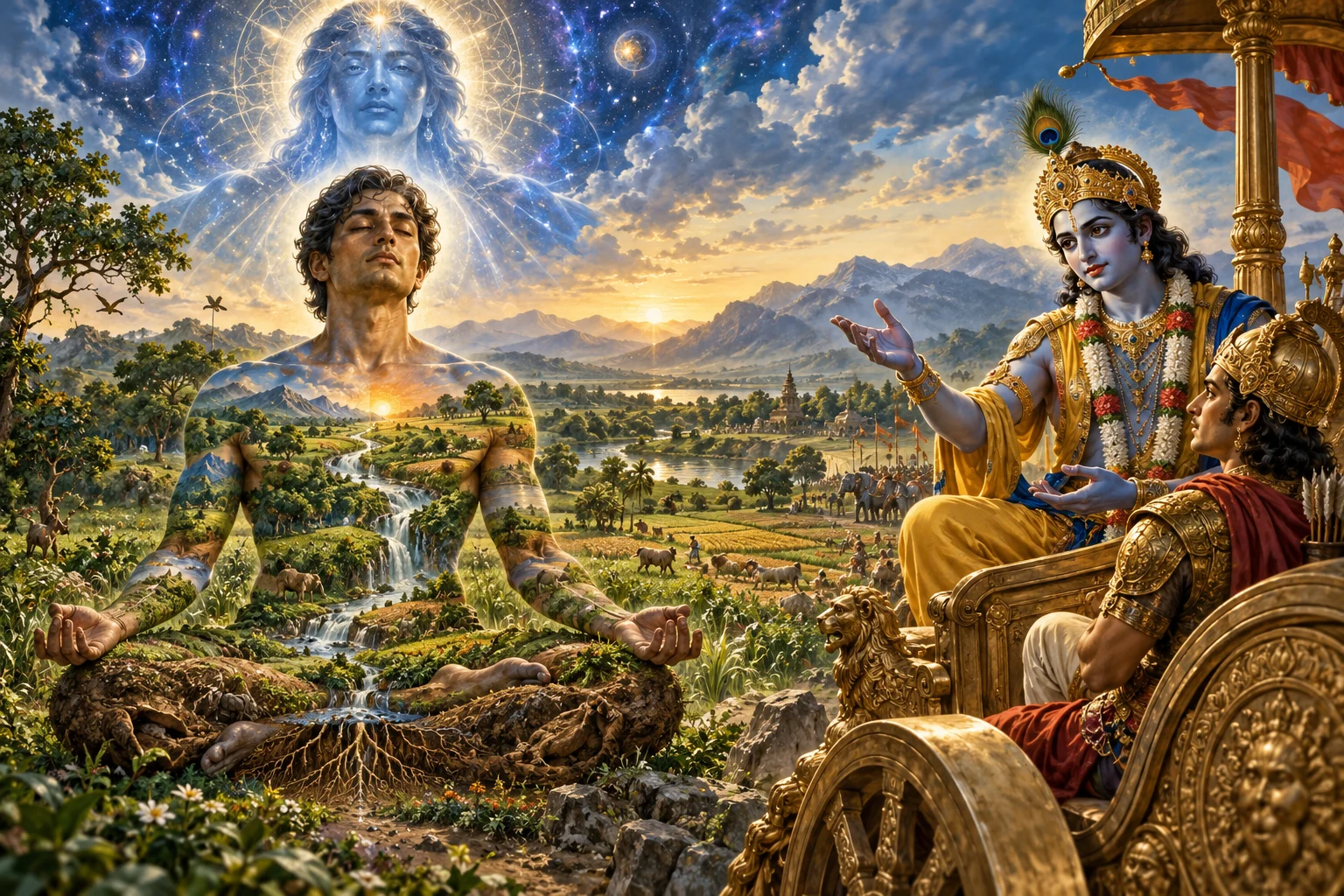
Chapter 13 of the Bhagavad Gita, Kshetra Kshetrajna Vibhaga Yoga — Field and Knower, is part of Krishna's dialogue with Arjuna on the battlefield of Kurukshetra. Each shloka below includes the original Sanskrit verse, a transliteration, Hindi and English meaning, a clear explanation of the philosophy behind it, and the practical life lesson it offers — so you can read a single verse in depth or follow this chapter's complete argument verse by verse. See thefull chapter list to move between all 18 chapters.
How to study Chapter 13
Read the verses in sequence first, then return to the shlokas that speak most directly to your question. Notice the movement between Arjuna's concerns and Krishna's response: the Gita develops its teaching through dialogue, examples, discipline, and repeated clarification. Sanskrit preserves the sound of the original text, transliteration helps with pronunciation, and the meanings provide an accessible doorway for daily reflection.
A useful practice is to choose one verse for a week. Write its central idea in your own words, observe where attachment or fear appears in your day, and revisit the verse before making a difficult choice. This chapter is part of the larger 18-chapter Bhagavad Gita, so compare its theme with the chapters before and after it rather than reading any single line as an isolated slogan.
अर्जुन उवाच | प्रकृतिं पुरुषं चैव क्षेत्रं क्षेत्रज्ञमेव च | एतद्वेदितुमिच्छामि ज्ञानं ज्ञेयं च केशव
13.1 Arjuna said I wish to learn about Nature (matter) and the Spirit (soul), the field and the knower of the field, knowledge and that which ought to be known, O Kesava.
13.2श्रीभगवानुवाच | इदं शरीरं कौन्तेय क्षेत्रमित्यभिधीयते | एतद्यो वेत्ति तं प्राहुः क्षेत्रज्ञ इति तद्विदः
13.2 The Blessed Lord said This body, O Arjuna, is called the field; he who knows it is called the knower of the field, by those who know of them.
13.3क्षेत्रज्ञं चापि मां विद्धि सर्वक्षेत्रेषु भारत | क्षेत्रक्षेत्रज्ञयोर्ज्ञानं यत्तज्ज्ञानं मतं मम
13.3 Do thou also know Me as the knower of the field in all fields, O Arjuna. Knowledge of both the field and the knower of the field is considered by Me to be ï1the ï1 knowledge.
13.4तत्क्षेत्रं यच्च यादृक्च यद्विकारि यतश्च यत् | स च यो यत्प्रभावश्च तत्समासेन मे शृणु
13.4 What the field is and of what nature, what are its modifications and whence it is and also who He is and what His powers are hear all that from Me in brief.
13.5ऋषिभिर्बहुधा गीतं छन्दोभिर्विविधैः पृथक् | ब्रह्मसूत्रपदैश्चैव हेतुमद्भिर्विनिश्चितैः
13.5 Sages have sung in many ways, in various distinctive chants and also in the suggestive words indicative of the Absolute, full of reasoning and decisive.
13.6महाभूतान्यहंकारो बुद्धिरव्यक्तमेव च | इन्द्रियाणि दशैकं च पञ्च चेन्द्रियगोचराः
13.6 The great elements, egoism, intellect, and also the Unmanifested Nature, the ten senses and one (mind), and the five objects of the senses.
13.7इच्छा द्वेषः सुखं दुःखं संघातश्चेतना धृतिः | एतत्क्षेत्रं समासेन सविकारमुदाहृतम्
13.7 Desire, hatred, pleasure, pain, the aggregate (the body), intelligence, fortitude the field has thus been briefly described with its modifications.
13.8अमानित्वमदम्भित्वमहिंसा क्षान्तिरार्जवम् | आचार्योपासनं शौचं स्थैर्यमात्मविनिग्रहः
13.8 Humility, unpretentiousness, non-injury, forgiveness, uprightness, service of the teacher, purity, steadfastness, self-control.
13.9इन्द्रियार्थेषु वैराग्यमनहंकार एव च | जन्ममृत्युजराव्याधिदुःखदोषानुदर्शनम्
13.9 Indifference to the objects of the senses and also absence of egoism; perception of (or reflection on) the evil in birth, death, old age, sickness and pain.
13.10असक्तिरनभिष्वङ्गः पुत्रदारगृहादिषु | नित्यं च समचित्तत्वमिष्टानिष्टोपपत्तिषु
13.10 Non-attachment, non-identification of the Self with son, wife, home and the rest, and constant even-mindedness on the attainment of the desirable and the undesirable.
13.11मयि चानन्ययोगेन भक्तिरव्यभिचारिणी | विविक्तदेशसेवित्वमरतिर्जनसंसदि
13.11 Unswerving devotion unto Me by the Yoga of non-separation, resort to solitary places, distaste for the society of men.
13.12अध्यात्मज्ञाननित्यत्वं तत्त्वज्ञानार्थदर्शनम् | एतज्ज्ञानमिति प्रोक्तमज्ञानं यदतोऽन्यथा
13.12 Constancy in Self-knowledge, perception of the end of true knowledge this is declared to be knowledge, and what is opposed to it is ignorance.
13.13ज्ञेयं यत्तत्प्रवक्ष्यामि यज्ज्ञात्वामृतमश्नुते | अनादिमत्परं ब्रह्म न सत्तन्नासदुच्यते
13.13 I will declare that which has to be known, knowing which one attains to immortality, the beginningless supreme Brahman, called neither being nor non-being.
13.14सर्वतः पाणिपादं तत्सर्वतोऽक्षिशिरोमुखम् | सर्वतः श्रुतिमल्लोके सर्वमावृत्य तिष्ठति
13.14 With hands and feet everywhere, with eyes, heads and mouths everywhere, with ears everywhere, He exists in the worlds enveloping all.
13.15सर्वेन्द्रियगुणाभासं सर्वेन्द्रियविवर्जितम् | असक्तं सर्वभृच्चैव निर्गुणं गुणभोक्तृ च
13.15 Shining by the functions of all the senses, yet without the senses; unattached, yet supporting all; devoid of alities, yet their experiencer.
13.16बहिरन्तश्च भूतानामचरं चरमेव च | सूक्ष्मत्वात्तदविज्ञेयं दूरस्थं चान्तिके च तत्
13.16 Without and within (all) beings the unmoving and also the moving; because of Its subtlety, unknowable; and near and far away is That.
13.17अविभक्तं च भूतेषु विभक्तमिव च स्थितम् | भूतभर्तृ च तज्ज्ञेयं ग्रसिष्णु प्रभविष्णु च
13.17 And undivided, yet It exists as if divided in beings; It is to be known as the supporter of being; It devours and It generates.
13.18ज्योतिषामपि तज्ज्योतिस्तमसः परमुच्यते | ज्ञानं ज्ञेयं ज्ञानगम्यं हृदि सर्वस्य विष्ठितम्
13.18 That, the Light of all lights, is said to be beyond darkness: knowledge, the knowable and the goal of knowledge, seated in the hearts of all.
13.19इति क्षेत्रं तथा ज्ञानं ज्ञेयं चोक्तं समासतः | मद्भक्त एतद्विज्ञाय मद्भावायोपपद्यते
13.19 Thus the field, as well as knowledge and the knowable have been briefly stated. My devotee, knowing this, enters into My Being.
13.20प्रकृतिं पुरुषं चैव विद्ध्यनादी उभावपि | विकारांश्च गुणांश्चैव विद्धि प्रकृतिसम्भवान्
13.20 Know thou that Nature (matter) and the Spirit are both beginningless; and know also that all modifications and alities are born of Nature.
13.21कार्यकारणकर्तृत्वे हेतुः प्रकृतिरुच्यते | पुरुषः सुखदुःखानां भोक्तृत्वे हेतुरुच्यते
13.21 In the production of the effect and the cause, Nature (matter) is said to be the cause; in the experience of pleasure and pain, the soul is said to be the cause.
13.22पुरुषः प्रकृतिस्थो हि भुङ्क्ते प्रकृतिजान्गुणान् | कारणं गुणसङ्गोऽस्य सदसद्योनिजन्मसु
13.22 The soul seated in Nature experiences the alities born of Nature; attachment to the alities is the cause of its birth in good and evil wombs.
13.23उपद्रष्टानुमन्ता च भर्ता भोक्ता महेश्वरः | परमात्मेति चाप्युक्तो देहेऽस्मिन्पुरुषः परः
13.23 The Supreme Soul in this body is also called the spectator, the permitter, the supporter, the enjoyer, the great Lord and the Supreme Self.
13.24य एवं वेत्ति पुरुषं प्रकृतिं च गुणैः सह | सर्वथा वर्तमानोऽपि न स भूयोऽभिजायते
13.24 He who thus knows the Spirit and Matter together with the alities, in whatever condition he may be, he is not born again.
13.25ध्यानेनात्मनि पश्यन्ति केचिदात्मानमात्मना | अन्ये साङ्ख्येन योगेन कर्मयोगेन चापरे
13.25 Some by meditation behold the Self in the self by the self, others by the Yoga of knowledge, and still others by the Yoga of action.
13.26अन्ये त्वेवमजानन्तः श्रुत्वान्येभ्य उपासते | तेऽपि चातितरन्त्येव मृत्युं श्रुतिपरायणाः
13.26 Others also, not knowing thus, worship, having heard of It from others; they, too, cross beyond death, regarding what they have heard as the Supreme refuge.
13.27समं सर्वेषु भूतेषु तिष्ठन्तं परमेश्वरम्।
One who sees the Supreme Lord equally present in all beings, imperishable within the perishable — that person truly sees.
13.28समं सर्वेषु भूतेषु तिष्ठन्तं परमेश्वरम् | विनश्यत्स्वविनश्यन्तं यः पश्यति स पश्यति
13.28 He sees, who sees the Supreme Lord, existing eally in all beings, the unperishing within the perishing.
13.29समं पश्यन्हि सर्वत्र समवस्थितमीश्वरम् | न हिनस्त्यात्मनात्मानं ततो याति परां गतिम्
13.29 Because he who sees the same Lord eally dwelling everywhere does not destroy the Self by the self; he goes to the highest goal.
13.30प्रकृत्यैव च कर्माणि क्रियमाणानि सर्वशः | यः पश्यति तथात्मानमकर्तारं स पश्यति
13.30 He sees, who sees that all actions are performed by Nature alone and that the Self is actionless.
13.31यदा भूतपृथग्भावमेकस्थमनुपश्यति | तत एव च विस्तारं ब्रह्म सम्पद्यते तदा
13.31 When a man sees the whole variety of beings as resting in the One, and spreading forth from That alone, he then becomes Brahman.
13.32अनादित्वान्निर्गुणत्वात्परमात्मायमव्ययः | शरीरस्थोऽपि कौन्तेय न करोति न लिप्यते
13.32 Being without beginning and being devoid of (any) alities, the Supreme Self, imperishable, though dwelling in the body, O Arjuna, neither acts nor is tainted.
13.33यथा सर्वगतं सौक्ष्म्यादाकाशं नोपलिप्यते | सर्वत्रावस्थितो देहे तथात्मा नोपलिप्यते
13.33 As the all-pervading ether is not tainted, because of its subtlety, so the Self seated everywhere in the body is not tainted.
13.34यथा प्रकाशयत्येकः कृत्स्नं लोकमिमं रविः | क्षेत्रं क्षेत्री तथा कृत्स्नं प्रकाशयति भारत
13.34 Just as the one sun illumines the whole world, so also the Lord of the field (Supreme Self) illumines the whole field, O Arjuna.
13.35क्षेत्रक्षेत्रज्ञयोरेवमन्तरं ज्ञानचक्षुषा | भूतप्रकृतिमोक्षं च ये विदुर्यान्ति ते परम्
13.35 They who, by the eye of knowledge, perceive the distinction between the field and its knower and also the liberation from the Nature of being, go to the Supreme.
35 verses of Chapter 13 are covered so far, with more being added as each one is written, translated, and checked for accuracy rather than published all at once. If there's a specific shloka from this chapter you'd like to see next, let us know via the contact page.