
Bhagavad Gita · Chapter 14 · 27 verses
Bhagavad Gita Chapter 14: Gunatraya Vibhaga Yoga
The Yoga of the Three Gunas
Chapter 14 summary
Bhagavad Gita Chapter 14 explains the three gunas, or qualities of nature: sattva (goodness), rajas (passion) and tamas (inertia). Krishna describes how each one binds the self, how to recognise which one dominates, and what each leads to. He ends by describing the person who has gone beyond the gunas through steady, unwavering devotion.
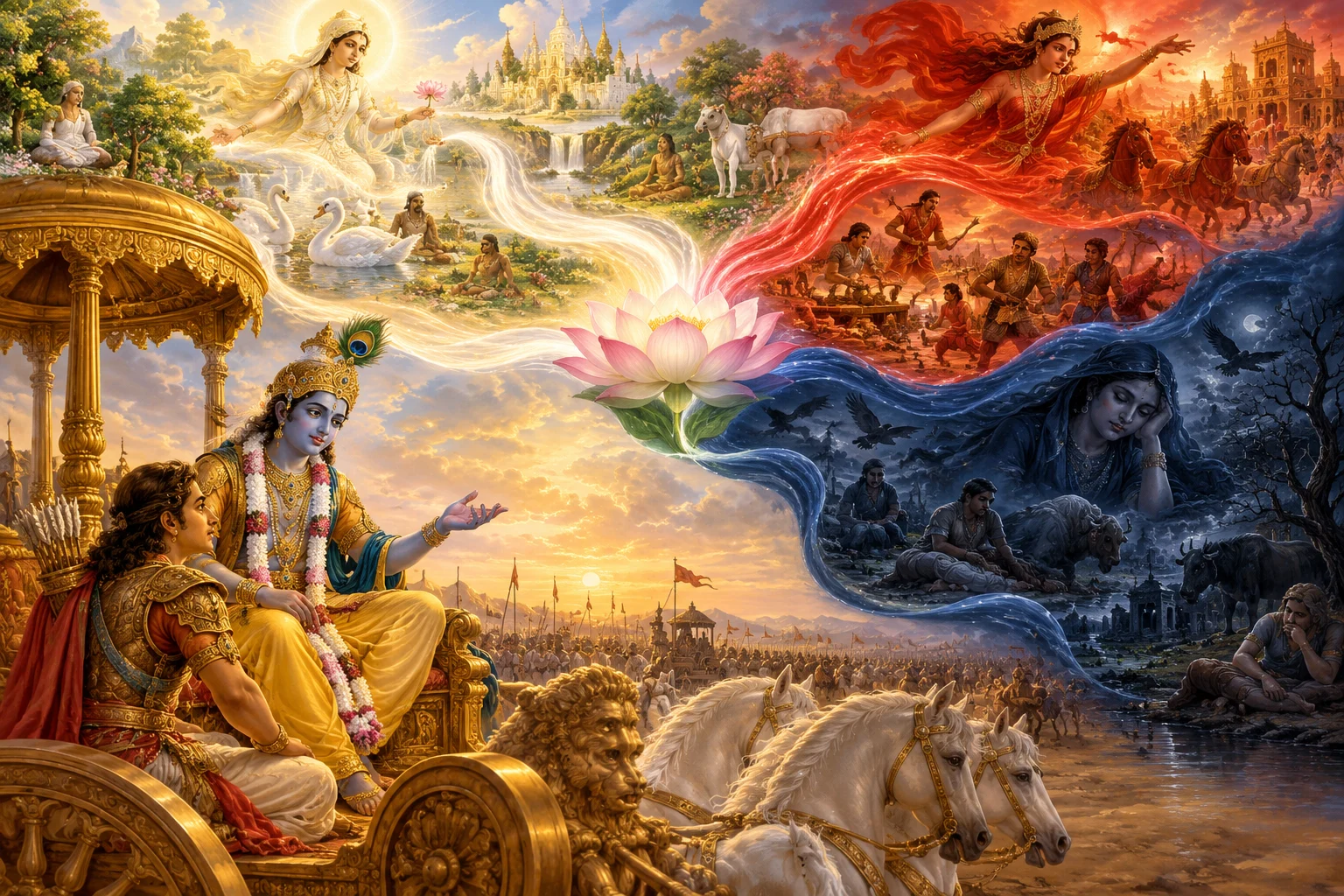
Key verses of Chapter 14
- Bhagavad Gita 14.5 — Sattva, rajas and tamas, born of nature, bind the imperishable self to the body.
- Bhagavad Gita 14.17 — From sattva arises knowledge, from rajas greed, and from tamas negligence and delusion.
- Bhagavad Gita 14.26 — One who serves Krishna with unwavering devotion rises above the gunas.
Chapter 14 of the Bhagavad Gita, Gunatraya Vibhaga Yoga — The Three Modes of Nature, has 27 verses and is part of Krishna's dialogue with Arjuna on the battlefield of Kurukshetra. Each shloka below includes the original Sanskrit verse, a transliteration, Hindi and English meaning, a clear explanation of the philosophy behind it, and the practical life lesson it offers — so you can read a single verse in depth or follow this chapter's complete argument verse by verse. See the full chapter list to move between all 18 chapters.
How to study Chapter 14
Read the verses in sequence first, then return to the shlokas that speak most directly to your question. Notice the movement between Arjuna's concerns and Krishna's response: the Gita develops its teaching through dialogue, examples, discipline, and repeated clarification. Sanskrit preserves the sound of the original text, transliteration helps with pronunciation, and the meanings provide an accessible doorway for daily reflection.
A useful practice is to choose one verse for a week. Write its central idea in your own words, observe where attachment or fear appears in your day, and revisit the verse before making a difficult choice. This chapter is part of the larger 18-chapter Bhagavad Gita, so compare its theme with the chapters before and after it rather than reading any single line as an isolated slogan. New to the text? Start with who wrote the Bhagavad Gita — Sage Vyasa as traditional author, Krishna as speaker.
All 27 verses of Bhagavad Gita Chapter 14
श्रीभगवानुवाच | परं भूयः प्रवक्ष्यामि ज्ञानानां ज्ञानमुत्तमम् | यज्ज्ञात्वा मुनयः सर्वे परां सिद्धिमितो गताः
14.1 The Blessed Lord said I will again declare (to thee) that supreme knowledge, the best of all knowledge, having known which all the sages have gone to the supreme perfection after this life.
14.2इदं ज्ञानमुपाश्रित्य मम साधर्म्यमागताः | सर्गेऽपि नोपजायन्ते प्रलये न व्यथन्ति च
14.2 They who, having taken refuge in this knowledge, have attained to unity with Me, are neither born at the time of creation nor are they disturbed at the time of dissolution.
14.3मम योनिर्महद् ब्रह्म तस्मिन्गर्भं दधाम्यहम् | सम्भवः सर्वभूतानां ततो भवति भारत
14.3 My womb is the great Brahma; in that I place the germ; thence, O Arjuna, is the birth of all beings.
14.4सर्वयोनिषु कौन्तेय मूर्तयः सम्भवन्ति याः | तासां ब्रह्म महद्योनिरहं बीजप्रदः पिता
14.4 Whatever forms are produced, O Arjuna, in any womb whatsoever, the great Brahma is their womb and I am the seed-giving father.
14.5सत्त्वं रजस्तम इति गुणाः प्रकृतिसम्भवाः।
O mighty-armed one, sattva (goodness), rajas (passion), and tamas (ignorance) — these three gunas, born of material nature, bind the imperishable soul to the body.
14.6तत्र सत्त्वं निर्मलत्वात्प्रकाशकमनामयम् | सुखसङ्गेन बध्नाति ज्ञानसङ्गेन चानघ
14.6 Of these, Sattva, which from its stainlessness is luminous and healthy, binds by attachment to happiness and by attachment to knowledge, O sinless one.
14.7रजो रागात्मकं विद्धि तृष्णासङ्गसमुद्भवम् | तन्निबध्नाति कौन्तेय कर्मसङ्गेन देहिनम्
14.7 Know thou Rajas to be of the nature of passion, the source of thirst (for sensual enjoyment) and attachment; it binds fast, O Arjuna, the embodied one by attachment to action.
14.8तमस्त्वज्ञानजं विद्धि मोहनं सर्वदेहिनाम् | प्रमादालस्यनिद्राभिस्तन्निबध्नाति भारत
14.8 But know thou Tamas to be born of ignorance, deluding all embodied beings; it binds fast, O Arjuna, by heedlessness, indolence and sleep.
14.9सत्त्वं सुखे सञ्जयति रजः कर्मणि भारत | ज्ञानमावृत्य तु तमः प्रमादे सञ्जयत्युत
14.9 Sattva attaches to happiness, Rajas to action, O Arjuna, while Tamas verily shrouding knowledge attaches to heedlessness.
14.10रजस्तमश्चाभिभूय सत्त्वं भवति भारत | रजः सत्त्वं तमश्चैव तमः सत्त्वं रजस्तथा
14.10 Now Sattva arises (prevails), O Arjuna, having overpowered Rajas and Tamas; nor Rajas, having overpowered Sattva and Tamas; and now Tamas, having overpowered Sattva and Rajas.
14.11सर्वद्वारेषु देहेऽस्मिन्प्रकाश उपजायते | ज्ञानं यदा तदा विद्याद्विवृद्धं सत्त्वमित्युत
14.11 When through every gate (sense) in this body, the wisdom-light shines, then it may be known that Sattva is predominant.
14.12लोभः प्रवृत्तिरारम्भः कर्मणामशमः स्पृहा | रजस्येतानि जायन्ते विवृद्धे भरतर्षभ
14.12 Greed, activity, the undertaking of actions, restlessness, longing these arise when Rajas is predominant, O Arjuna.
14.13अप्रकाशोऽप्रवृत्तिश्च प्रमादो मोह एव च | तमस्येतानि जायन्ते विवृद्धे कुरुनन्दन
14.13 Darkness, inertness, heedlessness and delusion these arise when Tamas is predominant, O Arjuna.
14.14यदा सत्त्वे प्रवृद्धे तु प्रलयं याति देहभृत् | तदोत्तमविदां लोकानमलान्प्रतिपद्यते
14.14 If the embodied one meets with death when Sattva is predominant, then he attains to the spotless worlds of the knowers of the Highest.
14.15रजसि प्रलयं गत्वा कर्मसङ्गिषु जायते | तथा प्रलीनस्तमसि मूढयोनिषु जायते
14.15 Meeting death in Rajas, he is born among those who are attached to action; and dying in Tamas, he is born in the womb of the senseless.
14.16कर्मणः सुकृतस्याहुः सात्त्विकं निर्मलं फलम् | रजसस्तु फलं दुःखमज्ञानं तमसः फलम्
14.16 The fruit of good action, they say, is Sattvic and pure, verily the fruit of Rajas is pain, and ignorance is the fruit of Tamas.
14.17सत्त्वात्सञ्जायते ज्ञानं रजसो लोभ एव च | प्रमादमोहौ तमसो भवतोऽज्ञानमेव च
14.17 From Sattva arises knowledge, and greed from Rajas; heedlessness and delusion arise from Tamas, and also ignorance.
14.18ऊर्ध्वं गच्छन्ति सत्त्वस्था मध्ये तिष्ठन्ति राजसाः | जघन्यगुणवृत्तिस्था अधो गच्छन्ति तामसाः
14.18 Those who are seated in Sattva go upwards; the Rajasic dwell in the middle; and the Tamasic, abiding in the function of the lowest Guna, go downwards.
14.19नान्यं गुणेभ्यः कर्तारं यदा द्रष्टानुपश्यति | गुणेभ्यश्च परं वेत्ति मद्भावं सोऽधिगच्छति
14.19 When the seer beholds no agent other than the Gunas and knows That which is higher than they, he attains to My Being.
14.20गुणानेतानतीत्य त्रीन्देही देहसमुद्भवान् | जन्ममृत्युजरादुःखैर्विमुक्तोऽमृतमश्नुते
14.20 The embodied one having crossed beyond these three Gunas out of which the body is evolved, is freed from birth, death, decay and pain, and attains to immortality.
14.21अर्जुन उवाच | कैर्लिङ्गैस्त्रीन्गुणानेतानतीतो भवति प्रभो | किमाचारः कथं चैतांस्त्रीन्गुणानतिवर्तते
14.21 Arjuna said What are the marks of him who has transcended the three alities, O Lord? What is his conduct and how does he go beyond these three alities?
14.22श्रीभगवानुवाच | प्रकाशं च प्रवृत्तिं च मोहमेव च पाण्डव | न द्वेष्टि सम्प्रवृत्तानि न निवृत्तानि काङ्क्षति
14.22 The Blessed Lord said When light, activity and delusion are present, he hates them not, nor does he long for them when they are absent.
14.23उदासीनवदासीनो गुणैर्यो न विचाल्यते | गुणा वर्तन्त इत्येवं योऽवतिष्ठति नेङ्गते
14.23 He who, seated like one unconcerned, is not moved by the alities, and who, knowing that the alities are active, is self-centred and moves not.
14.24समदुःखसुखः स्वस्थः समलोष्टाश्मकाञ्चनः | तुल्यप्रियाप्रियो धीरस्तुल्यनिन्दात्मसंस्तुतिः
14.24 Who is the same in pleasure and pain, who dwells in the Self, to whom a clod of earth, stone and gold are alike, who is the same to the dear and the unfriendly, who is firm, and to whom censure and praise are as one.
14.25मानापमानयोस्तुल्यस्तुल्यो मित्रारिपक्षयोः | सर्वारम्भपरित्यागी गुणातीतः स उच्यते
14.25 Who is the same in honour and dishonour, the same to friend and foe, abandoning all undertakings he is said to have transcended the alities.
14.26मां च योऽव्यभिचारेण भक्तियोगेन सेवते | स गुणान्समतीत्यैतान्ब्रह्मभूयाय कल्पते
14.26 And he who serves Me with unswerving devotion, he, crossing beyond the alities, is fit for becoming Brahman.
14.27ब्रह्मणो हि प्रतिष्ठाहममृतस्याव्ययस्य च | शाश्वतस्य च धर्मस्य सुखस्यैकान्तिकस्य च
14.27 For I am the abode of Brahman, the immortal and the immutable, of everlasting Dharma and of absolute bliss.
Bhagavad Gita Chapter 14: FAQ
What is Bhagavad Gita Chapter 14 about?
Bhagavad Gita Chapter 14 explains the three gunas, or qualities of nature: sattva (goodness), rajas (passion) and tamas (inertia). Krishna describes how each one binds the self, how to recognise which one dominates, and what each leads to. He ends by describing the person who has gone beyond the gunas through steady, unwavering devotion.
How many verses are in Bhagavad Gita Chapter 14?
Bhagavad Gita Chapter 14 has 27 verses (shlokas).
What is the name of Bhagavad Gita Chapter 14?
Chapter 14 is called Gunatraya Vibhaga Yoga, which means "The Yoga of the Three Gunas".
What are the most important verses of Bhagavad Gita Chapter 14?
14.5: Sattva, rajas and tamas, born of nature, bind the imperishable self to the body. 14.17: From sattva arises knowledge, from rajas greed, and from tamas negligence and delusion. 14.26: One who serves Krishna with unwavering devotion rises above the gunas.