
Bhagavad Gita · Chapter 15
Purushottama Yoga — The Supreme Person
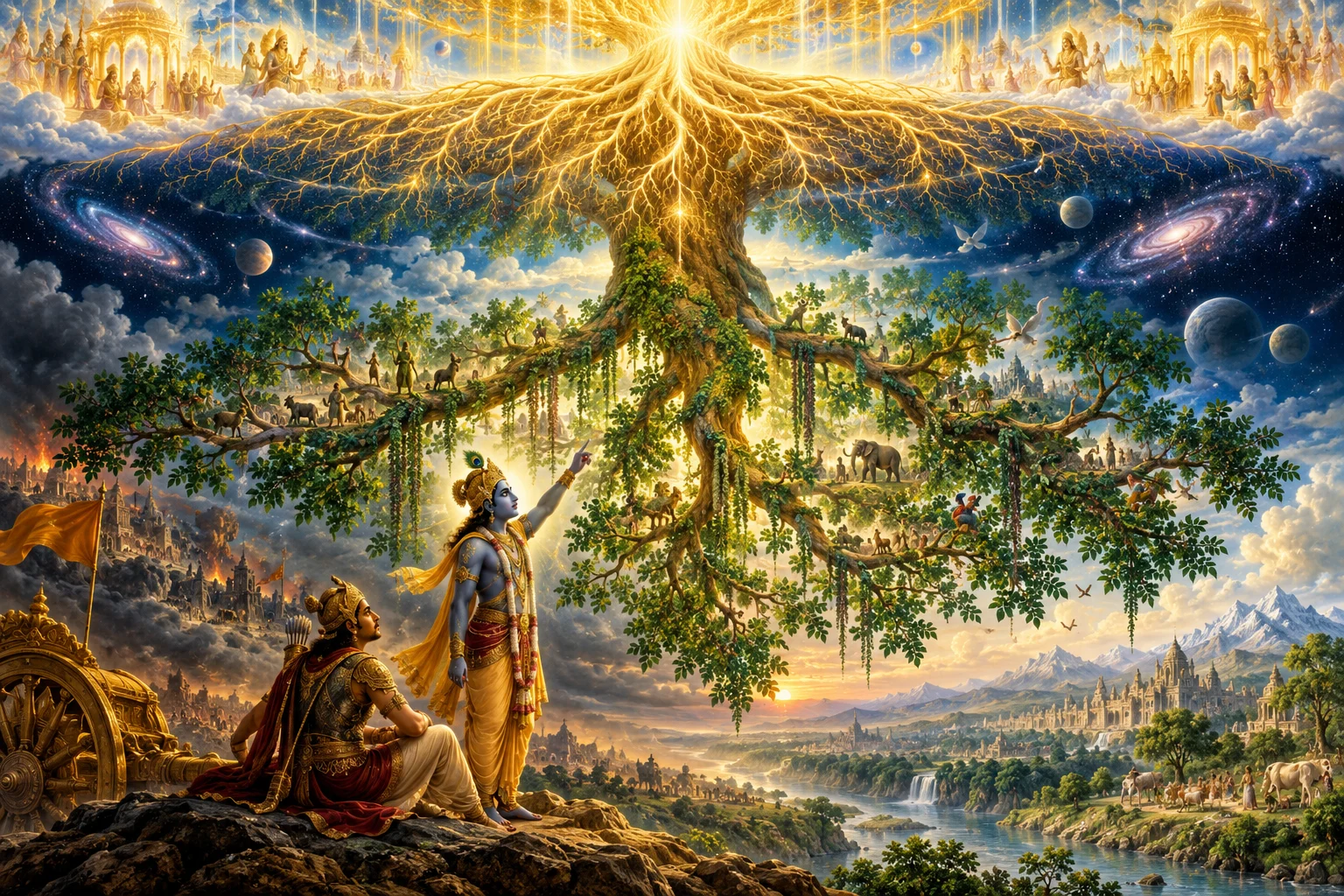
Chapter 15 of the Bhagavad Gita, Purushottama Yoga — The Supreme Person, is part of Krishna's dialogue with Arjuna on the battlefield of Kurukshetra. Each shloka below includes the original Sanskrit verse, a transliteration, Hindi and English meaning, a clear explanation of the philosophy behind it, and the practical life lesson it offers — so you can read a single verse in depth or follow this chapter's complete argument verse by verse. See thefull chapter list to move between all 18 chapters.
How to study Chapter 15
Read the verses in sequence first, then return to the shlokas that speak most directly to your question. Notice the movement between Arjuna's concerns and Krishna's response: the Gita develops its teaching through dialogue, examples, discipline, and repeated clarification. Sanskrit preserves the sound of the original text, transliteration helps with pronunciation, and the meanings provide an accessible doorway for daily reflection.
A useful practice is to choose one verse for a week. Write its central idea in your own words, observe where attachment or fear appears in your day, and revisit the verse before making a difficult choice. This chapter is part of the larger 18-chapter Bhagavad Gita, so compare its theme with the chapters before and after it rather than reading any single line as an isolated slogan.
श्रीभगवानुवाच | ऊर्ध्वमूलमधःशाखमश्वत्थं प्राहुरव्ययम् | छन्दांसि यस्य पर्णानि यस्तं वेद स वेदवित्
15.1 The Blessed Lord said They (the wise) speak of the indestructible peepul tree having its root above and branches below, whose leaves are the metres or hymns: he who knows it is a knower of the Vedas.
15.2अधश्चोर्ध्वं प्रसृतास्तस्य शाखा गुणप्रवृद्धा विषयप्रवालाः | अधश्च मूलान्यनुसन्ततानि कर्मानुबन्धीनि मनुष्यलोके
15.2 Below and above spread its branches, nourished by the Gunas; sense-objects are its buds; and below, in the world of men, stretch forth the roots, originating action.
15.3न रूपमस्येह तथोपलभ्यते नान्तो न चादिर्न च सम्प्रतिष्ठा | अश्वत्थमेनं सुविरूढमूलं असङ्गशस्त्रेण दृढेन छित्त्वा
15.3 Its form is not perceived here as such, neither its end nor its origin, nor its foundation nor resting place: having cut asunder this firmly rooted peepul tree with the strong axe of non-attachment.
15.4ततः पदं तत्परिमार्गितव्यं यस्मिन्गता न निवर्तन्ति भूयः | तमेव चाद्यं पुरुषं प्रपद्ये | यतः प्रवृत्तिः प्रसृता पुराणी
15.4 Then That goal should be sought for, whither having gone none returns again. I seek refuge in that Primeval Purusha Whence streamed forth the ancient activity or energy.
15.5निर्मानमोहा जितसङ्गदोषा अध्यात्मनित्या विनिवृत्तकामाः | द्वन्द्वैर्विमुक्ताः सुखदुःखसंज्ञैर्- गच्छन्त्यमूढाः पदमव्ययं तत्
15.5 Free from pride and delusion, victorious over the evil of attachment, dwelling constantly in the Self, their desires having completely turned away, freed from the pairs of opposites known as pleasure and pain, the undeluded reach the eternal goal.
15.6न तद्भासयते सूर्यो न शशाङ्को न पावकः | यद्गत्वा न निवर्तन्ते तद्धाम परमं मम
15.6 Neither doth the sun illumine there nor the moon, nor the fire; having gone thither they return not; that is My supreme abode.
15.7ममैवांशो जीवलोके जीवभूतः सनातनः।
The living beings in this conditioned world are eternal fragments of Me; they struggle with the six senses — the mind and the five senses — rooted in material nature.
15.8शरीरं यदवाप्नोति यच्चाप्युत्क्रामतीश्वरः | गृहीत्वैतानि संयाति वायुर्गन्धानिवाशयात्
15.8 When the Lord (as the individual soul) obtains a body and when He leaves it, He takes these and goes (with them) as the wind takes the scents from their seats (flowers, etc.).
15.9श्रोत्रं चक्षुः स्पर्शनं च रसनं घ्राणमेव च | अधिष्ठाय मनश्चायं विषयानुपसेवते
15.9 Presiding over the ear, the eye, touch, taste and smell, as well as the mind, it enjoys the objects of the senses.
15.10उत्क्रामन्तं स्थितं वापि भुञ्जानं वा गुणान्वितम् | विमूढा नानुपश्यन्ति पश्यन्ति ज्ञानचक्षुषः
15.10 The deluded do not see Him Who departs, stays and enjoys; but they who possess the eye of knowledge behold Him.
15.11यतन्तो योगिनश्चैनं पश्यन्त्यात्मन्यवस्थितम् | यतन्तोऽप्यकृतात्मानो नैनं पश्यन्त्यचेतसः
15.11 The Yogins striving (for perfection) behold Him dwelling in the Self; but, the unrefined and unintelligent, even though striving, see Him not.
15.12यदादित्यगतं तेजो जगद्भासयतेऽखिलम् | यच्चन्द्रमसि यच्चाग्नौ तत्तेजो विद्धि मामकम्
15.12 That light which residing in the sun illumines the whole world, that which is in the moon and in the fire know that light to be Mine.
15.13गामाविश्य च भूतानि धारयाम्यहमोजसा | पुष्णामि चौषधीः सर्वाः सोमो भूत्वा रसात्मकः
15.13 Permeating the earth I support all beings by (My) energy; and having become the watery moon I nourish all herbs.
15.14अहं वैश्वानरो भूत्वा प्राणिनां देहमाश्रितः | प्राणापानसमायुक्तः पचाम्यन्नं चतुर्विधम्
15.14 Having become the fire Vaisvanara, I abide in the body of living beings and, associated with the Prana and the Apana, digest the fourfold food.
15.15सर्वस्य चाहं हृदि सन्निविष्टो मत्तः स्मृतिर्ज्ञानमपोहनञ्च | वेदैश्च सर्वैरहमेव वेद्यो वेदान्तकृद्वेदविदेव चाहम्
15.15 And I am seated in the hearts of all; from Me are memory and knowledge, as well as their absence. I am verily That which has to be known by all the Vedas; I am indeed the author of the Vedanta and the knower of the Vedas am I.
15.16द्वाविमौ पुरुषौ लोके क्षरश्चाक्षर एव च | क्षरः सर्वाणि भूतानि कूटस्थोऽक्षर उच्यते
15.16 Two Purushas there are in this world, the perishable and the imperishable. All beings are the perishable and the Kutastha the unchanging is called the imperishable.
15.17उत्तमः पुरुषस्त्वन्यः परमात्मेत्युधाहृतः | यो लोकत्रयमाविश्य बिभर्त्यव्यय ईश्वरः
15.17 But distinct is the Supreme Purusha called the highest Self, the indestructible Lord Who, pervading the three worlds, sustains them.
15.18यस्मात्क्षरमतीतोऽहमक्षरादपि चोत्तमः | अतोऽस्मि लोके वेदे च प्रथितः पुरुषोत्तमः
15.18 As I transcend the perishable and am even higher than the imperishable, I am declared to be the highest Purusha in the world and in the Vedas.
15.19यो मामेवमसम्मूढो जानाति पुरुषोत्तमम् | स सर्वविद्भजति मां सर्वभावेन भारत
15.19 He who, undeluded, knows Me thus as the highest Purusha, he, knowing all, worships Me with his whole being (heart), O Arjuna.
15.20इति गुह्यतमं शास्त्रमिदमुक्तं मयानघ | एतद्बुद्ध्वा बुद्धिमान्स्यात्कृतकृत्यश्च भारत
15.20 Thus, this most secret science has been taught by Me, O sinless one; on knowing this, a man becomes wise, and all his duties are accomplished, O Arjuna.
20 verses of Chapter 15 are covered so far, with more being added as each one is written, translated, and checked for accuracy rather than published all at once. If there's a specific shloka from this chapter you'd like to see next, let us know via the contact page.