
Bhagavad Gita · Chapter 4
Jnana Karma Sannyasa Yoga — Knowledge and Renunciation of Action
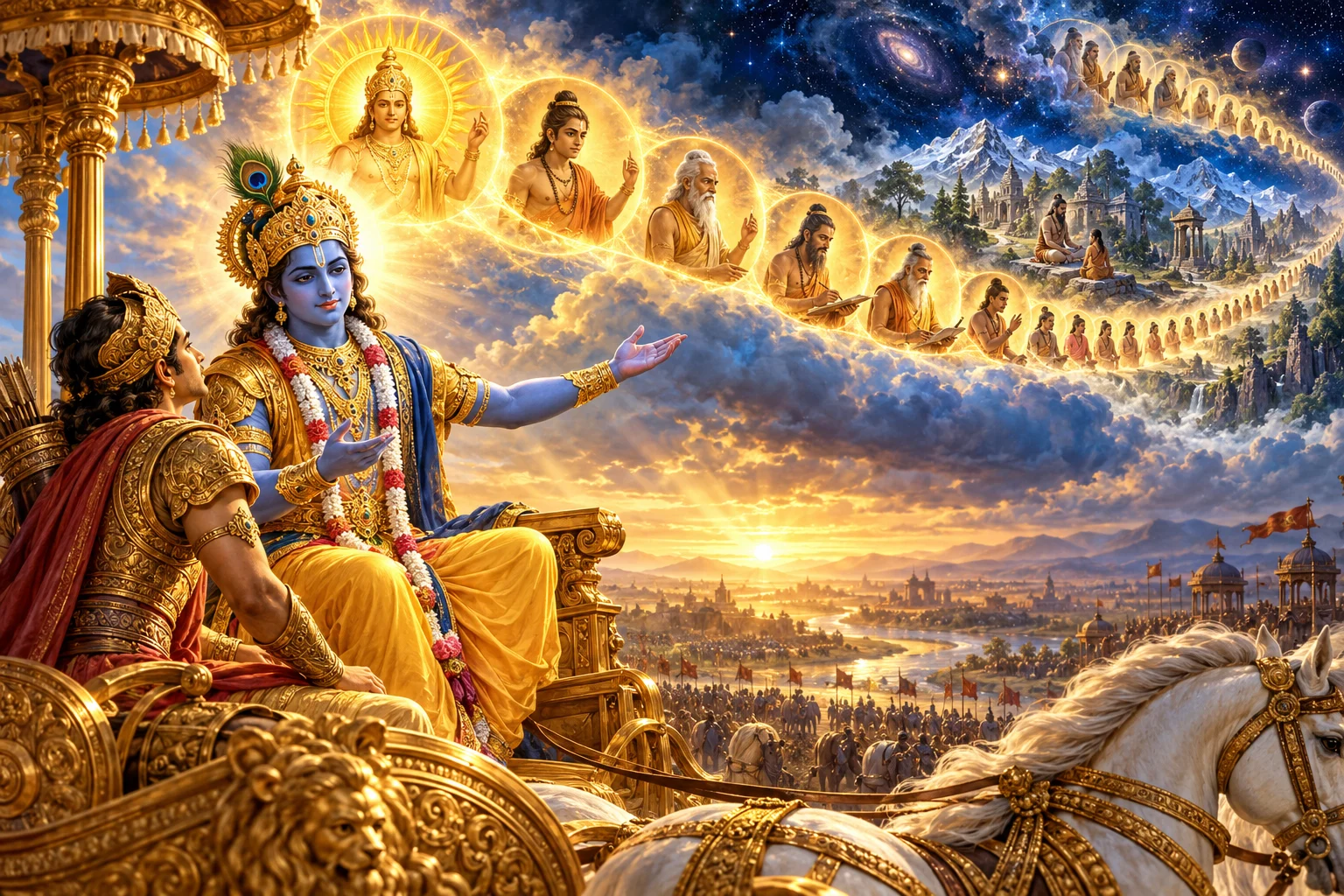
Chapter 4 of the Bhagavad Gita, Jnana Karma Sannyasa Yoga — Knowledge and Renunciation of Action, is part of Krishna's dialogue with Arjuna on the battlefield of Kurukshetra. Each shloka below includes the original Sanskrit verse, a transliteration, Hindi and English meaning, a clear explanation of the philosophy behind it, and the practical life lesson it offers — so you can read a single verse in depth or follow this chapter's complete argument verse by verse. See thefull chapter list to move between all 18 chapters.
How to study Chapter 4
Read the verses in sequence first, then return to the shlokas that speak most directly to your question. Notice the movement between Arjuna's concerns and Krishna's response: the Gita develops its teaching through dialogue, examples, discipline, and repeated clarification. Sanskrit preserves the sound of the original text, transliteration helps with pronunciation, and the meanings provide an accessible doorway for daily reflection.
A useful practice is to choose one verse for a week. Write its central idea in your own words, observe where attachment or fear appears in your day, and revisit the verse before making a difficult choice. This chapter is part of the larger 18-chapter Bhagavad Gita, so compare its theme with the chapters before and after it rather than reading any single line as an isolated slogan.
श्रीभगवानुवाच | इमं विवस्वते योगं प्रोक्तवानहमव्ययम् | विवस्वान्मनवे प्राह मनुरिक्ष्वाकवेऽब्रवीत्
4.1 The Blessed Lord said I taught this imperishable Yoga to Vivasvan; he told it to Manu; Manu proclaimed it to Ikshvaku.
4.2एवं परम्पराप्राप्तमिमं राजर्षयो विदुः | स कालेनेह महता योगो नष्टः परन्तप
4.2 This, handed down thus in regular succession, the royal sages knew. This Yoga, by long lapse of time, has been lost here, O Parantapa (burner of the foes).
4.3स एवायं मया तेऽद्य योगः प्रोक्तः पुरातनः | भक्तोऽसि मे सखा चेति रहस्यं ह्येतदुत्तमम्
4.3 That same ancient Yoga has been today taught to thee by Me, for thou art My devotee and My friend; it is the supreme secret.
4.4अर्जुन उवाच | अपरं भवतो जन्म परं जन्म विवस्वतः | कथमेतद्विजानीयां त्वमादौ प्रोक्तवानिति
4.4 Arjuna said Later on was Thy birth, and prior to it was the birth of Vivasvan (the Sun); how am I to understand that Thou taughtest this Yoga in the beginning?
4.5श्रीभगवानुवाच | बहूनि मे व्यतीतानि जन्मानि तव चार्जुन | तान्यहं वेद सर्वाणि न त्वं वेत्थ परन्तप
4.5 The Blessed Lord said Many births of Mine have passed as well as of thine, O Arjuna; I know them all but thou knowest not, O Parantapa (scorcher of foes).
4.6अजोऽपि सन्नव्ययात्मा भूतानामीश्वरोऽपि सन् | प्रकृतिं स्वामधिष्ठाय सम्भवाम्यात्ममायया
4.6 Though I am unborn, of imperishable nature, and though I am the Lord of all beings, yet, governing My own Nature, I am born by My own Maya.
4.7यदा यदा हि धर्मस्य ग्लानिर्भवति भारत।
Whenever there is a decline of righteousness (dharma) and a rise of unrighteousness (adharma), O Bharata (Arjuna), at that time I manifest myself.
4.8परित्राणाय साधूनां विनाशाय च दुष्कृताम्।
To protect the righteous, to destroy the wicked, and to reestablish the principles of dharma, I appear age after age.
4.9जन्म कर्म च मे दिव्यमेवं यो वेत्ति तत्त्वतः | त्यक्त्वा देहं पुनर्जन्म नैति मामेति सोऽर्जुन
4.9 He who thus know, in their true light, My divine birth and action, having abandoned the body, is not born again, he comes to Me, O Arjuna.
4.10वीतरागभयक्रोधा मन्मया मामुपाश्रिताः | बहवो ज्ञानतपसा पूता मद्भावमागताः
4.10 Freed from attachment, fear and anger, absorbed in Me, taking refuge in Me, purified by the fire of knowledge, many have attained to My Being.
4.11ये यथा मां प्रपद्यन्ते तांस्तथैव भजाम्यहम् | मम वर्त्मानुवर्तन्ते मनुष्याः पार्थ सर्वशः
4.11 In whatever way men approach Me even so do I reward them; My path do men tread in all ways, O Arjuna.
4.12काङ्क्षन्तः कर्मणां सिद्धिं यजन्त इह देवताः | क्षिप्रं हि मानुषे लोके सिद्धिर्भवति कर्मजा
4.12 Those who long for success in action in this world sacrifice to the gods; because success is ickly attained by men through action.
4.13चातुर्वर्ण्यं मया सृष्टं गुणकर्मविभागशः | तस्य कर्तारमपि मां विद्ध्यकर्तारमव्ययम्
4.13 The fourfold caste has been created by Me according to the differentiation of Guna and Karma; though I am the author thereof know Me as non-doer and immutable.
4.14न मां कर्माणि लिम्पन्ति न मे कर्मफले स्पृहा | इति मां योऽभिजानाति कर्मभिर्न स बध्यते
4.14 Actions do not taint Me, nor have I a desire for the fruit of actions. He who knows Me thus is not bound by actions.
4.15एवं ज्ञात्वा कृतं कर्म पूर्वैरपि मुमुक्षुभिः | कुरु कर्मैव तस्मात्त्वं पूर्वैः पूर्वतरं कृतम्
4.15 Having known this, the ancient seekers after freedom also performed action; therefore do thou also perform action, as did the ancients in days of yore.
4.16किं कर्म किमकर्मेति कवयोऽप्यत्र मोहिताः | तत्ते कर्म प्रवक्ष्यामि यज्ज्ञात्वा मोक्ष्यसेऽशुभात्
4.16 What is action? What is inaction? As to this even the wise are confused. Therefore I shall teach thee such action (the nature of action and inaction) by knowing which thou shalt be liberated from the evil (of Samsara, the wheel of birth and death).
4.17कर्मणो ह्यपि बोद्धव्यं बोद्धव्यं च विकर्मणः | अकर्मणश्च बोद्धव्यं गहना कर्मणो गतिः
4.17 For verily (the true nature) of action (enjoined by the scriptures) should be known, also (that) of forbidden (or unlawful) action, and of inaction; hard to understand is the nature (path) of action.
4.18कर्मण्यकर्म यः पश्येदकर्मणि च कर्म यः।
One who sees inaction in action, and action in inaction, is truly wise among men. Such a person is a yogi, even while performing all kinds of action.
4.19यस्य सर्वे समारम्भाः कामसङ्कल्पवर्जिताः | ज्ञानाग्निदग्धकर्माणं तमाहुः पण्डितं बुधाः
4.19 He whose undertakings are all devoid of desires and (selfish) purposes and whose actions have been burnt by the fire of knowledge, him the wise call a sage.
4.20त्यक्त्वा कर्मफलासङ्गं नित्यतृप्तो निराश्रयः | कर्मण्यभिप्रवृत्तोऽपि नैव किञ्चित्करोति सः
4.20 Having abandoned attachment to the fruits of the action, ever content, depending on nothing, he does not do anything though engaged in activity.
4.21निराशीर्यतचित्तात्मा त्यक्तसर्वपरिग्रहः | शारीरं केवलं कर्म कुर्वन्नाप्नोति किल्बिषम्
4.21 Without hope and with the mind and the self controlled, having abandoned all covetousness, doing mere bodily action, he incurs no sin.
4.22यदृच्छालाभसन्तुष्टो द्वन्द्वातीतो विमत्सरः | समः सिद्धावसिद्धौ च कृत्वापि न निबध्यते
4.22 Content with what comes to him without effort, free from the pairs of opposites and envy, even-minded in success and failure, though acting, he is not bound.
4.23गतसङ्गस्य मुक्तस्य ज्ञानावस्थितचेतसः | यज्ञायाचरतः कर्म समग्रं प्रविलीयते
4.23 To one who is devoid of attchment, who is liberated, whose mind is established in knowledge, who works for the sake of sacrifice (for the sake of God), the whole action is dissolved.
4.24ब्रह्मार्पणं ब्रह्म हविर्ब्रह्माग्नौ ब्रह्मणा हुतम् | ब्रह्मैव तेन गन्तव्यं ब्रह्मकर्मसमाधिना
4.24 Brahman is the oblation; Brahman is the melted butter (ghee); by Brahman is the oblation poured into the fire of Brahman; Brahman verily shall be reached by him who always sees Brahman in action.
4.25दैवमेवापरे यज्ञं योगिनः पर्युपासते | ब्रह्माग्नावपरे यज्ञं यज्ञेनैवोपजुह्वति
4.25 Some Yogies perform sacrifice to the gods alone; while others (who have realised the Self) offer the self as sacrifice by the Self in the fire of Brahman alone.
4.26श्रोत्रादीनीन्द्रियाण्यन्ये संयमाग्निषु जुह्वति | शब्दादीन्विषयानन्य इन्द्रियाग्निषु जुह्वति
4.26 Some again offer the organ of hearing and other senses as sacrifice in the fire of restraint; others offer sound and other objects of the senses as sacrifice in the fire of the senses.
4.27सर्वाणीन्द्रियकर्माणि प्राणकर्माणि चापरे | आत्मसंयमयोगाग्नौ जुह्वति ज्ञानदीपिते
4.27 Others again sacrifice all the functions of the senses and those of the breath (vital energy or Prana) in the fire of the Yoga of self-restraint kindled by knowledge.
4.28द्रव्ययज्ञास्तपोयज्ञा योगयज्ञास्तथापरे | स्वाध्यायज्ञानयज्ञाश्च यतयः संशितव्रताः
4.28 Others again offer wealth, austerity and Yoga as sacrifice, while the ascetics of self-restraint and rigid vows offer study of scriptures and knowledge as sacrifice.
4.29अपाने जुह्वति प्राणं प्राणेऽपानं तथापरे | प्राणापानगती रुद्ध्वा प्राणायामपरायणाः
4.29 Others offer as sacrifice the outgoing breath in the incoming, and the incoming in the outgoing, restraining the course of the outgoing and the incoming breaths, solely absorbed in the restraint of the breath.
4.30अपरे नियताहाराः प्राणान्प्राणेषु जुह्वति | सर्वेऽप्येते यज्ञविदो यज्ञक्षपितकल्मषाः
4.30 Others who regulate their diet offer life-breaths in life-breaths. All these are knowers of sacrifice, whose sins are destroyed by sacrifice.
4.31यज्ञशिष्टामृतभुजो यान्ति ब्रह्म सनातनम् | नायं लोकोऽस्त्ययज्ञस्य कुतोऽन्यः कुरुसत्तम
4.31 Those who eat the remnants of the sacrifice, which are like nectar, go to the eternal Brahman. This world is not for the man who does not perform sacrifice; how then can he have the other, O Arjuna?
4.32एवं बहुविधा यज्ञा वितता ब्रह्मणो मुखे | कर्मजान्विद्धि तान्सर्वानेवं ज्ञात्वा विमोक्ष्यसे
4.32 Thus, manifold sacrifices are spread out before Brahman (literally) at the mouth or face of Brahman). Know them all as born of action and thus knowing, thou shalt be liberated.
4.33श्रेयान्द्रव्यमयाद्यज्ञाज्ज्ञानयज्ञः परन्तप | सर्वं कर्माखिलं पार्थ ज्ञाने परिसमाप्यते
4.33 Superior to sacrifice performed with material objects is the sacrifice of knowledge, O scorcher of foes. All action without exception, O Partha, culminates in knowledge.
4.34तद्विद्धि प्रणिपातेन परिप्रश्नेन सेवया | उपदेक्ष्यन्ति ते ज्ञानं ज्ञानिनस्तत्त्वदर्शिनः
4.34 Know That by long prostration, by estion and by service; the wise who have realised the Truth will instruct thee in (that) knowledge.
4.35यज्ज्ञात्वा न पुनर्मोहमेवं यास्यसि पाण्डव | येन भूतान्यशेषेण द्रक्ष्यस्यात्मन्यथो मयि (var अशेषाणि)
4.35 Knowing ï1thatï1 thou shalt not, O Arjuna, again get deluded like this; and by that thou shalt see all beings in thy Self and also in Me.
4.36अपि चेदसि पापेभ्यः सर्वेभ्यः पापकृत्तमः | सर्वं ज्ञानप्लवेनैव वृजिनं सन्तरिष्यसि
4.36 Even if thou art the most sinful of all sinners, yet thou shalt verily cross all sins by the raft of knowledge.
4.37यथैधांसि समिद्धोऽग्निर्भस्मसात्कुरुतेऽर्जुन | ज्ञानाग्निः सर्वकर्माणि भस्मसात्कुरुते तथा
4.37 As the blazing fire reduces fuel to ashes, O Arjuna, so does the fire of knowledge reduce all actions to ashes.
4.38न हि ज्ञानेन सदृशं पवित्रमिह विद्यते | तत्स्वयं योगसंसिद्धः कालेनात्मनि विन्दति
4.38 Verily, there is no purifier in this world like knowledge. He who is perfected in Yoga finds it in the Self in time.
4.39श्रद्धावाँल्लभते ज्ञानं तत्परः संयतेन्द्रियः | ज्ञानं लब्ध्वा परां शान्तिमचिरेणाधिगच्छति
4.39 The man who is full of faith, who is devoted to it, and who has subdued the senses obtains (this) knowledge; and having obtained the knowledge he attains at once to the supreme peace.
4.40अज्ञश्चाश्रद्दधानश्च संशयात्मा विनश्यति | नायं लोकोऽस्ति न परो न सुखं संशयात्मनः
4.40 The ignorant the faithless, the doubting self goes to destruction; there is neither this world nor the other, nor happiness for the doubting.
4.41योगसंन्यस्तकर्माणं ज्ञानसञ्छिन्नसंशयम् | आत्मवन्तं न कर्माणि निबध्नन्ति धनञ्जय
4.41 He who has renounced actions by Yoga, whose doubts are rent asunder by knowledge, and who is self-possessed actions do not bind him, O Arjuna.
4.42तस्मादज्ञानसम्भूतं हृत्स्थं ज्ञानासिनात्मनः | छित्त्वैनं संशयं योगमातिष्ठोत्तिष्ठ भारत
4.42 Therefore with the sword of the knowledge (of the Self) cut asunder the doubt of the self born of ignorance, residing in thy heart, and take refuge in Yoga. Arise, O Arjuna.
42 verses of Chapter 4 are covered so far, with more being added as each one is written, translated, and checked for accuracy rather than published all at once. If there's a specific shloka from this chapter you'd like to see next, let us know via the contact page.