
Bhagavad Gita · Chapter 5
Karma Sannyasa Yoga — The Yoga of Renunciation
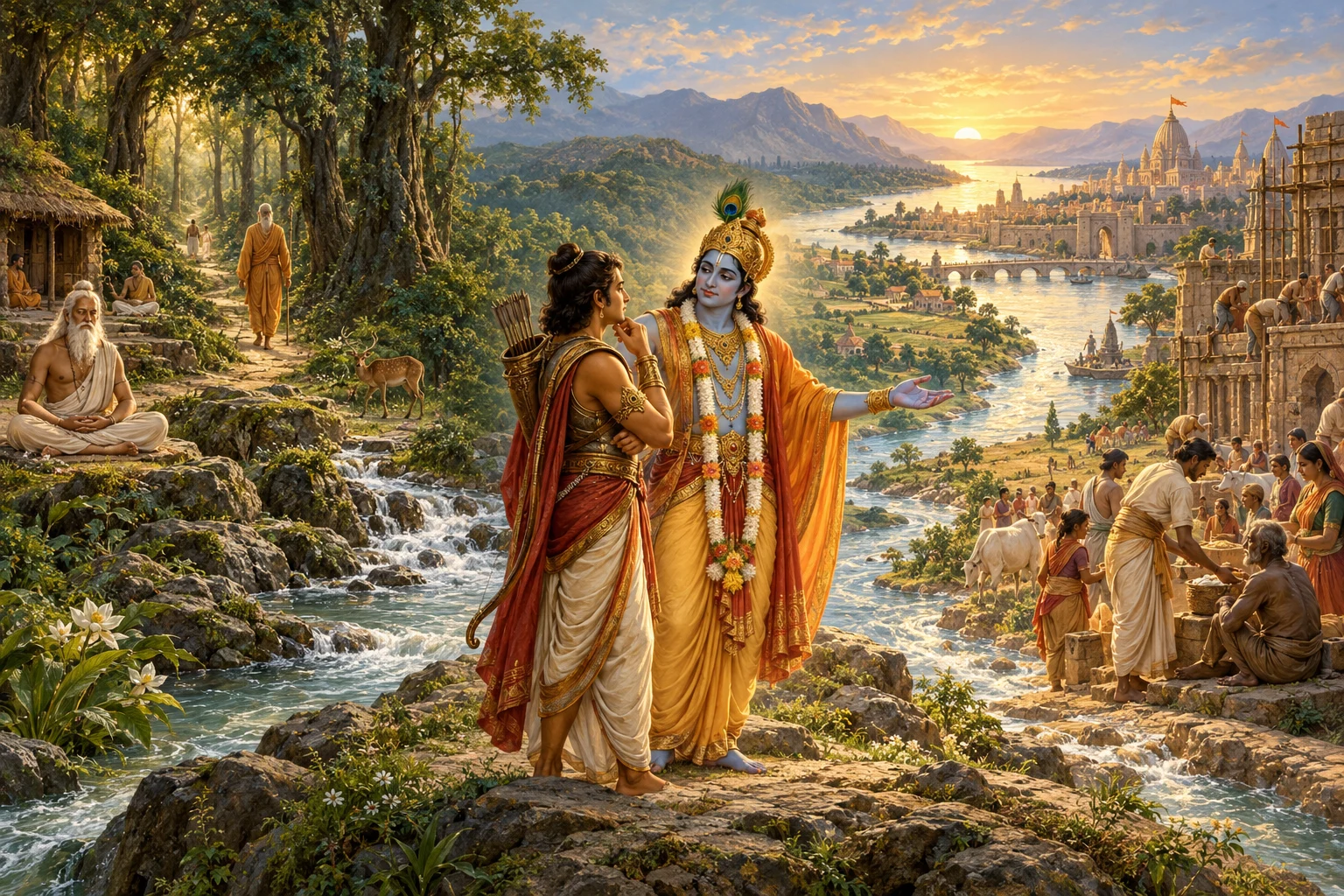
Chapter 5 of the Bhagavad Gita, Karma Sannyasa Yoga — The Yoga of Renunciation, is part of Krishna's dialogue with Arjuna on the battlefield of Kurukshetra. Each shloka below includes the original Sanskrit verse, a transliteration, Hindi and English meaning, a clear explanation of the philosophy behind it, and the practical life lesson it offers — so you can read a single verse in depth or follow this chapter's complete argument verse by verse. See thefull chapter list to move between all 18 chapters.
How to study Chapter 5
Read the verses in sequence first, then return to the shlokas that speak most directly to your question. Notice the movement between Arjuna's concerns and Krishna's response: the Gita develops its teaching through dialogue, examples, discipline, and repeated clarification. Sanskrit preserves the sound of the original text, transliteration helps with pronunciation, and the meanings provide an accessible doorway for daily reflection.
A useful practice is to choose one verse for a week. Write its central idea in your own words, observe where attachment or fear appears in your day, and revisit the verse before making a difficult choice. This chapter is part of the larger 18-chapter Bhagavad Gita, so compare its theme with the chapters before and after it rather than reading any single line as an isolated slogan.
अर्जुन उवाच | संन्यासं कर्मणां कृष्ण पुनर्योगं च शंससि | यच्छ्रेय एतयोरेकं तन्मे ब्रूहि सुनिश्चितम्
5.1 Arjuna said Renunciation of actions, O Krishna, Thou praisest, and again Yoga. Tell me conclusively that which is the better of the two.
5.2श्रीभगवानुवाच | संन्यासः कर्मयोगश्च निःश्रेयसकरावुभौ | तयोस्तु कर्मसंन्यासात्कर्मयोगो विशिष्यते
5.2 The Blessed Lord said Renunciation and the Yoga of action both lead to the highest bliss; but of the two, the Yoga of action is superior to the renunciation of action.
5.3ज्ञेयः स नित्यसंन्यासी यो न द्वेष्टि न काङ्क्षति | निर्द्वन्द्वो हि महाबाहो सुखं बन्धात्प्रमुच्यते
5.3 He should be known as a perpertual Sannyasi who neither hates nor desires; for, free from the pairs of opposites, O mighty-armed Arjuna, he is easily set free from bondage.
5.4साङ्ख्ययोगौ पृथग्बालाः प्रवदन्ति न पण्डिताः | एकमप्यास्थितः सम्यगुभयोर्विन्दते फलम्
5.4 Children, not the wise, speak of knowledge and the Yoga of action or the performance of action as though they are distinct and different; he who is truly established in one obtains the fruits of both.
5.5यत्साङ्ख्यैः प्राप्यते स्थानं तद्योगैरपि गम्यते | एकं साङ्ख्यं च योगं च यः पश्यति स पश्यति
5.5 That place which is reached by the Sankhyas or the Jnanis is reached by the Yogis (Karma Yogis). He sees, who sees knowledge and the performance of action (Karma Yoga) as one.
5.6संन्यासस्तु महाबाहो दुःखमाप्तुमयोगतः | योगयुक्तो मुनिर्ब्रह्म नचिरेणाधिगच्छति
5.6 But renunciation, O mighty-armed Arjuna, is hard to attain without Yoga; the Yoga-harmonised sage ickly goes to Brahman.
5.7योगयुक्तो विशुद्धात्मा विजितात्मा जितेन्द्रियः | सर्वभूतात्मभूतात्मा कुर्वन्नपि न लिप्यते
5.7 He who is devoted to the path of action, whose mind is ite pure, who has conered the self, who has subdued his senses and who realises his Self as the Self in all beings, though acting, is not tainted.
5.8नैव किञ्चित्करोमीति युक्तो मन्येत तत्त्ववित् | पश्यञ्शृण्वन्स्पृशञ्जिघ्रन्नश्नन्गच्छन्स्वपञ्श्वसन्
5.8 "I do nothing at all," thus would the harmonised knower of Truth think seeing, hearing, touching, smelling, eating, going, sleeping, breathing.
5.9प्रलपन्विसृजन्गृह्णन्नुन्मिषन्निमिषन्नपि | इन्द्रियाणीन्द्रियार्थेषु वर्तन्त इति धारयन्
5.9 Speaking, letting go, seizing, opening and closing the eyes convinced that the senses move among the sense-objects.
5.10ब्रह्मण्याधाय कर्माणि सङ्गं त्यक्त्वा करोति यः | लिप्यते न स पापेन पद्मपत्रमिवाम्भसा
5.10 He who does actions, offering them to Brahman, and abandoning attachment, is not tainted by sin, just as a lotus-leaf is not tainted by water.
5.11कायेन मनसा बुद्ध्या केवलैरिन्द्रियैरपि | योगिनः कर्म कुर्वन्ति सङ्गं त्यक्त्वात्मशुद्धये
5.11 Yogis, having abandoned attachment, perform actions only by the body, mind, intellect, and even by the senses, for the purification of the self.
5.12युक्तः कर्मफलं त्यक्त्वा शान्तिमाप्नोति नैष्ठिकीम् | अयुक्तः कामकारेण फले सक्तो निबध्यते
5.12 The united one (the well poised or the harmonised) having abandoned the fruit of action attains to the eternal peace: the non-united only (the unsteady or the unbalanced) impelled by desire, attached to the fruit, is bound.
5.13सर्वकर्माणि मनसा संन्यस्यास्ते सुखं वशी | नवद्वारे पुरे देही नैव कुर्वन्न कारयन्
5.13 Mentally renouncing all actions and self-controlled, the embodied one rests happily in the nine-gated city, neither acting nor causing others (body and senses) to act.
5.14न कर्तृत्वं न कर्माणि लोकस्य सृजति प्रभुः | न कर्मफलसंयोगं स्वभावस्तु प्रवर्तते
5.14 Neither agency nor actions does the Lord create for the world, nor union with the fruits of actions. But it is Nature that acts.
5.15नादत्ते कस्यचित्पापं न चैव सुकृतं विभुः | अज्ञानेनावृतं ज्ञानं तेन मुह्यन्ति जन्तवः
5.15 The Lord takes neither the demerit nor even the merit of any; knowledge is enveloped by ignorance, thery beings are deluded.
5.16ज्ञानेन तु तदज्ञानं येषां नाशितमात्मनः | तेषामादित्यवज्ज्ञानं प्रकाशयति तत्परम्
5.16 But to those whose ignorance is destroyed by the knowledge of the Self, like the sun, knowledge reveals the Supreme (Brahman).
5.17तद्बुद्धयस्तदात्मानस्तन्निष्ठास्तत्परायणाः | गच्छन्त्यपुनरावृत्तिं ज्ञाननिर्धूतकल्मषाः
5.17 Their intellect absorbed in That, their self being That, established in That, with That for their supreme goal, they go whence there is no return, their sins dispelled by knowledge.
5.18विद्याविनयसम्पन्ने ब्राह्मणे गवि हस्तिनि।
The truly wise, endowed with real knowledge, see with equal vision a learned and humble brahmin, a cow, an elephant, a dog, and even an outcaste.
5.19इहैव तैर्जितः सर्गो येषां साम्ये स्थितं मनः | निर्दोषं हि समं ब्रह्म तस्माद् ब्रह्मणि ते स्थिताः
5.19 Even here (in this world) birth (everything) is overcome by those whose minds rest in eality; Brahman is spotless indeed and eal; therefore they are established in Brahman.
5.20न प्रहृष्येत्प्रियं प्राप्य नोद्विजेत्प्राप्य चाप्रियम् | स्थिरबुद्धिरसम्मूढो ब्रह्मविद् ब्रह्मणि स्थितः
5.20 Resting in Brahman, with steady intellect and undeluded, the knower of Brahman neither rejoiceth on obtaining what is pleasant nor grieveth on obtaining what is unpleasant.
5.21बाह्यस्पर्शेष्वसक्तात्मा विन्दत्यात्मनि यत्सुखम् | स ब्रह्मयोगयुक्तात्मा सुखमक्षयमश्नुते
5.21 With the self unattached to external contacts he finds happiness in the Self; with the self engaged in the meditation of Brahman he attains to the endless happiness.
5.22ये हि संस्पर्शजा भोगा दुःखयोनय एव ते | आद्यन्तवन्तः कौन्तेय न तेषु रमते बुधः
5.22 The enjoyments that are born of contacts are only generators of pain, for they have a beginning and an end, O Arjuna; the wise man does not rejoice in them.
5.23शक्नोतीहैव यः सोढुं प्राक्शरीरविमोक्षणात् | कामक्रोधोद्भवं वेगं स युक्तः स सुखी नरः
5.23 He who is able, while still here (in this world) to withstand, before the liberation from the body, the impulse born out of desire and anger he is a Yogi, he is a happy man.
5.24योऽन्तःसुखोऽन्तरारामस्तथान्तर्ज्योतिरेव यः | स योगी ब्रह्मनिर्वाणं ब्रह्मभूतोऽधिगच्छति
5.24 He who is happy within, who rejoices within, and who is illuminated within, that Yogi attains absolute freedom or Moksha, himself becoming Brahman.
5.25लभन्ते ब्रह्मनिर्वाणमृषयः क्षीणकल्मषाः | छिन्नद्वैधा यतात्मानः सर्वभूतहिते रताः
5.25 The sages (Rishis) obtain absolute freedom or Moksha they whose sins have been destroyed, whose dualities (perception of dualities or experience of the pairs of opposites) are torn asunder, who are self-controlled, and intent on the welfare of all beings.
5.26कामक्रोधवियुक्तानां यतीनां यतचेतसाम् | अभितो ब्रह्मनिर्वाणं वर्तते विदितात्मनाम्
5.26 Absolute freedom (or Brahmic bliss) exists on all sides for those self-controlled ascetics who are free from desire and anger, who have controlled their thoughts and who have realised the Self.
5.27स्पर्शान्कृत्वा बहिर्बाह्यांश्चक्षुश्चैवान्तरे भ्रुवोः | प्राणापानौ समौ कृत्वा नासाभ्यन्तरचारिणौ
5.27 Shutting out (all) external contacts and fixing the gaze between the eyrow, ealising the outgoing and incoming breaths moving within the nostrils.
5.28यतेन्द्रियमनोबुद्धिर्मुनिर्मोक्षपरायणः | विगतेच्छाभयक्रोधो यः सदा मुक्त एव सः
5.28 With the senses, the mind and the intellect (ever) controlled, having liberation as his supreme goal, free from desire, fear and anger the sage is verily liberated for ever.
5.29भोक्तारं यज्ञतपसां सर्वलोकमहेश्वरम्।
Knowing Me as the ultimate recipient of all sacrifice and austerity, the great Lord of all worlds, and the true friend of every being, one attains peace.
29 verses of Chapter 5 are covered so far, with more being added as each one is written, translated, and checked for accuracy rather than published all at once. If there's a specific shloka from this chapter you'd like to see next, let us know via the contact page.