
Bhagavad Gita · Chapter 6 · 47 verses
Bhagavad Gita Chapter 6: Dhyana Yoga
The Yoga of Meditation
Chapter 6 summary
Bhagavad Gita Chapter 6 describes the practice of meditation. Krishna explains that the mind can be a person's friend or enemy, how to sit and focus in a clean, quiet place, and why moderation in food, sleep and activity matters. When Arjuna calls the mind as restless as the wind, Krishna answers that practice and detachment steady it.
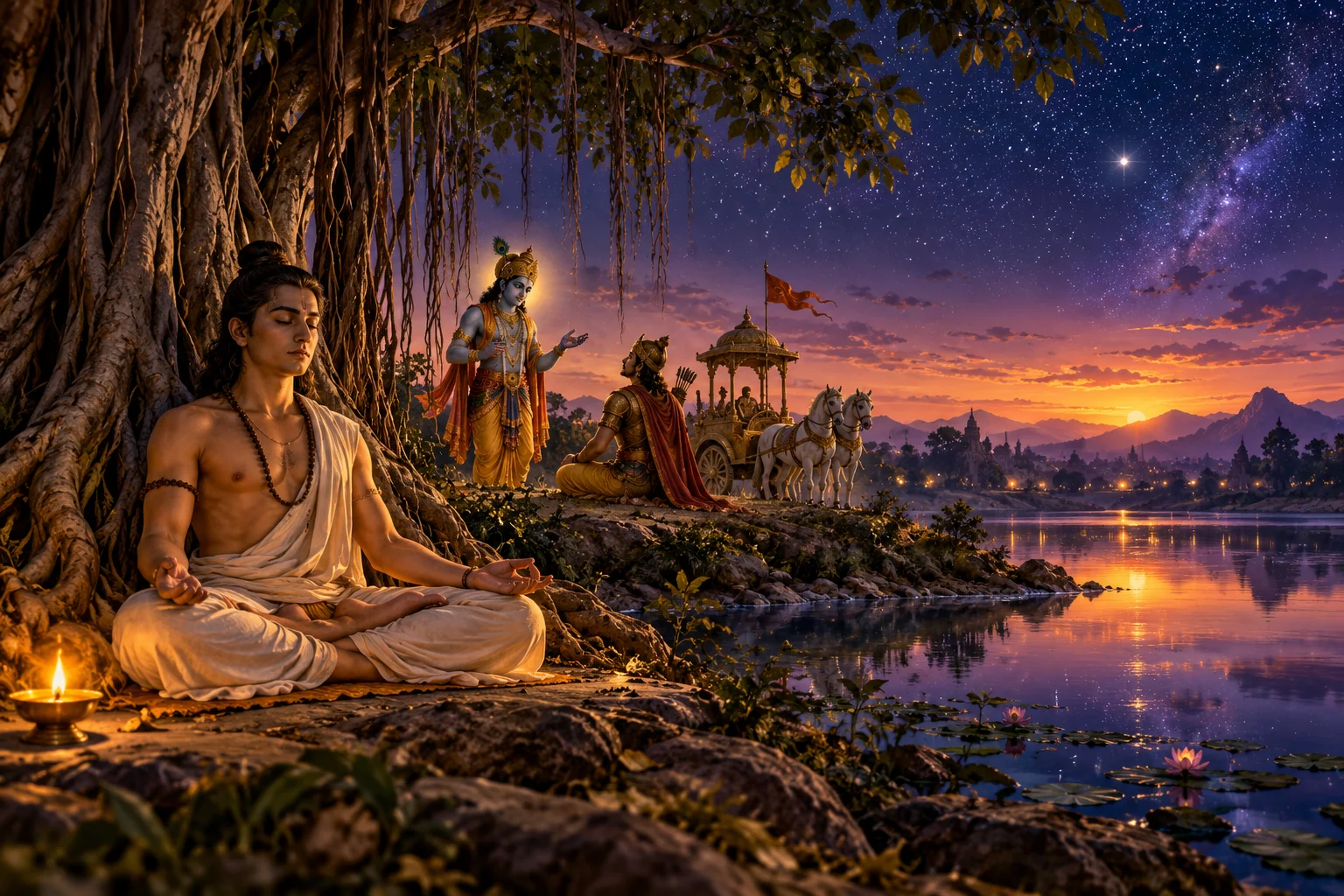
Key verses of Chapter 6
- Bhagavad Gita 6.5 — Lift yourself by your own mind; the mind is both your friend and your enemy.
- Bhagavad Gita 6.19 — The disciplined mind of a yogi is like a lamp in a windless place that does not flicker.
- Bhagavad Gita 6.26 — Whenever the restless mind wanders, bring it back under the control of the self.
- Bhagavad Gita 6.35 — The mind is hard to control, but it is restrained by practice and dispassion.
Chapter 6 of the Bhagavad Gita, Dhyana Yoga — The Yoga of Meditation, has 47 verses and is part of Krishna's dialogue with Arjuna on the battlefield of Kurukshetra. Each shloka below includes the original Sanskrit verse, a transliteration, Hindi and English meaning, a clear explanation of the philosophy behind it, and the practical life lesson it offers — so you can read a single verse in depth or follow this chapter's complete argument verse by verse. See the full chapter list to move between all 18 chapters.
How to study Chapter 6
Read the verses in sequence first, then return to the shlokas that speak most directly to your question. Notice the movement between Arjuna's concerns and Krishna's response: the Gita develops its teaching through dialogue, examples, discipline, and repeated clarification. Sanskrit preserves the sound of the original text, transliteration helps with pronunciation, and the meanings provide an accessible doorway for daily reflection.
A useful practice is to choose one verse for a week. Write its central idea in your own words, observe where attachment or fear appears in your day, and revisit the verse before making a difficult choice. This chapter is part of the larger 18-chapter Bhagavad Gita, so compare its theme with the chapters before and after it rather than reading any single line as an isolated slogan. New to the text? Start with who wrote the Bhagavad Gita — Sage Vyasa as traditional author, Krishna as speaker.
All 47 verses of Bhagavad Gita Chapter 6
श्रीभगवानुवाच | अनाश्रितः कर्मफलं कार्यं कर्म करोति यः | स संन्यासी च योगी च न निरग्निर्न चाक्रियः
6.1 The Blessed Lord said He who performs his bounden duty without depending on the fruits of his actions he is a Sannyasi and a Yogi; not he who is without fire and without action.
6.2यं संन्यासमिति प्राहुर्योगं तं विद्धि पाण्डव | न ह्यसंन्यस्तसङ्कल्पो योगी भवति कश्चन
6.2 Do thou, O Arjuna, know Yoga to be that which they call renunciation; no one verily becomes a Yogi who has not renounced thoughts.
6.3आरुरुक्षोर्मुनेर्योगं कर्म कारणमुच्यते | योगारूढस्य तस्यैव शमः कारणमुच्यते
6.3 For a sage who wishes to attain to Yoga, action is said to be the means; for the same sage who has attained to Yoga, inaction (iescence) is said to be the means.
6.4यदा हि नेन्द्रियार्थेषु न कर्मस्वनुषज्जते | सर्वसङ्कल्पसंन्यासी योगारूढस्तदोच्यते
6.4 When a man is not attached to the sense-objects or to actions, having renounced all thoughts, then he is said to have attained to Yoga.
6.5उद्धरेदात्मनात्मानं नात्मानमवसादयेत्।
One must elevate oneself through the power of one's own mind, not degrade oneself. The mind alone is the friend of the self, and the mind alone is the enemy of the self.
6.6बन्धुरात्मात्मनस्तस्य येनात्मैवात्मना जितः | अनात्मनस्तु शत्रुत्वे वर्तेतात्मैव शत्रुवत्
6.6 The Self is the friend of the self of him by whom the self has been conered by the Self, but to the unconered self, this Self stands in the position of an enemy, like an (external) foe.
6.7जितात्मनः प्रशान्तस्य परमात्मा समाहितः | शीतोष्णसुखदुःखेषु तथा मानापमानयोः
6.7 The Supreme Self of him who is self-controlled and peaceful is balanced in cold and heat, pleasure and pain, as also in honour and dishonour.
6.8ज्ञानविज्ञानतृप्तात्मा कूटस्थो विजितेन्द्रियः | युक्त इत्युच्यते योगी समलोष्टाश्मकाञ्चनः
6.8 The Yogi who is satisfied with the knowledge and the wisdom (of the Self), who has conered the senses, and to whom a clod of earth, a piece of stone and gold are the same, is said to be harmonied (i.e., is said to have attained Nirvikalpa Samadhi).
6.9सुहृन्मित्रार्युदासीनमध्यस्थद्वेष्यबन्धुषु | साधुष्वपि च पापेषु समबुद्धिर्विशिष्यते
6.9 He who is of the same mind to the good-hearted, friends, enemies, the indifferent, the neutral, the hateful, the relatives, the righteous and the unrighteous, excels.
6.10योगी युञ्जीत सततमात्मानं रहसि स्थितः | एकाकी यतचित्तात्मा निराशीरपरिग्रहः
6.10 Let the Yogi try constantly to keep the mind steady, remaining in solitude, alone, with the mind and the body controlled, and free from hope and covetousness.
6.11शुचौ देशे प्रतिष्ठाप्य स्थिरमासनमात्मनः | नात्युच्छ्रितं नातिनीचं चैलाजिनकुशोत्तरम्
6.11 In a clean spot, having established a firm seat of his own, neither too high nor too low, made of a cloth, a skin and Kusa-grass, one over the other.
6.12तत्रैकाग्रं मनः कृत्वा यतचित्तेन्द्रियक्रियः | उपविश्यासने युञ्ज्याद्योगमात्मविशुद्धये
6.12 There, having made the mind one-pointed, with the actions of the mind and the senses controlled, let him, seated on the seat, practise Yoga for the purification of the self.
6.13समं कायशिरोग्रीवं धारयन्नचलं स्थिरः | सम्प्रेक्ष्य नासिकाग्रं स्वं दिशश्चानवलोकयन्
6.13 Let him firmly hold his body, head and neck erect and still, gazing at the tip of his nose, without looking around.
6.14प्रशान्तात्मा विगतभीर्ब्रह्मचारिव्रते स्थितः | मनः संयम्य मच्चित्तो युक्त आसीत मत्परः
6.14 Serene-minded, fearless, firm in the vow of a Brahmachari, having controlled the mind, thinking of Me and balanced in mind, let him sit, having Me as his supreme goal.
6.15युञ्जन्नेवं सदात्मानं योगी नियतमानसः | शान्तिं निर्वाणपरमां मत्संस्थामधिगच्छति
6.15 Thus always keeping the mind balanced, the Yogi, with the mind controlled, attains to the peace abiding in Me, which culminates in liberation.
6.16नात्यश्नतस्तु योगोऽस्ति न चैकान्तमनश्नतः | न चातिस्वप्नशीलस्य जाग्रतो नैव चार्जुन
6.16 Verily Yoga is not possible for him who eats too much, nor for him who does not eat at all, nor for him who sleeps too much, nor for him who is (always) awake, O Arjuna.
6.17युक्ताहारविहारस्य युक्तचेष्टस्य कर्मसु | युक्तस्वप्नावबोधस्य योगो भवति दुःखहा
6.17 Yoga becomes the destroyer of pain for him who is moderate in eating and recreation (such as walking, etc.), who is moderate in exertion in actions, who is moderate in sleep and wakefulness.
6.18यदा विनियतं चित्तमात्मन्येवावतिष्ठते | निःस्पृहः सर्वकामेभ्यो युक्त इत्युच्यते तदा
6.18 When the perfectly controlled mind rests in the Self only, free from longing for all the objects of desires, then it is said, 'He is united'.
6.19यथा दीपो निवातस्थो नेङ्गते सोपमा स्मृता।
As a lamp in a windless place does not flicker, so is the disciplined mind of a yogi compared, who practices union with the Self.
6.20यत्रोपरमते चित्तं निरुद्धं योगसेवया | यत्र चैवात्मनात्मानं पश्यन्नात्मनि तुष्यति
6.20 When the mind, restrained by the practice of Yoga attains to quietude and when seeing the Self by the self, he is satisfied in his own Self.
6.21सुखमात्यन्तिकं यत्तद् बुद्धिग्राह्यमतीन्द्रियम् | वेत्ति यत्र न चैवायं स्थितश्चलति तत्त्वतः
6.21 When he (the Yogi) feels that Infinite Bliss which can be grasped by the (pure) intellect and which transcends the senses, and established wherein he never moves from the Reality.
6.22यं लब्ध्वा चापरं लाभं मन्यते नाधिकं ततः | यस्मिन्स्थितो न दुःखेन गुरुणापि विचाल्यते
6.22 Which, having obtained, he thinks there is no other gain superior to it; wherein estabished, he is not moved even by heavy sorrow.
6.23तं विद्याद् दुःखसंयोगवियोगं योगसंज्ञितम् | स निश्चयेन योक्तव्यो योगोऽनिर्विण्णचेतसा
6.23 Let that be known by the name of Yoga, the severance from union with pain. This Yoga should be practised with determination and with an undesponding mind.
6.24सङ्कल्पप्रभवान्कामांस्त्यक्त्वा सर्वानशेषतः | मनसैवेन्द्रियग्रामं विनियम्य समन्ततः
6.24 Abandoning without reserve all desires born of Sankalpa (thought and imagination) and completely restraining the whole group of the senses by the mind from all sides.
6.25शनैः शनैरुपरमेद् बुद्ध्या धृतिगृहीतया | आत्मसंस्थं मनः कृत्वा न किञ्चिदपि चिन्तयेत्
6.25 Little by little let him attain to ietude by the intellect held firmly; having made the mind establish itself in the Self, let him not think of anything.
6.26यतो यतो निश्चरति मनश्चञ्चलमस्थिरम् | ततस्ततो नियम्यैतदात्मन्येव वशं नयेत्
6.26 From whatever cause the restless and unsteady mind wanders away, from that let him restrain it and bring it under the control of the Self alone.
6.27प्रशान्तमनसं ह्येनं योगिनं सुखमुत्तमम् | उपैति शान्तरजसं ब्रह्मभूतमकल्मषम्
6.27 Supreme Bliss verily comes to this Yogi whose mind is ite peaceful, whose passion is ieted, who has become Brahman and who is free from sin.
6.28युञ्जन्नेवं सदात्मानं योगी विगतकल्मषः | सुखेन ब्रह्मसंस्पर्शमत्यन्तं सुखमश्नुते
6.28 The Yogi, always engaging the mind thus (in the practice of Yoga), freed from sins, easily enjoys the Infinite Bliss of contact with Brahman (the Eternal).
6.29सर्वभूतस्थमात्मानं सर्वभूतानि चात्मनि | ईक्षते योगयुक्तात्मा सर्वत्र समदर्शनः
6.29 With the mind harmonised by Yoga he sees the Self abiding in all beings and all beings in the Self; he sees the same everywhere.
6.30यो मां पश्यति सर्वत्र सर्वं च मयि पश्यति | तस्याहं न प्रणश्यामि स च मे न प्रणश्यति
6.30 He who sees Me everywhere and sees everything in Me, he never becomes separated from Me, nor do I become separated from him.
6.31सर्वभूतस्थितं यो मां भजत्येकत्वमास्थितः | सर्वथा वर्तमानोऽपि स योगी मयि वर्तते
6.31 He who, being established in unity, worships Me Who dwells in all beings, that Yogi abides in Me, whatever may be his mode of living.
6.32आत्मौपम्येन सर्वत्र समं पश्यति योऽर्जुन | सुखं वा यदि वा दुःखं स योगी परमो मतः
6.32 He who, through the likeness of the Self, O Arjuna, sees eality everywhere, be it pleasure or pain, he is regarded as the highest Yogi.
6.33अर्जुन उवाच | योऽयं योगस्त्वया प्रोक्तः साम्येन मधुसूदन | एतस्याहं न पश्यामि चञ्चलत्वात्स्थितिं स्थिराम्
6.33 Arjuna said This Yoga of eanimity taught by Thee, O Krishna, I do not see its steady continuance, because of the restlessness (of the mind).
6.34चञ्चलं हि मनः कृष्ण प्रमाथि बलवद् दृढम् | तस्याहं निग्रहं मन्ये वायोरिव सुदुष्करम्
6.34 The mind verily is restless, turbulent, strong and unyielding, O Krishna: I deem it as difficult to control it as to control the wind.
6.35श्रीभगवानुवाच | असंशयं महाबाहो मनो दुर्निग्रहं चलम् | अभ्यासेन तु कौन्तेय वैराग्येण च गृह्यते
6.35 The Blessed Lord said Undoubtedly, O mighty-armed Arjuna, the mind is difficult to control and restless; but by practice and by dispassion it may be restrained.
6.36असंयतात्मना योगो दुष्प्राप इति मे मतिः | वश्यात्मना तु यतता शक्योऽवाप्तुमुपायतः
6.36 I think Yoga is hard to be attained by one of uncontrolled self, but the self-controlled and striving one can attain to it by the (proper) means.
6.37अर्जुन उवाच | अयतिः श्रद्धयोपेतो योगाच्चलितमानसः | अप्राप्य योगसंसिद्धिं कां गतिं कृष्ण गच्छति
6.37 Arjuna said He who is unable to control himself though he has the faith, and whose mind wanders away from Yoga, what end does he, having failed to attain perfection in Yoga, mee,t O Krishna?
6.38कच्चिन्नोभयविभ्रष्टश्छिन्नाभ्रमिव नश्यति | अप्रतिष्ठो महाबाहो विमूढो ब्रह्मणः पथि
6.38 Fallen from both, does he not perish like a broken cloud, O mighty-armed Krishna, without any support and deluded on the path of Brahman?
6.39एतन्मे संशयं कृष्ण छेत्तुमर्हस्यशेषतः | त्वदन्यः संशयस्यास्य छेत्ता न ह्युपपद्यते
6.39 This doubt of mine, O Krishna, do Thou dispel completely; because it is not possible for any but Thee to dispel this doubt.
6.40श्रीभगवानुवाच | पार्थ नैवेह नामुत्र विनाशस्तस्य विद्यते | न हि कल्याणकृत्कश्चिद् दुर्गतिं तात गच्छति
6.40 The Blessed Lord said O Arjuna, neither in this world, nor in the next world is there destruction for him; none, verily, who does good, O My son, ever comes to grief.
6.41प्राप्य पुण्यकृतां लोकानुषित्वा शाश्वतीः समाः | शुचीनां श्रीमतां गेहे योगभ्रष्टोऽभिजायते
6.41 Having attained to the worlds of the righteous and having dwelt there for everlasting years, he who fell from Yoga is rorn in a house of the pure and wealthy.
6.42अथवा योगिनामेव कुले भवति धीमताम् | एतद्धि दुर्लभतरं लोके जन्म यदीदृशम्
6.42 Or he is born in a family of even the wise Yogis; verily a birth like this is very difficult to obtain in this world.
6.43तत्र तं बुद्धिसंयोगं लभते पौर्वदेहिकम् | यतते च ततो भूयः संसिद्धौ कुरुनन्दन
6.43 Thee he comes in touch with the knowledge acired in his former body and strives more than before for perfection, O Arjuna.
6.44पूर्वाभ्यासेन तेनैव ह्रियते ह्यवशोऽपि सः | जिज्ञासुरपि योगस्य शब्दब्रह्मातिवर्तते
6.44 By that very former practice he is borne on in spite of himself. Even he who merely wishes to know Yoga goes beyond the Brahmic word.
6.45प्रयत्नाद्यतमानस्तु योगी संशुद्धकिल्बिषः | अनेकजन्मसंसिद्धस्ततो याति परां गतिम्
6.45 But the Yogi who strives with assiduity, purified of sins and perfected gradually through many births, reaches the highest goal.
6.46तपस्विभ्योऽधिको योगी ज्ञानिभ्योऽपि मतोऽधिकः | कर्मिभ्यश्चाधिको योगी तस्माद्योगी भवार्जुन
6.46 The Yogi is thought to be superior to the ascetics and even superior to men of knowledge (obtained through the study of scriptures); he is also superior to men of action; therefore be thou a Yogi, O Arjuna.
6.47योगिनामपि सर्वेषां मद्गतेनान्तरात्मना | श्रद्धावान्भजते यो मां स मे युक्ततमो मतः
6.47 And among all the Yogis he who, full of faith and with his inner self merged in Me, worships Me is deemed by Me to be the most devout.
Bhagavad Gita Chapter 6: FAQ
What is Bhagavad Gita Chapter 6 about?
Bhagavad Gita Chapter 6 describes the practice of meditation. Krishna explains that the mind can be a person's friend or enemy, how to sit and focus in a clean, quiet place, and why moderation in food, sleep and activity matters. When Arjuna calls the mind as restless as the wind, Krishna answers that practice and detachment steady it.
How many verses are in Bhagavad Gita Chapter 6?
Bhagavad Gita Chapter 6 has 47 verses (shlokas).
What is the name of Bhagavad Gita Chapter 6?
Chapter 6 is called Dhyana Yoga, which means "The Yoga of Meditation".
What are the most important verses of Bhagavad Gita Chapter 6?
6.5: Lift yourself by your own mind; the mind is both your friend and your enemy. 6.19: The disciplined mind of a yogi is like a lamp in a windless place that does not flicker. 6.26: Whenever the restless mind wanders, bring it back under the control of the self. 6.35: The mind is hard to control, but it is restrained by practice and dispassion.