
💎 Mythology
Ashwatthama: Drona's Immortal Son, His Night Raid and Krishna's Curse
Ashwatthama is the warrior son of Drona, born with a jewel in his forehead and cursed by Krishna to wander the earth. Here is his full story from the Mahabharata and why he is called immortal.
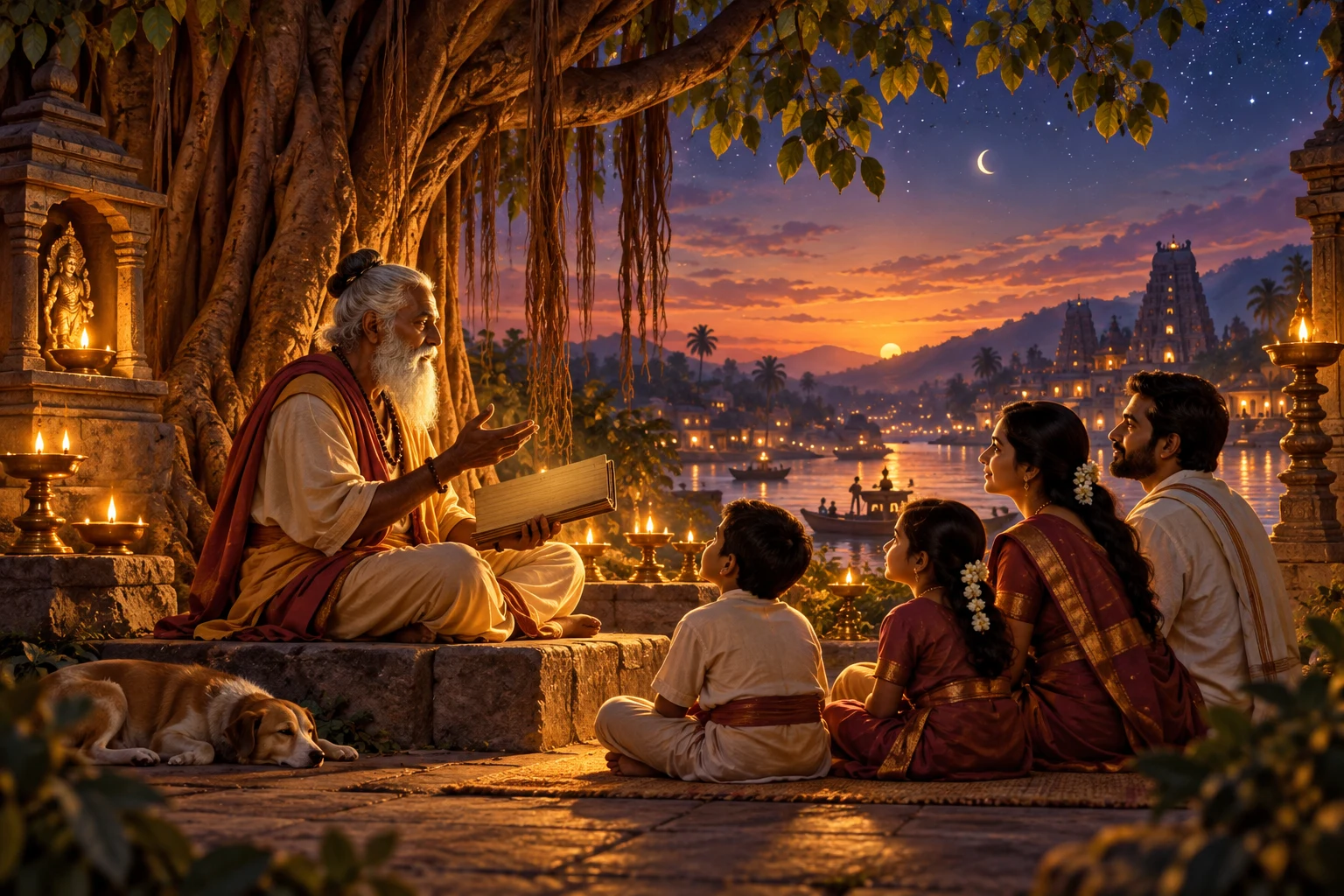
Ashwatthama is the son of Drona and Kripi, born with a protective jewel in his forehead. He fought for the Kauravas, survived the war, and killed the sleeping sons of Draupadi in a night raid. For turning a divine weapon on an unborn child, Krishna cursed him to wander the earth — hence his place among the immortal Chiranjivis.
His story is one of the darkest in the epic — a study of grief, rage and the misuse of power.
Ashwatthama at a glance
| Parents | Dronacharya and Kripi (sister of Kripacharya) |
| Born as | A partial incarnation of Rudra, according to the Mahabharata |
| Distinctive mark | A jewel (mani) in the forehead |
| Side in the war | Kauravas; made commander by the dying Duryodhana |
| Famous weapons | Narayanastra, Brahmashira |
| Key episode | The night raid on the Pandava camp (Sauptika Parva) |
| Fate | Cursed by Krishna to wander for 3,000 years |
| Status in tradition | One of the Chiranjivis |
Birth and name
Drona and his wife Kripi performed austerities to Shiva for a son. Ashwatthama was born with a jewel in his forehead that guarded him against hunger, thirst, fatigue, weapons and spirits. The Adi Parva says his first cry sounded like the neighing of the celestial horse Uchchaihshravas, so a voice from the sky named him Ashwatthama.
Drona was poor in Ashwatthama’s childhood. One famous story tells of the boy being given flour mixed in water to drink in place of milk — a humiliation that drove Drona to seek his old friend King Drupada, and later to become teacher of the Kuru princes.
Ashwatthama in the Kurukshetra war
Drona trained his son alongside the Pandavas and Kauravas and taught him powerful weapons, including the Narayanastra and the Brahmashira. Ashwatthama fought for the Kauravas throughout the war.
| Day | What happened |
|---|---|
| 1–14 | Fights as a leading Kaurava warrior under Bhishma and then his father |
| 15 | The Pandavas trick Drona: Bhima kills an elephant named Ashwatthama, and Yudhishthira tells Drona “Ashwatthama is dead”, muffling the word “elephant”. Drona lays down his arms and is killed by Dhrishtadyumna |
| 15 | Enraged, Ashwatthama releases the Narayanastra. Krishna tells the Pandavas to drop their weapons and bow, and the weapon passes harmlessly |
| 18 | Duryodhana is struck down by Bhima. That evening, dying, he appoints Ashwatthama commander of the remaining Kaurava forces |
See the full sequence in the 18 days of the Mahabharata war.
The night raid
The Sauptika Parva (“Book of the Sleepers”) tells what followed. Only three Kaurava warriors survived: Ashwatthama, his uncle Kripacharya and Kritavarma. Resting beneath a tree, Ashwatthama watched an owl swoop down and kill crows as they slept. He took it as his model.
Ignoring Kripa’s protest that killing sleeping men was against all dharma, he entered the Pandava camp at night, with Kripa and Kritavarma guarding the gates. He killed Dhrishtadyumna, his father’s slayer, by trampling and strangling him rather than with a weapon; then Shikhandi, the five young sons of Draupadi (the Upapandavas), and many others. The Pandavas and Krishna were away from the camp and survived.
The Brahmashira and Parikshit
Draupadi, grieving, demanded justice. Bhima, Arjuna and Krishna pursued Ashwatthama to the hermitage of Vyasa on the bank of the Ganga.
- Cornered, Ashwatthama released the Brahmashira, a weapon capable of destroying the world.
- Arjuna released the same weapon to neutralise it.
- The sages Vyasa and Narada stood between the two weapons and asked both warriors to withdraw them.
- Arjuna, disciplined in his training, withdrew his. Ashwatthama could not.
- Instead he redirected it at the wombs of the Pandava women, aiming at Uttara, widow of Abhimanyu, who was carrying the only heir of the Pandava line.
- The child was stillborn, but Krishna revived him. That child was Parikshit, the future king to whom the Bhagavata Purana is narrated.
Krishna’s curse
Krishna then pronounced Ashwatthama’s sentence: for three thousand years he would wander the earth alone, with no one to speak to him, his body covered in sores that smelled of blood and pus, shunned by all. Vyasa confirmed the curse.
Ashwatthama gave up the jewel from his forehead. The Pandavas took it to Draupadi, who gave it to Yudhishthira to wear. The open wound on Ashwatthama’s forehead is the detail most often recalled in later legends. Read more about Draupadi’s story.
Is Ashwatthama immortal?
Ashwatthama is named in a well-known verse listing the Chiranjivis, the “long-lived ones”:
Aśvatthāmā balir vyāso hanūmāṃś ca vibhīṣaṇaḥ kṛpaḥ paraśurāmaś ca saptaite cirajīvinaḥ
“Ashwatthama, Bali, Vyasa, Hanuman, Vibhishana, Kripa and Parashurama — these seven are long-lived.”
An extended form adds Markandeya as the eighth. The Bhagavata Purana (8.13) also names Drauni, “son of Drona”, among the seven sages of a future age, the eighth Manvantara.
Folk legends say Ashwatthama still wanders, especially along the Narmada river, and that he offers flowers at dawn at the Shiva temple inside Asirgarh fort near Burhanpur in Madhya Pradesh. These stories are part of living folklore rather than the epic.
| Chiranjivi | Why long-lived |
|---|---|
| Ashwatthama | Cursed by Krishna |
| Bali | Blessed by Vishnu as Vamana |
| Vyasa | To preserve the scriptures |
| Hanuman | Boon from Rama to live while his story is told |
| Vibhishana | Rama’s gift of kingship |
| Kripa | Teacher who will serve in a future age |
| Parashurama | To teach Kalki |
What Ashwatthama teaches
- Grief can turn into ruin. His father’s death, caused by a lie, was a real wrong; his response multiplied it.
- Power without restraint destroys. Arjuna could withdraw the Brahmashira; Ashwatthama could not. The epic treats mastery over one’s weapons — and one’s anger — as part of dharma.
- Ends do not excuse means. Kripa’s warning that killing sleepers is a sin stands at the centre of the episode.
The Pandavas’ own lie about Ashwatthama’s death is not excused by the epic either. Like much of the Mahabharata, the story refuses simple heroes and villains; see the Bhagavad Gita and the Mahabharata for how the war frames Krishna’s teaching.
Frequently Asked Questions
Who is Ashwatthama?
Ashwatthama is the son of Dronacharya and Kripi in the Mahabharata. A mighty warrior who fought for the Kauravas, he survived the Kurukshetra war, killed the sleeping sons of Draupadi in a night raid, and was cursed by Krishna to wander the earth. He is counted among the Chiranjivis, the long-lived immortals of Hindu tradition.
Is Ashwatthama still alive?
According to the Mahabharata, Krishna cursed Ashwatthama to wander for three thousand years, and later tradition counts him among the Chiranjivis who live until the end of the age. Folk legends place him near the Narmada river and at the Asirgarh fort in Madhya Pradesh. These are matters of faith and legend, not verified events.
Why did Krishna curse Ashwatthama?
After the war, Ashwatthama killed the sleeping sons of Draupadi and then released the Brahmashira weapon. Unable to withdraw it, he directed it at the wombs of the Pandava women, aiming at Uttara's unborn child, Parikshit. Krishna revived the child and cursed Ashwatthama to roam alone for three thousand years, diseased and shunned.
What was the gem on Ashwatthama's forehead?
Ashwatthama was born with a jewel in his forehead that protected him from hunger, thirst, weapons, disease and spirits. After his defeat, the Pandavas took the gem, and it was given to Draupadi, who passed it to Yudhishthira. Legend says the wound it left never healed.
Why was he named Ashwatthama?
The Mahabharata says that at birth he cried out with a sound like the neighing of the divine horse Uchchaihshravas. A heavenly voice therefore named him Ashwatthama, 'he whose strength or voice is like a horse's'.
Who are the Chiranjivis?
The Chiranjivis are the long-lived or immortal figures of Hindu tradition. A well-known verse lists seven: Ashwatthama, Bali, Vyasa, Hanuman, Vibhishana, Kripa and Parashurama; an extended version adds Markandeya as the eighth.