
☀️ Festivals
Makar Sankranti Story and Significance: The Sun's Northward Journey
Last updated: September 26, 2026
Makar Sankranti follows the solar calendar and marks a seasonal turning point celebrated through harvest foods, charity, bathing, and gratitude.
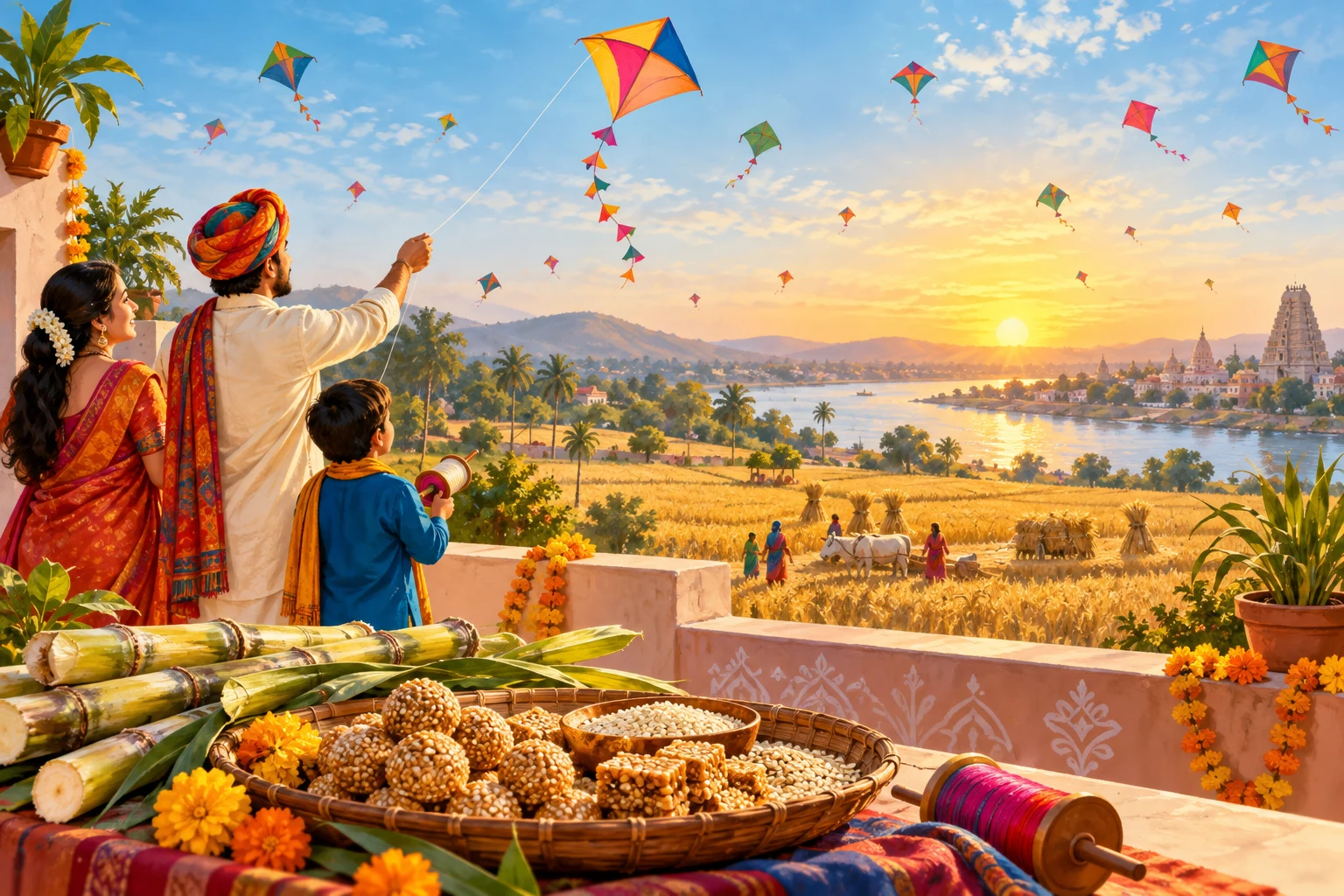
Makar Sankranti marks the Sun’s traditional transition into Makara, or Capricorn, and is associated with Uttarayana, the northward course of the Sun. Because its calculation is solar rather than primarily lunar, it usually falls near 14 January. Exact observance may vary by calendar, location, and lineage.
The festival belongs to a wider harvest season across India. Its regional expressions should be appreciated on their own terms rather than treated as interchangeable names for one uniform event.
The meaning of Uttarayana
In traditional Indian timekeeping, Uttarayana is an auspicious half of the solar year. Around the December solstice the Sun’s apparent northward movement begins in astronomical terms, while Makar Sankranti’s sidereal zodiac calculation occurs later. This distinction is useful: a sacred calendar can carry observational, mathematical, and symbolic meanings without being identical to a modern astronomy definition.
Light and lengthening days become symbols of clarity, disciplined effort, and renewal. Sunrise prayer, bathing, charity, and sharing food turn the seasonal idea outward. The festival asks not only, “What do I hope to receive?” but also, “What warmth can I offer?”
Bhishma and the auspicious time
The Mahabharata tells that Bhishma, granted the ability to choose the time of his death, remained on his bed of arrows until the auspicious northward course. The episode strengthens Uttarayana’s association with conscious transition and spiritual preparation. It need not be read as a promise that one calendar date mechanically determines anyone’s destiny.
Another common devotional layer honours Surya, whose dependable light sustains crops and daily life. Explore the Surya Mantra and use a translation so that recitation remains connected to meaning.
Regional celebrations
In Gujarat, Uttarayan is strongly associated with kite flying. Maharashtra households exchange sesame-and-jaggery sweets; Karnataka has its own ellu-bella sharing customs. Punjab celebrates Lohri with a bonfire on the preceding evening, Assam marks Magh or Bhogali Bihu, and Tamil Nadu begins its multi-day Pongal cycle. Read VedicVani’s fuller Pongal story and significance guide to understand that tradition on its own terms.
Foods reflect agriculture and climate: sesame, jaggery, sugarcane, newly harvested rice, peanuts, and dairy appear in different combinations. Ask hosts about local etiquette and dietary ingredients instead of assuming every family follows the same menu.
A simple and safe observance
At sunrise, face the light from a safe place, offer clean water if that is your custom, and express gratitude for the people and ecosystems behind your food. Never look directly at the Sun for prolonged periods, and do not perform practices that strain the eyes. Follow with a short prayer, a seasonal meal, and a useful donation of food, blankets, or funds through a trustworthy organisation.
Kite flyers should use open authorised spaces away from roads, airports, and power lines. Avoid glass-coated or dangerous synthetic string, which can injure people, birds, and animals. Retrieve fallen line and dispose of it securely. Bonfires require local permission, adult supervision, ventilation, and consideration for air quality.
The Government of India’s tourism portal gives an overview of regional Makar Sankranti celebrations. Treat it as an introduction and defer to the community hosting you.
Plan a low-waste celebration
Buy only the food the household can use, serve small portions first, and store leftovers safely. Choose reusable plates, natural decorations, and locally appropriate gifts instead of glitter, plastic bunting, or single-use packages. Never release lanterns or balloons; both can become fire hazards and wildlife litter.
If offering water or flowers outdoors, follow temple and municipal rules and keep drains and waterways clear. A donation is more useful when it matches a verified need, so ask a local organisation whether it requires food, clothing, funds, or volunteer time before arriving with supplies.
A simple observance
Carry the harvest message forward
Harvest festivals reveal interdependence: soil, water, sunlight, seed, animals, cultivators, transport workers, cooks, and families all participate in a meal. A meaningful Makar Sankranti acknowledges that chain. Reduce food waste, pay workers fairly, support a farmer-led initiative, or learn where one staple food comes from.
The movement toward light is ultimately ethical, not decorative. Share sweetness without excluding someone, celebrate without injuring wildlife, and let gratitude become generosity after the festival day ends.
Frequently Asked Questions
What does Makar Sankranti celebrate?
It marks the Sun's traditional transition into Makara and a seasonal turning associated with Uttarayana, harvest gratitude, charity, and increasing light.
Why does Makar Sankranti usually fall on 14 January?
It follows a solar calculation rather than the lunar calendar used for many Hindu festivals, so its civil-calendar date stays near mid-January, with occasional variation.
Are Pongal, Lohri, and Makar Sankranti the same festival?
They share the midwinter harvest season and overlapping themes, but each has its own regional history, ritual sequence, foods, and community identity.
How can I observe Makar Sankranti simply at home?
Offer gratitude at sunrise, share a seasonal meal or sesame sweet, give useful charity, learn a regional tradition, and avoid unsafe kite strings or polluting offerings.