
🦁 Festivals
Narasimha Jayanti Story and Significance: Prahlada's Faith
Last updated: September 26, 2026
Narasimha Jayanti remembers Vishnu's fierce protection of Prahlada and the defeat of a tyrant who believed himself beyond the reach of justice.
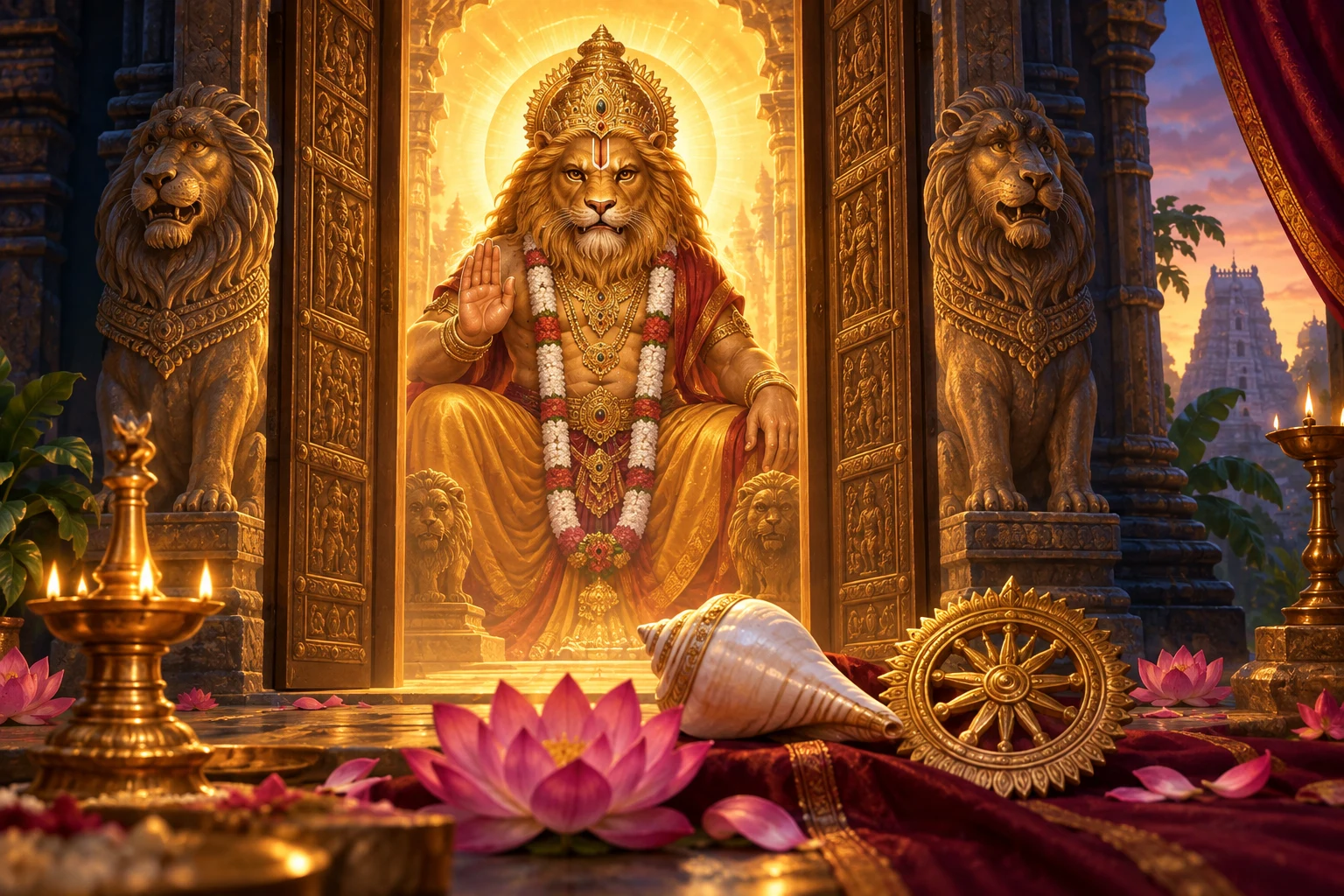
Narasimha Jayanti celebrates Vishnu’s appearance as Narasimha, a form that is neither simply human nor animal. The best-known telling appears in the Bhagavata Purana and centres on Prahlada, whose devotion survives persecution by his father, Hiranyakashipu. Dates and detailed rituals follow regional and temple calendars, so devotees should consult a trusted local panchang.
Prahlada’s faith under pressure
Hiranyakashipu seeks extraordinary power after the death of his brother Hiranyaksha. His austerities win a carefully worded boon, and he comes to believe no one can defeat him. He demands obedience and rejects Vishnu, while his son Prahlada continues to remember Vishnu despite threats and repeated attempts on his life.
Prahlada’s devotion is not portrayed as a contest of ego. He does not seek personal revenge or political power. He holds to what he understands as truth, even when authority tries to control belief. This makes the story especially relevant to the protection of conscience and vulnerable people.
The boon that seemed impossible to overcome
Hiranyakashipu’s protection excludes death by a human or animal, inside or outside, by day or night, on earth or in the sky, and by a weapon. He treats this legalistic arrangement as freedom from moral consequence.
When Hiranyakashipu demands to know whether Vishnu is present in a pillar, Narasimha emerges from it. The encounter occurs at twilight, neither day nor night; on a threshold, neither inside nor outside; with Hiranyakashipu on Narasimha’s lap, neither ground nor sky; and with claws rather than a conventional weapon. The narrative shows that power cannot escape accountability merely by manipulating definitions.
After the tyrant falls, Narasimha remains fierce until Prahlada approaches in devotion. Protection, rather than uncontrolled rage, completes the episode. A fuller introduction to Vishnu’s incarnations is available in Dashavatara: the ten avatars of Vishnu.
What Narasimha represents
Narasimha is fierce, but that fierceness has a boundary and purpose: ending persecution and restoring moral order. Iconography may look frightening because it makes protective power visible. Devotees also contemplate Narasimha as a source of refuge and fearlessness.
The story does not license anger whenever someone disagrees with us. Hiranyakashipu’s central failure is the abuse of power and refusal to recognise limits. A contemporary observance should therefore reduce intimidation, not imitate it—defending a bullied child, supporting someone facing coercion, or examining how authority is used at home or work.
Observing Narasimha Jayanti
Devotees may bathe, tidy the worship space, offer water, flowers, fruit, or a lamp, and read the Prahlada narrative. Vishnu or Narasimha worship often becomes especially focused around sunset, reflecting the story’s twilight setting. Temple programmes may include abhisheka, devotional singing, and distribution of prasad.
For home practice, begin with a few quiet breaths and recite the Narasimha Mantra at a comfortable pace. Do not force breath retention or extreme repetition counts. If lighting a diya, use a stable holder and never leave it unattended. Close by dedicating the practice to someone’s safety and doing one protective act.
Some devotees keep a fast until evening. Children, pregnant or breastfeeding people, older adults, people with diabetes, those with eating-disorder histories, and anyone taking medication should choose a safe alternative with appropriate medical advice. A simple sattvic meal, reduced indulgence, or a period of focused prayer can be sufficient.
Reflecting on the story with children
The narrative contains frightening imagery, so adapt details to a child’s age and temperament. Emphasise that Prahlada seeks refuge, that adults must not punish a child for belief, and that protective strength has limits. Avoid presenting violence as entertainment or telling children that every frightening event is divine punishment.
Useful questions include: What helps Prahlada remain calm? Why does Hiranyakashipu mistake protection from certain dangers for permission to harm? How can a student help someone being bullied without taking unsafe risks? The practical answer may involve calling a trusted adult, documenting a pattern, or using a school safeguarding process—not confronting an aggressor alone.
The Sanskrit text of the Srimad Bhagavatam is available through GRETIL at the University of Göttingen. Whatever form the day takes, its measure is not dramatic display but whether strength is used to shelter life and conscience.
Frequently Asked Questions
What does Narasimha Jayanti celebrate?
It celebrates Vishnu's appearance as Narasimha, the man-lion form who protects Prahlada and ends Hiranyakashipu's violent rule.
Why did Vishnu take a half-man, half-lion form?
The form and circumstances answer the conditions of Hiranyakashipu's boon: Narasimha is neither ordinary human nor animal and appears at twilight on a threshold.
Is fasting required on Narasimha Jayanti?
Fasting customs vary and are not compulsory for everyone. A health-safe meal, scripture reading, mantra practice, temple visit, or protective act of service can honour the day.
Which mantra can beginners chant on Narasimha Jayanti?
Beginners may use a short Narasimha mantra learned with correct pronunciation, or simply repeat a name such as Om Namo Narasimhaya with steady attention.