
🕉️ Practice Guides
Purusha Suktam: Sanskrit, Meaning and the Vedic Recension
The Purusha Sukta of Rigveda 10.90, given here in the commonly recited 18-verse liturgical form, with the six-verse Uttara Narayana. Sanskrit, meaning, and a clear note on the recension.
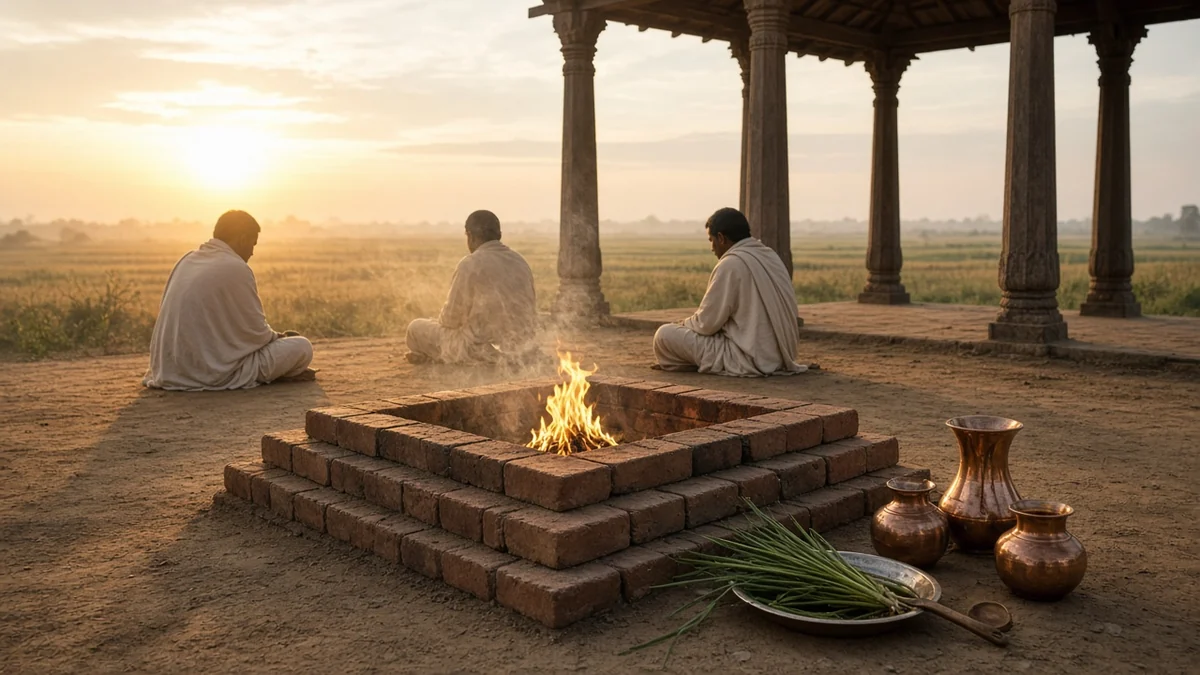
The Purusha Suktam is a Vedic hymn of the cosmic person — the Purusha — from whom, the seers say, the worlds, the sacrifice and living beings arise. Its core is Rigveda 10.90, a hymn of sixteen verses. What most temples and households actually recite is a slightly longer liturgical form: eighteen verses, in which two well-known lines beginning “I have known this great Purusha” are placed before the Rigvedic close, and then the Uttara Narayana, a six-verse sequel, is added.
That is the recension given here, following the widely used text at Sanskrit Documents. A Shukla Yajurveda arrangement of the same material uses a different verse order; if your family recites from a Yajurveda tradition, stay with that order.
The hymn is a companion, not a double, of the Shri Suktam. In later Vaishnava reading the Purusha is also Narayana, which is why the liturgical text inserts the bow oṃ namo nārāyaṇāya before the Uttara Narayana. For related vocabulary on this site, see Brahman and the ten avatars of Vishnu.
The Devanagari below is unsvarated, for reading. Vedic accents should be learned from a teacher.
Shanti patha
ॐ तच्छं योरावृणीमहे । गातुं यज्ञाय । गातुं यज्ञपतये । दैवी स्वस्तिरस्तु नः । स्वस्तिर्मानुषेभ्यः । ऊर्ध्वं जिगातु भेषजम् । शन्नो अस्तु द्विपदे । शं चतुष्पदे । ॐ शान्तिः शान्तिः शान्तिः । हरिः ॐ ।
oṃ tacchaṃ yorāvṛṇīmahe | gātuṃ yajñāya | gātuṃ yajñapataye | daivī svastirastu naḥ | svastirmānuṣebhyaḥ | ūrdhvaṃ jigātu bheṣajam | śanno astu dvipade | śaṃ catuṣpade | oṃ śāntiḥ śāntiḥ śāntiḥ | hariḥ oṃ |
Meaning. We choose that peace and well-being. A good path for the sacrifice. A good path for the lord of the sacrifice. May divine well-being be ours. Well-being for human beings. May the healing power rise upward. Welfare for the two-footed. Welfare for the four-footed. Peace, peace, peace.
Verse 1
ॐ सहस्रशीर्षा पुरुषः । सहस्राक्षः सहस्रपात् । स भूमिं विश्वतो वृत्वा । अत्यतिष्ठद्दशाङ्गुलम् ॥ १॥
oṃ sahasraśīrṣā puruṣaḥ | sahasrākṣaḥ sahasrapāt | sa bhūmiṃ viśvato vṛtvā | atyatiṣṭhaddaśāṅgulam || 1||
Meaning. The Purusha has a thousand heads, a thousand eyes, a thousand feet. Covering the earth on every side, he stood beyond it by ten fingers’ breadth.
Verse 2
पुरुष एवेदं सर्वम् । यद्भूतं यच्च भव्यम् । उतामृतत्वस्येशानः । यदन्नेनातिरोहति ॥ २॥
puruṣa evedaṃ sarvam | yadbhūtaṃ yacca bhavyam | utāmṛtatvasyeśānaḥ | yadannenātirohati || 2||
Meaning. This Purusha is all that is — what has been and what will be. He is also the lord of immortality, of that which still rises beyond through food.
Verse 3
एतावानस्य महिमा । अतो ज्यायांश्च पूरुषः । पादोऽस्य विश्वा भूतानि । त्रिपादस्यामृतं दिवि ॥ ३॥
etāvānasya mahimā | ato jyāyāṃśca pūruṣaḥ | pādo’sya viśvā bhūtāni | tripādasyāmṛtaṃ divi || 3||
Meaning. Such is his greatness — and the Purusha is greater still than this. A quarter of him is all beings; three quarters are the immortal in heaven.
Verse 4
त्रिपादूर्ध्व उदैत्पुरुषः । पादोऽस्येहाभवात्पुनः । ततो विश्वं व्यक्रामत् । साशनानशने अभि ॥ ४॥
tripādūrdhva udaitpuruṣaḥ | pādo’syehābhavātpunaḥ | tato viśvaṃ vyakrāmat | sāśanānaśane abhi || 4||
Meaning. With three quarters the Purusha rose upward; a quarter of him came to be here again. From that he strode out over the whole, toward what eats and what does not eat.
Verse 5
तस्माद्विराडजायत । विराजो अधि पूरुषः । स जातो अत्यरिच्यत । पश्चाद्भूमिमथो पुरः ॥ ५॥
tasmādvirāḍajāyata | virājo adhi pūruṣaḥ | sa jāto atyaricyata | paścādbhūmimatho puraḥ || 5||
Meaning. From him was born Viraj; from Viraj, the Purusha again. Once born, he extended beyond — behind the earth, and also in front.
Verse 6
यत्पुरुषेण हविषा । देवा यज्ञमतन्वत । वसन्तो अस्यासीदाज्यम् । ग्रीष्म इध्मः शरद्धविः ॥ ६॥
yatpuruṣeṇa haviṣā | devā yajñamatanvata | vasanto asyāsīdājyam | grīṣma idhmaḥ śaraddhaviḥ || 6||
Meaning. When the gods spread the sacrifice with the Purusha as the offering, spring was its ghee, summer its fuel, autumn its oblation.
Verse 7
सप्तास्यासन्परिधयः । त्रिः सप्त समिधः कृताः । देवा यद्यज्ञं तन्वानाः । अबध्नन्पुरुषं पशुम् ॥ ७॥
saptāsyāsanparidhayaḥ | triḥ sapta samidhaḥ kṛtāḥ | devā yadyajñaṃ tanvānāḥ | abadhnanpuruṣaṃ paśum || 7||
Meaning. Seven were the enclosing sticks; twenty-one the kindling sticks they made. The gods, spreading the sacrifice, bound the Purusha as the victim.
Verse 8
तं यज्ञं बर्हिषि प्रौक्षन् । पुरुषं जातमग्रतः । तेन देवा अयजन्त । साध्या ऋषयश्च ये ॥ ८॥
taṃ yajñaṃ barhiṣi praukṣan | puruṣaṃ jātamagrataḥ | tena devā ayajanta | sādhyā ṛṣayaśca ye || 8||
Meaning. They sprinkled him as the sacrifice on the sacred grass — the Purusha born in the beginning. With him the gods sacrificed, and the Sadhyas and the seers who were there.
Verse 9
तस्माद्यज्ञात्सर्वहुतः । संभृतं पृषदाज्यम् । पशूंस्तांश्चक्रे वायव्यान् । आरण्यान्ग्राम्याश्च ये ॥ ९॥
tasmādyajñātsarvahutaḥ | saṃbhṛtaṃ pṛṣadājyam | paśūṃstāṃścakre vāyavyān | āraṇyāngrāmyāśca ye || 9||
Meaning. From that sacrifice, offered in its entirety, the mixed ghee was gathered. He made the beasts of the air, and those of the forest and of the village.
Verse 10
तस्माद्यज्ञात्सर्वहुतः । ऋचः सामानि जज्ञिरे । छन्दांसि जज्ञिरे तस्मात् । यजुस्तस्मादजायत ॥ १०॥
tasmādyajñātsarvahutaḥ | ṛcaḥ sāmāni jajñire | chandāṃsi jajñire tasmāt | yajustasmādajāyata || 10||
Meaning. From that sacrifice, offered in its entirety, the Riks and the Samans were born. The metres were born from it; the Yajus was born from it.
Verse 11
तस्मादश्वा अजायन्त । ये के चोभयादतः । गावो ह जज्ञिरे तस्मात् । तस्माज्जाता अजावयः ॥ ११॥
tasmādaśvā ajāyanta | ye ke cobhayādataḥ | gāvo ha jajñire tasmāt | tasmājjātā ajāvayaḥ || 11||
Meaning. From it horses were born, and whatever animals have incisors in both jaws. Cows were born from it; from it were born goats and sheep.
Verse 12
यत्पुरुषं व्यदधुः । कतिधा व्यकल्पयन् । मुखं किमस्य कौ बाहू । कावूरू पादावुच्येते ॥ १२॥
yatpuruṣaṃ vyadadhuḥ | katidhā vyakalpayan | mukhaṃ kimasya kau bāhū | kāvūrū pādāvucyete || 12||
Meaning. When they divided the Purusha, into how many parts did they fashion him? What was his mouth? What his arms? What are his thighs and his feet called?
Verse 13
ब्राह्मणोऽस्य मुखमासीत् । बाहू राजन्यः कृतः । ऊरू तदस्य यद्वैश्यः । पद्भ्यां शूद्रो अजायत ॥ १३॥
brāhmaṇo’sya mukhamāsīt | bāhū rājanyaḥ kṛtaḥ | ūrū tadasya yadvaiśyaḥ | padbhyāṃ śūdro ajāyata || 13||
Meaning. The brahmana was his mouth; the rajanya (the kshatriya) was made his arms; his thighs were that which is the vaishya; from his feet the shudra was born.
This is the hymn’s image of the four varnas arising from one cosmic body. It is a liturgical cosmology from the Vedic ritual world, not a modern social rule, and it is not a prescription this page adopts as social policy. The preceding verse has already said that the one Purusha is being divided in the sacrifice: the four are described as members of a single person, not as separately created kinds.
Verse 14
चन्द्रमा मनसो जातः । चक्षोः सूर्यो अजायत । मुखादिन्द्रश्चाग्निश्च । प्राणाद्वायुरजायत ॥ १४॥
candramā manaso jātaḥ | cakṣoḥ sūryo ajāyata | mukhādindraścāgniśca | prāṇādvāyurajāyata || 14||
Meaning. The moon was born from his mind; the sun was born from his eye. From his mouth came Indra and Agni; from his breath, Vayu was born.
Verse 15
नाभ्या आसीदन्तरिक्षम् । शीर्ष्णो द्यौः समवर्तत । पद्भ्यां भूमिर्दिशः श्रोत्रात् । तथा लोकां अकल्पयन् ॥ १५॥
nābhyā āsīdantarikṣam | śīrṣṇo dyauḥ samavartata | padbhyāṃ bhūmirdiśaḥ śrotrāt | tathā lokāṃ akalpayan || 15||
Meaning. From his navel came the mid-space; from his head the sky was fashioned. From his feet the earth, from his ear the directions. Thus they shaped the worlds.
Verse 16
वेदाहमेतं पुरुषं महान्तम् । आदित्यवर्णं तमसस्तु पारे । सर्वाणि रूपाणि विचित्य धीरः । नामानि कृत्वाभिवदन् यदास्ते ॥ १६॥
vedāhametaṃ puruṣaṃ mahāntam | ādityavarṇaṃ tamasastu pāre | sarvāṇi rūpāṇi vicitya dhīraḥ | nāmāni kṛtvābhivadan yadāste || 16||
Meaning. I have known this great Purusha, coloured like the sun, beyond darkness. Having distinguished all forms, the wise one, making their names, speaks them as he abides.
This verse, and verse 17, are the liturgical additions. They are not part of the sixteen-verse Rigveda hymn. They are widely recited and are kept here in their usual place.
Verse 17
धाता पुरस्ताद्यमुदाजहार । शक्रः प्रविद्वान्प्रदिशश्चतस्रः । तमेवं विद्वानमृत इह भवति । नान्यः पन्था अयनाय विद्यते ॥ १७॥
dhātā purastādyamudājahāra | śakraḥ pravidvānpradiśaścatasraḥ | tamevaṃ vidvānamṛta iha bhavati | nānyaḥ panthā ayanāya vidyate || 17||
Meaning. The Creator, from the front, brought him forth; Shakra, the knowing one, (brought him) through the four directions. One who knows him thus becomes immortal here. There is no other path for going to that goal.
Verse 18
यज्ञेन यज्ञमयजन्त देवाः । तानि धर्माणि प्रथमान्यासन् । ते ह नाकं महिमानः सचन्ते । यत्र पूर्वे साध्याः सन्ति देवाः ॥ १८॥
yajñena yajñamayajanta devāḥ | tāni dharmāṇi prathamānyāsan | te ha nākaṃ mahimānaḥ sacante | yatra pūrve sādhyāḥ santi devāḥ || 18||
Meaning. With the sacrifice the gods sacrificed the sacrifice. These were the first sacred ordinances. Those great ones share the heaven where the ancient Sadhyas and the gods are.
This is Rigveda 10.90.16, the close of the core hymn, placed last in the eighteen-verse recitation.
ॐ नमो नारायणाय ॥
Uttara Narayana
The six verses that follow are the Uttara Narayana, a traditional sequel used in many recitations of the Purusha Suktam, especially in Vaishnava and Vedic puja. They are not part of Rigveda 10.90. They are numbered again from 1, as in the edition used here.
Uttara Narayana 1
अद्भ्यः संभूतः पृथिव्यै रसाच्च । विश्वकर्मणः समवर्तताधि । तस्य त्वष्टा विदधद्रूपमेति । तत्पुरुषस्य विश्वमाजानमग्रे ॥ १॥
adbhyah saṃbhūtaḥ pṛthivyai rasācca | viśvakarmaṇaḥ samavartatādhi | tasya tvaṣṭā vidadhadrūpameti | tatpuruṣasya viśvamājānamagre || 1||
Meaning. He was born from the waters and from the essence of the earth, and arose over the surface from Vishvakarman. Tvashtar shapes his form as he comes; this, in the beginning, was the birth of the Purusha’s whole world.
Uttara Narayana 2
वेदाहमेतं पुरुषं महान्तम् । आदित्यवर्णं तमसः परस्तात् । तमेवं विद्वानमृत इह भवति । नान्यः पन्था विद्यतेऽयनाय ॥ २॥
vedāhametaṃ puruṣaṃ mahāntam | ādityavarṇaṃ tamasaḥ parastāt | tamevaṃ vidvānamṛta iha bhavati | nānyaḥ panthā vidyate’yanāya || 2||
Meaning. I have known this great Purusha, coloured like the sun, beyond darkness. One who knows him thus becomes immortal here. There is no other path for going to that goal.
The wording is close to verses 16–17 above, with small changes (parastāt for pāre; the last padas in a different order). Reciters treat it as a second, confirming knowledge of the same Purusha.
Uttara Narayana 3
प्रजापतिश्चरति गर्भे अन्तः । अजायमानो बहुधा विजायते । तस्य धीराः परिजानन्ति योनिम् । मरीचीनां पदमिच्छन्ति वेधसः ॥ ३॥
prajāpatiścarati garbhe antaḥ | ajāyamāno bahudhā vijāyate | tasya dhīrāḥ parijānanti yonim | marīcīnāṃ padamicchanti vedhasaḥ || 3||
Meaning. Prajapati moves within the womb. Unborn, he is born in many ways. The wise fully know his source; the knowers seek the place of the Marichis.
Uttara Narayana 4
यो देवेभ्य आतपति । यो देवानां पुरोहितः । पूर्वो यो देवेभ्यो जातः । नमो रुचाय ब्राह्मये ॥ ४॥
yo devebhya ātapati | yo devānāṃ purohitaḥ | pūrvo yo devebhyo jātaḥ | namo rucāya brāhmaye || 4||
Meaning. Homage to the radiance, to the Brahman-principle — to him who gives heat for the gods, who is the priest of the gods, who was born before the gods.
Uttara Narayana 5
रुचं ब्राह्मं जनयन्तः । देवा अग्रे तदब्रुवन् । यस्त्वैवं ब्राह्मणो विद्यात् । तस्य देवा असन् वशे ॥ ५॥
rucaṃ brāhmaṃ janayantaḥ | devā agre tadabruvan | yastvaivaṃ brāhmaṇo vidyāt | tasya devā asan vaśe || 5||
Meaning. The gods, in the beginning, generating that Brahman-radiance, said this: the brahmana who knows you thus — the gods come under his will.
As in verse 13 of the main hymn, brāhmaṇa here is the one who knows this teaching, not a claim of social rank. The verse is about knowledge of the Purusha.
Uttara Narayana 6
ह्रीश्च ते लक्ष्मीश्च पत्न्यौ । अहोरात्रे पार्श्वे । नक्षत्राणि रूपम् । अश्विनौ व्यात्तम् । इष्टं मनिषाण । अमुं मनिषाण । सर्वं मनिषाण ॥ ६॥
hrīśca te lakṣmīśca patnyau | ahorātre pārśve | nakṣatrāṇi rūpam | aśvinau vyāttam | iṣṭaṃ maniṣāṇa | amuṃ maniṣāṇa | sarvaṃ maniṣāṇa || 6||
Meaning. Hri and Lakshmi are your two consorts; day and night are your two sides; the constellations are your form; the Ashvins are your open mouth. Grant what is desired; grant that (yonder); grant all.
The recitation commonly closes by repeating the opening shanti patha.
Text notes
The Sanskrit was checked against the proofread public-domain Purushasukta at Sanskrit Documents (encoded and proofread by Rajagopal Iyer). That file prints Vedic svara marks; they have been omitted here for ordinary reading, as on the other hymn pages on this site. A few anusvara writings were standardised (idam, paśūn, chandāṃsi, lokān). The English meanings are original to VedicVani and are not taken from that site or from a published translation.
A short map of the recension:
- Rigveda 10.90 has sixteen verses, ending with “With the sacrifice the gods sacrificed the sacrifice.”
- Verses 16–17 in the liturgical recitation (“I have known this great Purusha…”) are widely recited additions, not stanzas of RV 10.90.
- Verse 18 here is RV 10.90.16.
- Uttara Narayana (six verses) is the traditional sequel. Some books print a slightly different close in its second verse.
- The Shukla Yajurveda recension arranges some of the same mantras in another order. If you already chant from a Yajurveda tradition, do not switch mid-way.
The hymn is a Vedic recitation. It is not a charm for status, and verse 13 should not be used to rank human beings. If you are learning it by heart, stay with one teacher or one printed recension, including the accents.
Related reading
The natural companion hymn is the Shri Suktam. For Vishnu and the later reading of the Purusha as Narayana, see powerful Vishnu mantras, the Vishnu Sahasranama and the ten avatars of Vishnu. For the words brahman and purusha in philosophy, see Brahman. The four aims of life, a different use of the word purusha, are on the purusharthas page. A wider starting point is the beginner’s guide to Hindu mantras.
Frequently Asked Questions
What is the Purusha Suktam?
It is a Vedic hymn to the Purusha, the cosmic person from whom the world, the ritual and the living beings are described as arising. The core text is Rigveda 10.90, a hymn of 16 verses. Many temple and household recitations use an 18-verse liturgical form and then add the six-verse Uttara Narayana.
How many verses are in the Purusha Suktam?
Rigveda 10.90 has 16 verses. The recitation on this page follows a widely used liturgical recension of 18 verses: Rigveda 10.90.1–15, two additional 'I have known this great Purusha' verses (here 16–17), and then Rigveda 10.90.16 as verse 18. The Uttara Narayana, six further verses, is a traditional sequel, printed here under its own heading. A Shukla Yajurveda recension uses a different verse order.
Is Purusha Suktam the same as Shri Suktam?
No. They are two different Vedic hymns, often recited in the same puja. Shri Suktam praises Shri or Lakshmi. Purusha Suktam praises the cosmic Purusha, and in later Vaishnava reading is also a hymn of Vishnu-Narayana. This site has a separate page on the meaning of the Shri Suktam.
What does verse 13 of the Purusha Suktam say?
Verse 13 says that the brahmana was the Purusha's mouth, the rajanya (kshatriya) was made his arms, the vaishya his thighs, and the shudra was born from his feet. In the hymn this is a liturgical image of the four varnas arising from the one cosmic person. It is a Vedic cosmology, not a modern social rule, and it is not a prescription this page adopts as social policy.
Should I chant the Purusha Suktam with Vedic accents?
Yes, if you are learning it as a Vedic recitation. The Devanagari on this page is given without svara marks, for ordinary reading, as on the other hymn pages on this site. The accents belong to a living Vedic tradition and are best learned from a teacher. Do not treat unsvarated text as a substitute for that training.
When is the Purusha Suktam recited?
It is used in many Vishnu and Vedic pujas, in some sandhya and homa recitations, and as a daily hymn in some households. There is no single required weekday. Recitation is a sacred practice, not a shortcut to status or a substitute for ethical life.