
🏹 Mythology
Ramayana Stories: A Complete Overview of the Epic
Last updated: August 31, 2026
The Ramayana is one of the two great epics of Hindu tradition. This guide walks through its major episodes in order, for readers meeting the full story for the first time.
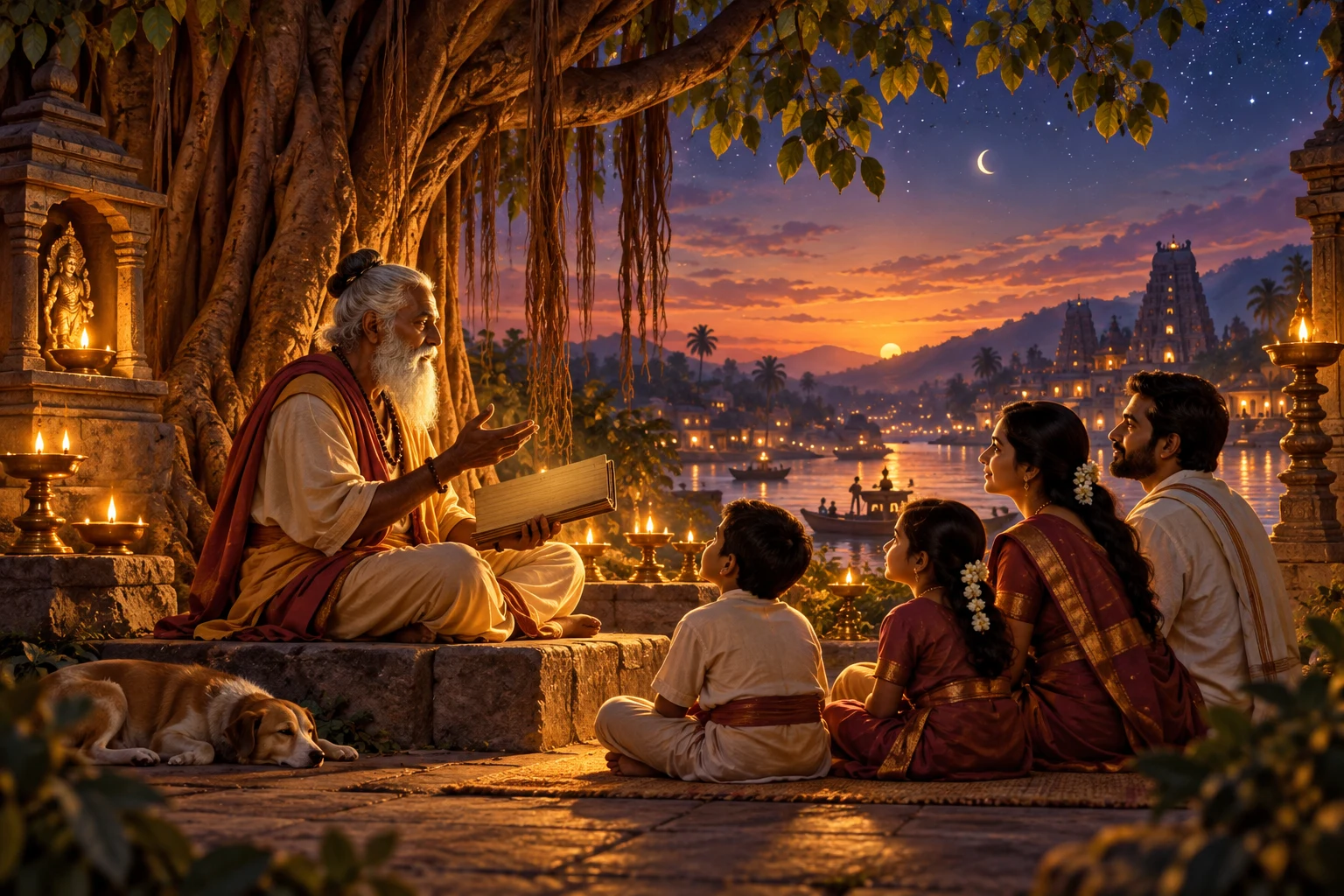
The Ramayana is one of the two great epics of Hindu tradition, alongside the Mahabharata, traditionally attributed to the sage Valmiki. It tells the story of Rama, prince of Ayodhya, and is organized into seven books (kandas). Ramayana traditions differ across regions and languages — Tamil, Telugu, Bengali, and many other retellings add their own details and emphasis — so this guide covers the episodes most widely shared across traditions, as an entry point rather than a single definitive version.
For a closer look at Rama himself and the themes his story raises, see Stories of Lord Rama; for the full cast, see characters of the Ramayana. This page instead follows the Ramayana’s narrative arc from beginning to end.
Bala Kanda: birth and early life
The epic opens in Ayodhya, where King Dasharatha’s four sons — Rama, Bharata, Lakshmana, and Shatrughna — are born through a special yajna (sacred fire ritual). Rama grows up trained in scripture and warfare by the sage Vashishtha, and later travels with the sage Vishwamitra, protecting his hermitage from demons. This section ends with Rama winning Sita’s hand in marriage at her swayamvar (marriage-choice ceremony) in Mithila, by stringing and breaking the mighty bow of Shiva — a feat no other suitor could accomplish.
Ayodhya Kanda: the exile
As Dasharatha prepares to crown Rama as his successor, his wife Kaikeyi — manipulated by her maid Manthara — invokes two old promises (boons) from the king: that Bharata be crowned instead, and that Rama be exiled to the forest for fourteen years. Rama accepts without protest, choosing to honor his father’s word over his own claim to the throne. Sita and Lakshmana insist on accompanying him into exile. Dasharatha dies of grief soon after, and Bharata, refusing to rule in his brother’s place, governs as a regent in Rama’s name, placing Rama’s sandals on the throne until his return.
Aranya Kanda: the forest years and Sita’s abduction
Living in the forest, Rama and Lakshmana defend hermitages from demon attacks, most notably killing the demoness Tataka and the fierce demon Khara. This section introduces Surpanakha, sister of the demon king Ravana, whose rejected advances toward Rama and mutilation by Lakshmana set the epic’s central conflict in motion. Ravana, seeking revenge, abducts Sita by trickery — sending the demon Maricha in the form of a golden deer to lure Rama away, then carrying Sita off to his kingdom of Lanka while Rama and Lakshmana search in vain.
Kishkindha Kanda: the alliance with the monkeys
Searching for Sita and guided by the devoted forest woman Shabari, Rama allies with Sugriva, the exiled king of the monkey kingdom Kishkindha, and helps him reclaim his throne from his brother Vali. In return, Sugriva’s forces — led by the wise and devoted Hanuman — commit to finding Sita. This section establishes Hanuman as one of the epic’s most beloved figures; see Stories of Hanuman and the Hanuman and Rama story for more on this relationship.
Sundara Kanda: Hanuman’s journey to Lanka
Often read as the emotional heart of the epic, this book follows Hanuman leaping across the ocean to Lanka, finding Sita held captive in the Ashoka grove, and delivering Rama’s ring as proof of his mission. Before returning, Hanuman allows himself to be captured and his tail set on fire by Ravana’s forces — and uses the burning tail to set fire to parts of Lanka before making his way back to Rama with news of Sita.
Yuddha Kanda: the war with Ravana
Rama’s army, aided by Vibhishana — Ravana’s own brother, who defects rather than support the abduction — builds a bridge across the ocean to Lanka (Rama Setu). The resulting war includes major battles against Ravana’s commanders and his son Indrajit, and Lakshmana is gravely wounded, saved only by Hanuman’s flight to fetch the Sanjeevani herb from a Himalayan mountain. The book ends with Rama defeating Ravana in single combat, and Sita undergoing Agni Pariksha (a trial by fire) to prove her purity before the couple, along with Lakshmana, returns to Ayodhya — an event still celebrated today as Diwali.
Uttara Kanda: the later years
This final book, considered a later addition by many scholars, covers Rama’s reign as king (Rama Rajya, often held up as an ideal of just rule), and the more difficult later chapters of the story, including Sita’s eventual exile and the birth of their sons Luv and Kush. Because this section is treated differently across traditions and communities, this guide covers it only briefly rather than in detail.
Frequently asked questions
How many books (kandas) does the Ramayana have?
Traditionally seven: Bala Kanda, Ayodhya Kanda, Aranya Kanda, Kishkindha Kanda, Sundara Kanda, Yuddha Kanda, and Uttara Kanda.
Who wrote the Ramayana?
The Sanskrit Ramayana is traditionally attributed to the sage Valmiki. Many later poets across Indian languages — including Tulsidas, whose Awadhi Ramcharitmanas is especially influential in North India — composed their own retellings, which is part of why versions of the story vary by region.
What is the difference between the Ramayana and the Mahabharata?
Both are foundational Hindu epics. The Ramayana follows Rama’s exile, Sita’s abduction, and the war with Ravana; the Mahabharata follows the Kurukshetra war between the Pandavas and Kauravas and contains the Bhagavad Gita as one of its episodes.
Which part of the Ramayana is Sundara Kanda?
Sundara Kanda is the fifth book, following Hanuman’s journey to Lanka to find Sita. It’s widely read independently as a devotional text in its own right, especially in times of difficulty.
Where can I read more about individual characters from the Ramayana?
See Stories of Lord Rama and Stories of Hanuman for character-focused guides, or the Hanuman Chalisa for a devotional hymn that recounts several of these episodes.