
🏯 Mythology
Vibhishana: Ravana's Brother Who Joined Rama, His Story and Meaning
Vibhishana chose dharma over family when he left his brother Ravana and surrendered to Rama. Here is his story, from his boon and his exile to his crowning as king of Lanka.
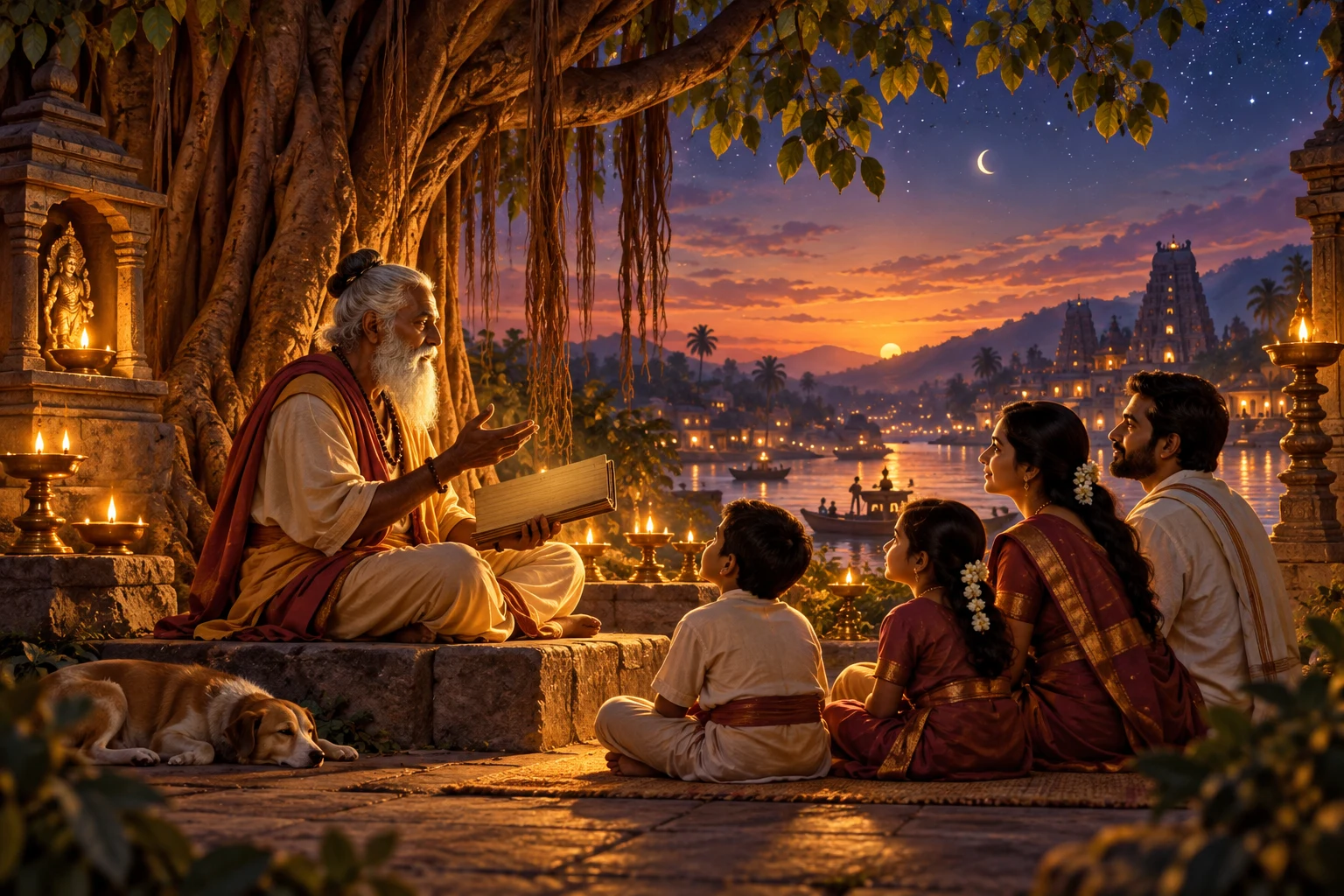
Vibhishana is the righteous younger brother of Ravana in the Ramayana. A devotee of dharma, he urged Ravana to return Sita to Rama and, when he was insulted and expelled, crossed over to Rama’s side. He guided Rama through the war and was crowned king of Lanka. He is counted among the seven Chiranjivis, the immortals.
His choice — dharma over family — makes him one of the most debated figures in the epic, and one of the most honoured.
Vibhishana at a glance
| Sanskrit | Vibhīṣaṇa (विभीषण) |
| Parents | The sage Vishrava and the rakshasi Kaikesi |
| Siblings | Ravana, Kumbhakarna, Shurpanakha; half-brother Kubera |
| Wife | Sarama |
| Daughter | Trijata (in many later retellings) |
| Known for | Leaving Ravana, surrendering to Rama, becoming king of Lanka |
| Status | One of the seven Chiranjivis |
| Key texts | Valmiki Ramayana, Yuddha and Uttara Kandas; Ramcharitmanas |
Birth and boon
Vibhishana was the youngest son of the sage Vishrava and the rakshasi Kaikesi, and so the brother of Ravana, Kumbhakarna and Shurpanakha. The god of wealth, Kubera, was their half-brother.
The three brothers performed severe austerities to please Brahma. When the god appeared, Ravana asked for invulnerability against gods and demons, and Kumbhakarna (tricked by the goddess of speech) asked for sleep. Vibhishana asked that his mind should always remain fixed on dharma, even in the worst calamity. Pleased, Brahma granted this and added the gift of immortality.
Counsel ignored
When Ravana abducted Sita, Vibhishana repeatedly warned him. After Hanuman burnt Lanka, he spoke in the full court: Sita should be returned to Rama with honour, or Lanka and its people would be destroyed. Kumbhakarna and others agreed that the abduction had been wrong. Ravana, enraged, called Vibhishana a coward and an enemy in the guise of a brother. In Valmiki’s telling, he says that a jealous kinsman is worse than an enemy. (In the Ramcharitmanas, Ravana kicks him.)
Vibhishana rose into the air with four loyal ministers, said one last time that he had spoken for Ravana’s good, and left.
Surrender to Rama
Vibhishana came to the northern shore, where Rama’s army was camped, and asked for refuge. The vanara king Sugriva was suspicious, and others advised caution. Rama listened and then made the famous declaration of refuge (sharanagati):
Sakṛd eva prapannāya tavāsmīti ca yācate Abhayaṁ sarva-bhūtebhyo dadāmy etad vrataṁ mama
“To anyone who comes to me even once and says, ‘I am yours’, I give freedom from fear from all beings. This is my vow.” (Yuddha Kanda 6.18.33 in common editions)
Rama added that he would accept even Ravana himself if he came in surrender. He then had Vibhishana anointed king of Lanka with seawater on the shore, before a single battle had been fought. This verse is central to the Sri Vaishnava teaching of surrender to God.
Vibhishana’s role in the war
Vibhishana’s knowledge of Lanka was crucial:
- He advised Rama on the city’s defences and the strengths of its warriors.
- When Indrajit made Rama and Lakshmana fall with the serpent weapon and later with illusions, he helped the vanaras understand what was happening.
- He revealed that Indrajit could become invincible by completing a secret sacrifice at the Nikumbhila shrine, and guided Lakshmana there to stop it.
- In later versions, including the Ramcharitmanas, he tells Rama that Ravana keeps the nectar of immortality in his navel, which Rama must dry up with an arrow.
After Ravana’s death, Vibhishana grieved for his brother and at first hesitated to perform his funeral rites. Rama told him that enmity ends with death and that Ravana deserved full honour; Vibhishana then cremated him as a king. For the war in context, see Ramayana stories and characters of the Ramayana.
King of Lanka and Chiranjivi
Vibhishana was crowned king of Lanka and ruled righteously. He accompanied Rama to Ayodhya for the coronation. A popular legend from Srirangam says Rama gave him an image of Ranganatha (Vishnu reclining) to take home; when he set it down on the bank of the Kaveri, it could not be lifted again, and the great Srirangam temple stands there. In this version Ganesha, disguised as a boy, causes the image to be put down — a story also linked to the Ucchi Pillayar temple at Tiruchirappalli. See stories of Ganesha.
Vibhishana is one of the seven Chiranjivis traditionally said to live until the end of the age: Ashwatthama, King Bali, Ved Vyasa, Hanuman, Vibhishana, Kripacharya and Parashurama. In Sri Lanka, he is also honoured as a protective deity, notably at the Kelaniya temple near Colombo.
Hero or traitor?
The Hindi proverb “Ghar ka bhedi Lanka dhaye” — “the insider who knows the secrets brings down Lanka” — uses Vibhishana as a byword for betrayal, and the name is sometimes used as an insult. Tradition sees it differently. Vibhishana did not leave for gain; he advised his brother honestly, was thrown out, and chose the side of dharma. Rama’s acceptance of him is held up as proof that God shelters anyone who comes to him sincerely, whatever their birth or past.
His story raises a question that still matters: when family and right conduct conflict, which comes first? The Ramayana’s answer, through Vibhishana, is dharma — offered with honesty, and without hatred for those left behind.
Frequently Asked Questions
Who is Vibhishana in the Ramayana?
Vibhishana is the youngest brother of Ravana and Kumbhakarna. A devout and righteous rakshasa, he urged Ravana to return Sita to Rama. When Ravana insulted and expelled him, he went over to Rama, helped him win the war, and was crowned king of Lanka.
Why did Vibhishana leave Ravana?
Vibhishana repeatedly advised Ravana that abducting Sita was wrong and would destroy Lanka, and asked him to return her to Rama. Ravana called him a traitor and coward in front of the court. Unable to support adharma, Vibhishana left Lanka with four companions and sought refuge with Rama.
Is Vibhishana a traitor?
In popular speech he is sometimes called one, as in the Hindi saying 'Ghar ka bhedi Lanka dhaye' — the insider who knows the secrets brings down Lanka. In the tradition, though, he is honoured as a devotee who put dharma above family loyalty, and Rama accepts and crowns him.
Is Vibhishana immortal?
Yes. Vibhishana is counted among the seven Chiranjivis, the long-lived beings who remain alive until the end of the present age. Brahma granted him immortality along with his wish that his mind should always stay fixed on dharma.
Who was Vibhishana's wife?
His wife was Sarama, a gentle rakshasi who comforted Sita in the Ashoka grove and kept her informed of events. In many later retellings, Trijata, the rakshasi who dreams of Ravana's fall and befriends Sita, is called Vibhishana's daughter.
What did Rama promise Vibhishana?
When Vibhishana surrendered, Rama declared that he would protect anyone who came to him even once and said 'I am yours', whoever they were. He then had Vibhishana anointed king of Lanka on the seashore, even before the war began.