
🏹 Mythology
Characters of the Ramayana: A Guide to the Main Figures
The Ramayana turns on a large cast of kings, princes, sages, and vanaras. This guide introduces the figures a first-time reader most needs to know.
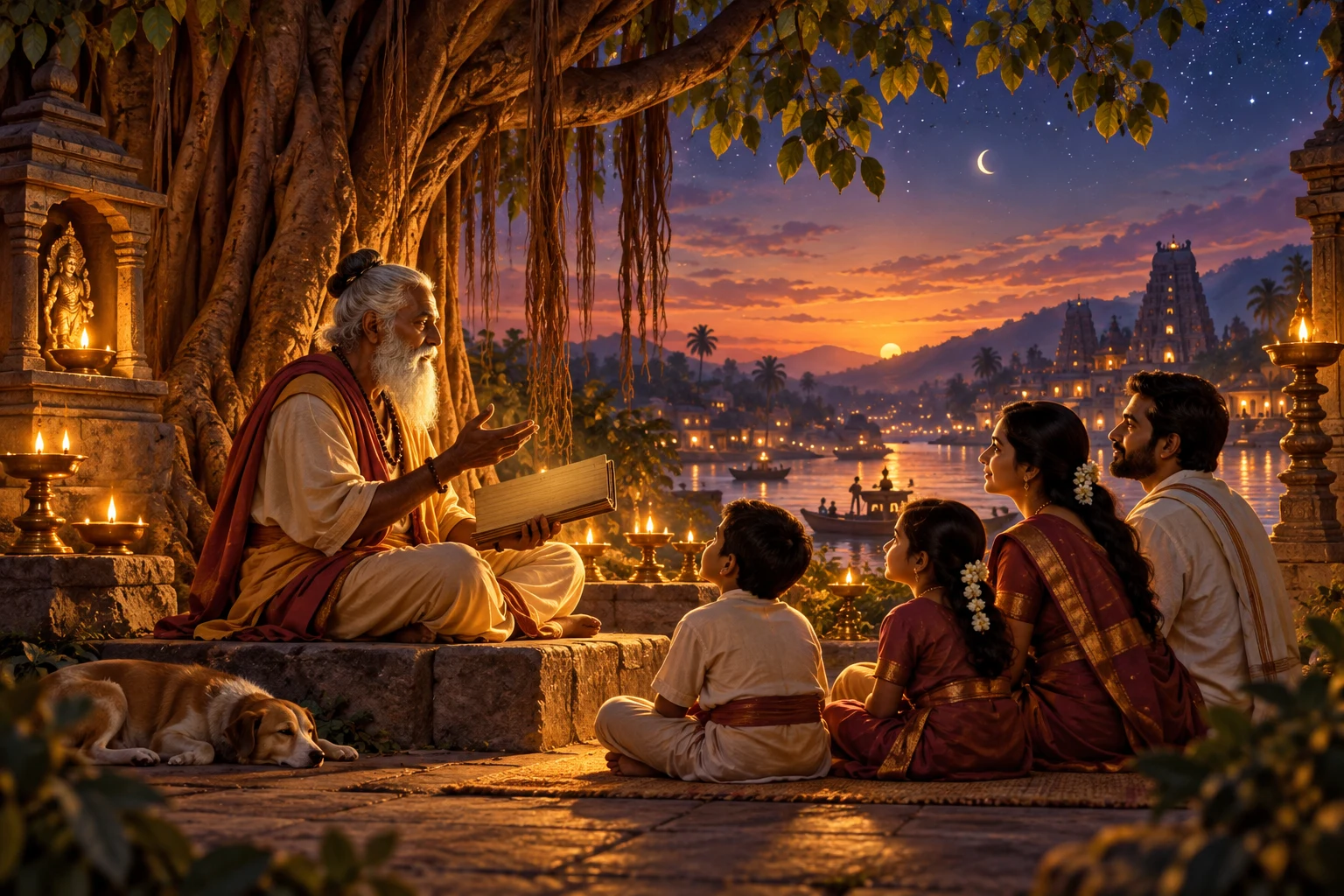
The Ramayana, traditionally attributed to the sage Valmiki, follows Rama, prince of Ayodhya, through exile, the abduction of his wife Sita, and the war to recover her. Its story rests on a large cast of characters, and different regional retellings — Tamil, Telugu, Bengali, the Awadhi Ramcharitmanas, and many others — shade their personalities differently. This guide introduces the main figures in the widely shared Valmiki account.
For the story itself in narrative order, see Ramayana stories. For character-focused reading, see Stories of Lord Rama and Stories of Hanuman.
The house of Ayodhya
Rama — the eldest son of King Dasharatha and the epic’s central figure, later counted among the avatars of Vishnu. He accepts fourteen years of forest exile without protest to honour his father’s word, and is held up in the tradition as a model of duty, restraint, and just kingship (Rama Rajya).
Sita — Rama’s wife, found as an infant in a furrow by King Janaka of Mithila and often regarded as an incarnation of Lakshmi. Her abduction by Ravana sets the war in motion. She is portrayed as steadfast through captivity and, in the later books, through hardship after the return to Ayodhya.
Lakshmana — Rama’s devoted younger brother, who insists on joining the exile and serves as Rama’s constant companion and protector in the forest. His temper and fierce loyalty often contrast with Rama’s composure.
Bharata — Dasharatha’s son by Queen Kaikeyi. Though the throne is forced onto him, he refuses to rule in Rama’s place, sets Rama’s sandals on the throne, and governs as a regent until Rama returns.
Shatrughna — the fourth brother, twin to Lakshmana in devotion, closely attached to Bharata.
Dasharatha — king of Ayodhya, bound by two old promises to Kaikeyi. He exiles Rama against his own wishes and dies of grief soon after.
Kaikeyi — Dasharatha’s queen, Bharata’s mother. Urged on by her maid Manthara, she invokes her boons to demand Rama’s exile and Bharata’s coronation. Some retellings treat her more sympathetically than others.
Kausalya — Rama’s mother and Dasharatha’s chief queen. Sumitra — mother of Lakshmana and Shatrughna. Manthara — Kaikeyi’s hunchbacked maid, whose counsel triggers the exile.
Sages and allies
Vishwamitra — the sage who takes the young Rama and Lakshmana to protect his hermitage and leads them to Mithila, where Rama wins Sita’s hand by breaking Shiva’s bow.
Vashishtha — the royal preceptor of Ayodhya. Valmiki — the sage traditionally named as the epic’s author, who also shelters Sita and raises her sons in the later books. Agastya, Bharadwaja, and Atri with Anasuya — sages the exiles meet in the forest. Jatayu — the aged vulture king who tries to stop Ravana’s chariot and is mortally wounded. Shabari — the elderly forest devotee who waits years for Rama and guides him to Sugriva. Guha — the tribal chief of the Nishadas who ferries the exiles across the Ganga.
The vanaras
Hanuman — the vanara devotee of Rama whose leap across the ocean, discovery of Sita in Lanka, and burning of the city form the emotional centre of the epic. He is one of the most widely worshipped figures in the whole tradition; see the Hanuman and Rama story.
Sugriva — the exiled vanara king whom Rama helps reclaim the throne of Kishkindha; in return, Sugriva commits his armies to the search for Sita. Vali — Sugriva’s powerful brother, killed by Rama in a debated episode. Angada — Vali’s son, a leader of the search party and later an envoy to Ravana. Jambavan — the wise bear king who reminds Hanuman of his forgotten strength. Nala — the vanara engineer credited with building the bridge to Lanka (Rama Setu).
Lanka
Ravana — the ten-headed rakshasa king of Lanka, a learned devotee of Shiva and a formidable warrior, whose abduction of Sita drives the war. The tradition presents him as brilliant but ruined by pride and desire.
Vibhishana — Ravana’s younger brother, who counsels returning Sita and, when refused, defects to Rama and is later crowned king of Lanka.
Kumbhakarna — Ravana’s giant brother, cursed to sleep for long stretches, who fights and dies for Lanka despite disapproving of the war.
Indrajit (Meghnad) — Ravana’s son and greatest warrior, who twice wounds Rama and Lakshmana with magical weapons before being killed by Lakshmana.
Surpanakha — Ravana’s sister, whose advances toward Rama and Lakshmana are rejected and who is mutilated by Lakshmana, setting the central conflict in motion. Maricha — the rakshasa who takes the form of a golden deer to lure Rama away from Sita. Mandodari — Ravana’s queen, often portrayed as wise and grieving.
Frequently asked questions
Who are the four brothers in the Ramayana?
Rama, Bharata, Lakshmana, and Shatrughna, the sons of King Dasharatha of Ayodhya by his three queens.
Who is the main villain of the Ramayana?
Ravana, the rakshasa king of Lanka, who abducts Sita. His brother Kumbhakarna and his son Indrajit are his chief warriors; his other brother Vibhishana joins Rama.
Is Hanuman a monkey or a god?
Hanuman is described as a vanara, a forest being often depicted with monkey features, and the son of the wind god Vayu. He is widely worshipped as a deity in his own right.
Who wrote the Ramayana?
The Sanskrit Ramayana is traditionally attributed to the sage Valmiki. Later poets across Indian languages, including Tulsidas with the Ramcharitmanas, composed their own influential retellings.
Where can I read the full story?
See Ramayana stories for a book-by-book walkthrough, and the Diwali story, which celebrates Rama’s return to Ayodhya.