
🪶 Mythology
Valmiki: The Adi Kavi Who Wrote the Ramayana, His Life and Legacy
Maharshi Valmiki is honoured as the first poet of Sanskrit and the author of the Ramayana. Here is his life, the birth of the first shloka, the robber legend, his role in the story and Valmiki Jayanti.
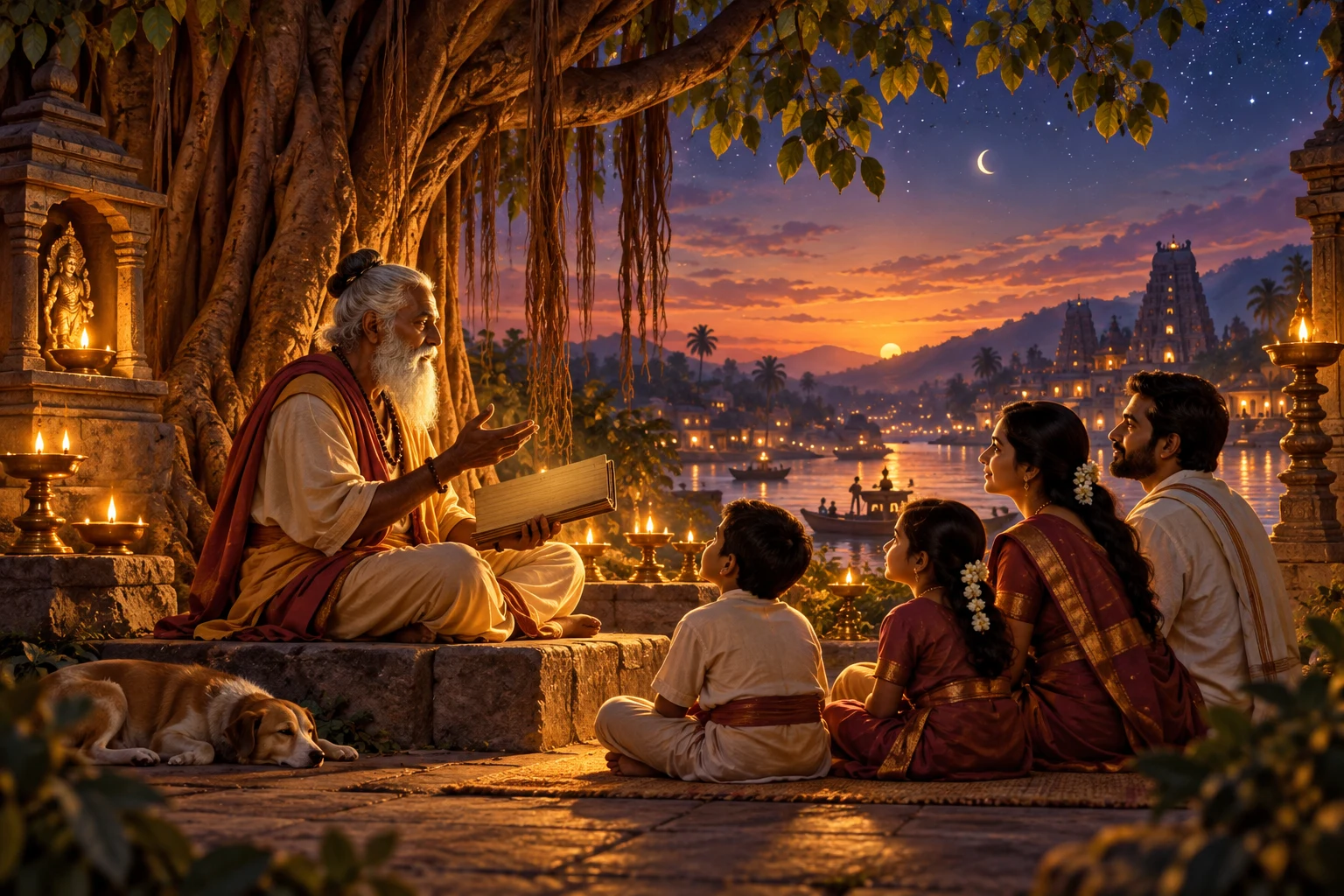
Maharshi Valmiki (वाल्मीकि) is the sage traditionally credited with composing the Ramayana, the Sanskrit epic of Rama. He is honoured as the Adi Kavi, the first poet, because his first verse, born of grief at a hunter’s cruelty, began Sanskrit poetry. In his epic he shelters Sita and raises her sons.
His birthday, Valmiki Jayanti, is celebrated on Ashwin Purnima, the same full moon as Sharad Purnima.
Valmiki at a glance
| Title | Adi Kavi (first poet), Maharshi |
| Work | Ramayana: about 24,000 shlokas in 7 kandas |
| Parentage (in the epic) | Describes himself as son (descendant) of Pracheta |
| Name | From valmika, “anthill” |
| Ashram | Associated with the banks of the Tamasa river; claimed sites include Bithoor (UP) and Valmikinagar (Bihar) |
| Disciples | Bharadvaja; Lava and Kusha |
| Festival | Valmiki Jayanti, Ashwin Purnima |
How the Ramayana began: Narada’s question
The Bala Kanda opens with Valmiki asking the sage Narada a question: “Who in this world today is truly virtuous, powerful, righteous, truthful and steadfast in his vows?” Narada answers with the story of Rama of Ayodhya, summarising his life. (See Narada.)
The krauncha bird and the first shloka
Soon after, Valmiki went to bathe in the Tamasa river with his disciple Bharadvaja. He watched a pair of krauncha birds (often identified as sarus cranes) in courtship — when a hunter’s arrow struck the male. As the female cried over her mate, Valmiki, overcome with compassion, cursed the hunter. The words came out in a perfect metre:
Mā niṣāda pratiṣṭhāṁ tvam agamaḥ śāśvatīḥ samāḥ | Yat krauñcamithunād ekam avadhīḥ kāmamohitam ||
“O hunter, may you find no rest for endless years, for you killed one of this pair of krauncha birds, lost in love.”
Valmiki was astonished: his sorrow (shoka) had become verse (shloka). Then Brahma appeared and told him that this metre had come by divine will, and that he should use it to tell the full story of Rama. With the vision Brahma granted him, Valmiki composed the Ramayana.
This scene is why Indian tradition sees compassion at the root of poetry, and why the anushtubh shloka became the standard metre of the epics.
The Ratnakara legend
The best-known popular story about Valmiki is that he was once Ratnakara, a robber who waylaid travellers to feed his family. One day he stopped the sage Narada, who asked him: “Will your family share the sin of your crimes?” Ratnakara went home to ask; none of them would. Shaken, he asked Narada for guidance and was given Rama’s name to chant. Unable at first to say “Rama”, he chanted “mara, mara”, which became “Rama, Rama” in repetition. He meditated so long that an anthill (valmika) grew over him — hence the name Valmiki.
This legend is found in later Puranic and regional traditions, such as the Bengali Krittivasi Ramayana, and not in the Valmiki Ramayana itself, where the poet calls himself a descendant of Pracheta. Many people today find the story meaningful as a parable of transformation, while the Valmiki community and others reject the “robber” image as a later slur on the sage. It is best read as legend, not biography.
Valmiki inside his own story
Valmiki appears as a character in the Ramayana:
- Ayodhya Kanda: Rama, Sita and Lakshmana visit Valmiki’s ashram near Chitrakuta during exile.
- Uttara Kanda: When Rama, bowing to public gossip, sends the pregnant Sita away, Lakshmana leaves her near Valmiki’s hermitage. Valmiki gives her shelter; her twin sons Lava and Kusha are born there.
- Valmiki teaches the boys to sing the Ramayana. They recite it at Rama’s Ashvamedha sacrifice, where Rama recognises them as his sons. Valmiki then testifies to Sita’s purity before the assembly, and Sita returns to the Earth, her mother.
For more on these figures, see characters of the Ramayana and stories of Rama.
The Valmiki Ramayana: structure
| Kanda | Contents |
|---|---|
| Bala | Birth and youth of Rama; marriage to Sita |
| Ayodhya | Exile |
| Aranya | Forest life; Sita’s abduction |
| Kishkindha | Alliance with Sugriva and Hanuman |
| Sundara | Hanuman’s leap to Lanka |
| Yuddha | War and Ravana’s death |
| Uttara | Later life; Sita’s exile; Lava and Kusha |
Scholars generally date the core of the epic (books 2–6) to the second half of the first millennium BCE, with the Bala and Uttara Kandas added later; tradition places Valmiki in the Treta Yuga as Rama’s contemporary. Later Ramayanas — Kamban’s in Tamil, Tulsidas’s Ramcharitmanas in Awadhi, Krittivasi in Bengali — all look back to Valmiki. For an overview of the story, read Ramayana stories.
Valmiki Jayanti
Valmiki Jayanti (also Pargat Divas) is celebrated on Ashwin Purnima. Devotees hold processions (shobha yatras) with images of the sage, recite the Ramayana, and decorate Valmiki temples. It is especially important for the Valmiki (Balmiki) community, who revere him as their guru, and is a public holiday in some Indian states.
Places associated with Valmiki
Several sites claim to be Valmiki’s ashram. Bithoor, near Kanpur in Uttar Pradesh, is a popular pilgrimage spot where Lava and Kusha are said to have been born. Valmikinagar in Bihar, near the Nepal border, gives its name to the Valmiki Tiger Reserve. Tradition also places hermitages near Chitrakuta, where Rama visited him. As with many sacred places, these claims reflect devotion rather than historical certainty.
Valmiki’s legacy
Valmiki gave Indian culture its model of the ideal king, husband, brother and devotee, and its first great poem. His portrait of Rama — a man bound by dharma yet deeply human — has shaped art, drama, temple worship and moral imagination across Asia for more than two thousand years.
Frequently Asked Questions
Who was Valmiki?
Valmiki was the sage traditionally credited with composing the Ramayana, the Sanskrit epic of Rama. He is called the Adi Kavi, 'first poet', because his verse is regarded as the first true poetry in Sanskrit. In the Uttara Kanda he shelters Sita, and Lava and Kusha are born and raised at his hermitage.
Was Valmiki a robber named Ratnakara?
A popular legend says Valmiki was once a highway robber called Ratnakara, who reformed after meeting the sage Narada and meditated so long that an anthill (valmika) grew over him. This story comes from later texts and regional Ramayanas, not from Valmiki's own epic, where he calls himself the son of Pracheta.
What was the first shloka written by Valmiki?
On seeing a hunter kill one of a pair of krauncha birds, Valmiki uttered in grief: 'Ma nishada pratishtham tvam agamah shashvatih samah, yat krauncha mithunad ekam avadhih kama mohitam.' It means 'O hunter, may you never find rest, for you killed one of a pair of birds lost in love.' His sorrow (shoka) became verse (shloka).
How many shlokas are in the Valmiki Ramayana?
The Valmiki Ramayana is traditionally said to have about 24,000 shlokas in seven books (kandas): Bala, Ayodhya, Aranya, Kishkindha, Sundara, Yuddha and Uttara. Many scholars consider the first and last books to be later additions to an older core.
When is Valmiki Jayanti?
Valmiki Jayanti is celebrated on Ashwin Purnima, the full moon of the month of Ashwin (September–October), the same day as Sharad Purnima. Processions, Ramayana recitations and temple worship mark the day, especially in north India.
Did Valmiki meet Rama?
Yes. In the Ramayana, Rama, Sita and Lakshmana visit Valmiki's ashram at Chitrakuta during their exile. Later, in the Uttara Kanda, the pregnant Sita lives at his hermitage, and Valmiki teaches Lava and Kusha to sing the Ramayana, which they perform before Rama himself.