
🇮🇳 Indian National Days
Republic Day of India: History, Constitution, and Significance
Last updated: September 26, 2026
Republic Day marks the moment India became a constitutional republic, placing the values of justice, liberty, equality, and fraternity at the center of national life.
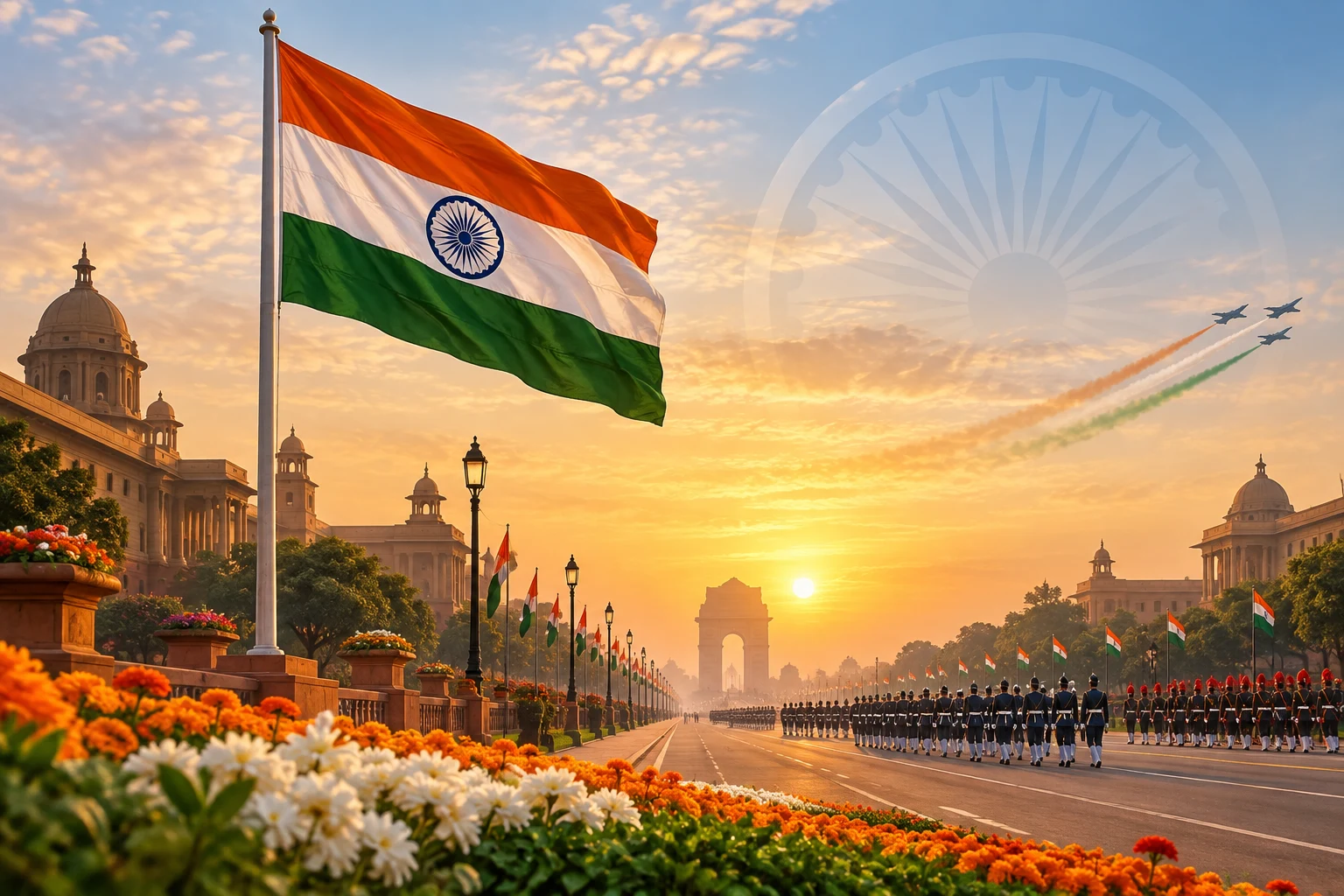
India celebrates Republic Day on 26 January. On that date in 1950, most provisions of the Constitution of India came into force and the country began operating as a republic under its own constitutional framework. Independence had arrived on 15 August 1947; Republic Day marks a different milestone—the transition from colonial-era constitutional arrangements to government grounded in a Constitution adopted by India’s Constituent Assembly.
Why 26 January was chosen
The Constitution was adopted on 26 November 1949, a date now observed as Constitution Day. Its commencement was set for 26 January 1950. The chosen date honoured the freedom movement’s association with 26 January 1930, when Purna Swaraj—complete independence—was publicly affirmed and commemorated.
Article 394 of the Constitution itself records 26 January 1950 as the date on which its remaining provisions would come into force. This distinction prevents a common mix-up: 26 November is the date of adoption; 26 January is the principal date of commencement.
The Constitution emerged from sustained debate in the Constituent Assembly rather than from a single author working alone. Dr B. R. Ambedkar chaired the Drafting Committee, while Assembly members, committees, advisers, and staff contributed to the wider process. Remembering that collective work helps students see the document as an argued framework for a diverse country, not merely a ceremonial book displayed once a year.
What becoming a republic means
A republic does not vest the office of head of state in a hereditary monarch. In India, the President serves as the constitutional head of state, while public institutions derive authority from the Constitution. Elections, legislatures, courts, the Union-state relationship, executive power, rights, and duties all operate within that framework.
The Preamble describes India as a sovereign, socialist, secular, democratic republic and sets out commitments to justice, liberty, equality, and fraternity. “Republic” therefore belongs within a larger constitutional promise. Elections are essential, but constitutional democracy also requires limited power, equal citizenship, due process, accountability, and peaceful disagreement.
Republic Day and Independence Day are not interchangeable
Independence Day on 15 August remembers the end of British colonial rule in 1947. The Prime Minister hoists the national flag at the Red Fort during the principal national ceremony. On Republic Day, the President of India presides over the main celebration in New Delhi. The two occasions share patriotic symbols, but they commemorate different constitutional moments.
The national celebration
The central ceremony includes the Republic Day parade in New Delhi. Its programme brings together ceremonial armed-forces participation, honours, cultural performances, and tableaux that represent states, Union Territories, and national initiatives. Exact routes, access rules, and programmes may change, so visitors should consult current official announcements rather than rely on an older itinerary.
Schools, resident groups, and public institutions organise flag ceremonies, songs, speeches, quizzes, and readings. The Flag Code and local safety rules still matter: the national flag should be handled with dignity, not printed on disposable items that will be discarded or allowed to touch the ground.
A more meaningful classroom or family observance
Begin with the Preamble and unpack one word. What does equality of status mean in a school? How does liberty coexist with responsibility? Why does fraternity mention the dignity of the individual? Older students can compare a Fundamental Right with a Fundamental Duty or explore the Constituent Assembly Debates.
Avoid reducing the day to costume, slogans, or military spectacle. Learn about constitution-makers from different regions and backgrounds. Discuss how citizens can question government while respecting other citizens. A local service project—helping someone access a public resource, cleaning a shared space, or supporting a library—can turn civic ideals into practice.
Republic Day’s continuing significance
The Constitution is not self-executing in everyday life. Institutions must respect it, representatives must be accountable to it, and citizens must understand both their protections and responsibilities. Republic Day is therefore an annual checkpoint: not a claim that the constitutional promise is complete, but an invitation to keep working toward it.
The authoritative Constitution of India confirms the commencement date in Article 394. The President of India’s Republic Day 2026 address also explains the relationship between the republic and the constitutional ideals of justice, liberty, equality, and fraternity.
Frequently Asked Questions
Why is Republic Day celebrated on 26 January?
Most provisions of the Constitution came into force on 26 January 1950. The date also recalled 26 January 1930, associated with the freedom movement's declaration of Purna Swaraj.
What is the difference between Republic Day and Independence Day?
Independence Day on 15 August marks freedom from British rule in 1947. Republic Day marks the Constitution's commencement and India's emergence as a republic on 26 January 1950.
When was the Constitution of India adopted?
The Constituent Assembly adopted the Constitution on 26 November 1949. Most of its provisions commenced on 26 January 1950.
How can students observe Republic Day meaningfully?
Students can read the Preamble, study a Constituent Assembly member, discuss a Fundamental Right and Duty, verify civic information, or participate in a local service activity.